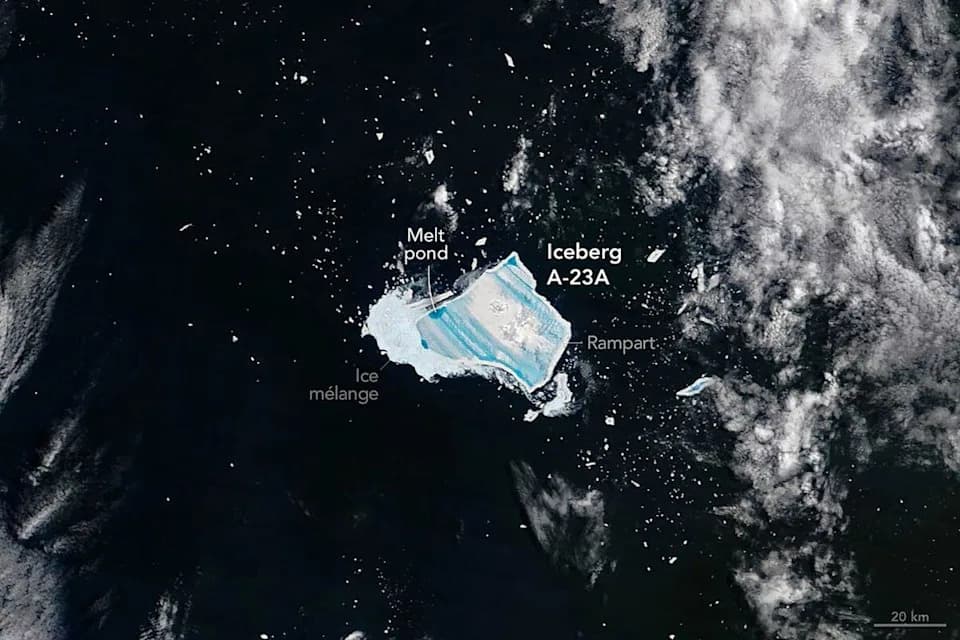
NASA images show iceberg A-23A turning a vivid blue as deep meltwater ponds form on its surface, indicating widespread melting and internal weakening. The berg, which calved from the Filchner Ice Shelf in 1986, has shrunk to about 580 square miles. MODIS data from Terra on Dec. 26, 2025, revealed clear, deep ponds that absorb red wavelengths and reflect blue, intensifying the hue. Scientists warn that pooled water can drive fractures and that A-23A may break apart within days or weeks as it moves into warmer seas.
Why Iceberg A-23A Has Turned Vivid Blue — And What It Means For Its Breakup

Iceberg A-23A as seen from the International Space Station. (Image: NASA)
New satellite imagery from NASA shows iceberg A-23A — once among the largest icebergs on record — taking on an intense blue cast as it drifts through the South Atlantic. Scientists say the color change is not just striking visually: it signals extensive surface melting and growing structural weakness that could foreshadow the iceberg's breakup.
NASA explains that intact icebergs normally look white because billions of tiny air bubbles scatter sunlight across all wavelengths. As ice loses those bubbles through melting and compaction, it becomes clearer and absorbs longer (red and yellow) wavelengths while scattering shorter blue wavelengths — the same optical effect that makes deep glacial ice and open ocean appear blue.
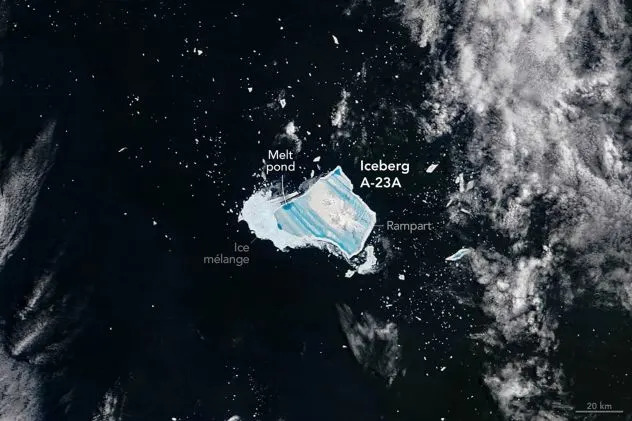
An image of iceberg A-23A in the South Atlantic Ocean taken on Dec. 26, 2025 by NASA's Terra satellite showing extensive pools of blue meltwater visible on its surface. (Image: NASA)
When A-23A calved from Antarctica's Filchner Ice Shelf in 1986, it was nearly twice the size of Rhode Island. Today the berg has shrunk to roughly 580 square miles. On Dec. 26, 2025, the Terra satellite's MODIS (Moderate Resolution Imaging Spectroradiometer) instrument captured extensive surface ponds of meltwater across A-23A. The water collects in depressions and fractures and, when several meters deep and relatively clear, amplifies the blue tones visible in satellite imagery.
Why the Meltwater Is Forming Now
After nearly four decades adrift, A-23A has gradually lost mass through natural fragmentation. During the recent Southern Hemisphere summer, warmer air temperatures and warmer surrounding ocean waters increased surface melt, producing widespread pooling. Meltwater settles into low areas and crevasses, creating deep blue streaks and patches that contrast with remaining snow-white ice.
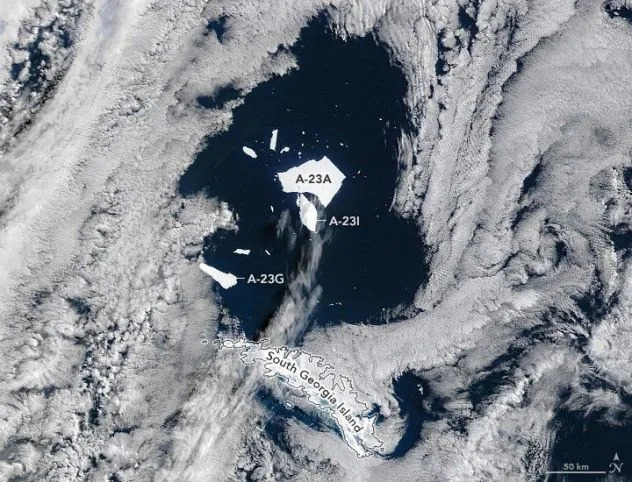
An image captured on Sept. 11, 2025, by NASA's Terra Satellite shows the ongoing disintegration of Iceberg A-23A. (Image: NASA Earth Observatory)
What the Color Change Reveals About A-23A's Future
The presence of deep, standing water is more than cosmetic: scientists warn that the weight of water in cracks can force fractures to widen through a process called hydrofracture. Imagery from satellites and photographs taken by astronauts aboard the International Space Station suggest A-23A could be only days to weeks away from a major breakup as it drifts into progressively warmer seas.
Key takeaway: The vivid blue color marks extensive surface melting and structural weakening, and it may precede the iceberg's final fragmentation.
Sources: NASA Earth Observatory imagery and MODIS/Terra observations; statements from Earth scientists monitoring A-23A.
Help us improve.