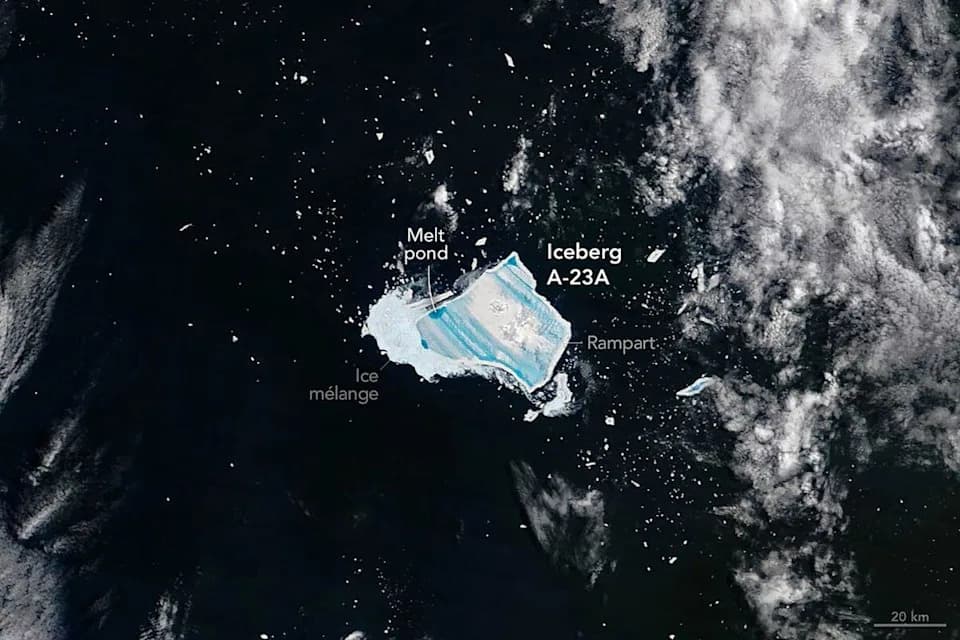
NASA says iceberg A23a — once about 4,000 sq km — has turned a vivid blue as large meltwater pools form on its surface and may be close to collapsing. Satellite and ISS images reveal an expanding melt pool and signs the berg has "sprung a leak," where water has punctured through the ice. Carried by currents toward warmer seas and exposed to seasonal heat, A23a could fragment within days or weeks; it measured roughly 1,182 sq km in early January 2026.
Iconic Iceberg A23a Turns Bright Blue and Is Poised To Break Apart, NASA Warns
Iceberg A23a has turned blue and is
A23a, one of the largest and longest-tracked icebergs, has taken on a vivid blue hue and appears to be on the brink of total disintegration, NASA reported.
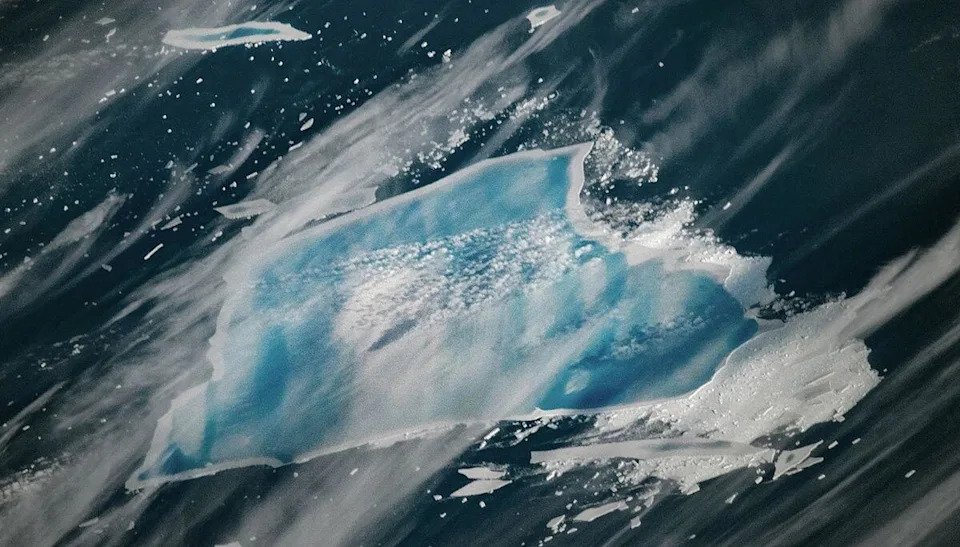
NASA satellite imagery captured the berg the day after Christmas, revealing extensive pools of blue meltwater scattered across its surface. An astronaut aboard the International Space Station took a closer photo the following day, showing an even larger melt pool and additional surface weakening.
Analysts say the images suggest A23a has "sprung a leak": the weight of meltwater collected in depressions has penetrated the ice and created openings that accelerate breakup. Scientists warn that currents are carrying the iceberg toward warmer waters, and seasonal air warming could hasten its fragmentation over the coming days or weeks.
Why the Iceberg Is Turning Blue
Blue-and-white linear patterns visible on A23a likely reflect ancient striations — ridges that were scoured when the ice was once attached to Antarctic bedrock. Those ridges create valleys and channels on the berg’s surface that funnel meltwater into pools, concentrating stress and increasing the chance of collapse.
Iceberg A23a has turned blue and is
"I certainly don't expect A-23A to last through the austral summer," said retired University of Maryland, Baltimore County scientist Chris Shuman.
Walt Meier, a senior research scientist at the National Snow & Ice Data Center, explained that the striations formed parallel to the ice flow and now help direct meltwater, which accelerates structural weakening.
From Grounded Giant to Waning Remnant
When A23a calved from Antarctica in 1986 it measured roughly 4,000 square kilometers and even hosted a Soviet research station. It remained grounded for more than three decades before breaking free in 2020 and beginning a slow northward journey. In early January 2026 the U.S. National Ice Center estimated its area at about 1,182 square kilometers — still larger than New York City but a fraction of its original size.
Last summer several large fragments separated from A23a after it moved into relatively warm seasonal conditions. In January 2025 the berg briefly threatened a remote penguin colony but ultimately did not collide with it. Scientists say continued satellite monitoring has been crucial in documenting the iceberg’s dramatic evolution.
Bottom line: A23a’s newly visible meltwater pools, likely leaks and its northward path toward warmer seas make complete disintegration a near-term possibility.
Help us improve.