A supermassive black hole, J1007+3540, has reawakened after nearly 100 million years and is launching fresh jets of magnetized plasma into intergalactic space. LOFAR and uGMRT radio imaging show a bright inner jet nested within older, faded lobes — clear evidence of repeated eruption episodes. The hot, high-pressure gas of the surrounding galaxy cluster is bending and compressing the jets, producing distorted lobes and a steep radio spectrum. Researchers plan higher-resolution observations to map jet propagation and measure how often such episodic AGN activity occurs.
Supermassive Black Hole Reawakens After Nearly 100 Million Years — Erupts Like a Space Volcano
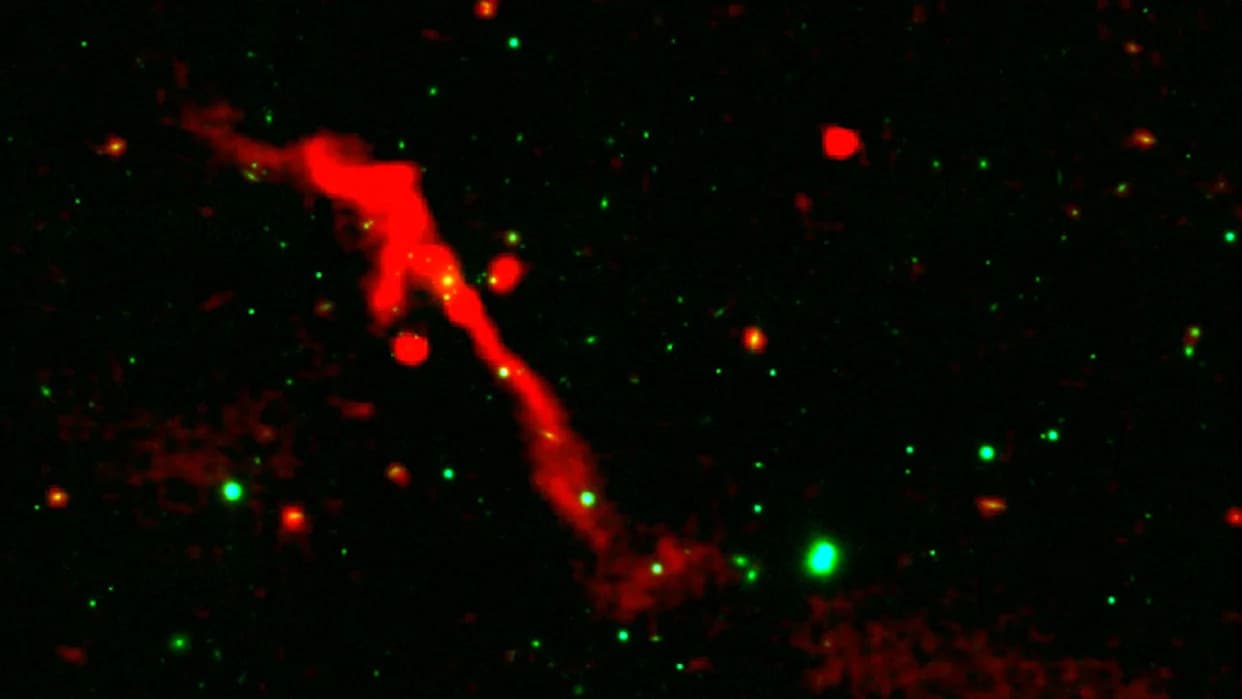
This LOFAR DR2 image of J1007+3540 superimposed over an optical image by Pan-STARRS shows a compact, bright inner jet, indicating the reawakening of what had been a ‘sleeping’ supermassive black hole at the heart of the gigantic radio galaxy.
A supermassive black hole designated J1007+3540 has reawakened inside a distant galaxy cluster after almost 100 million years of dormancy, and astronomers say it is erupting like a space volcano. A study published in Monthly Notices of the Royal Astronomical Society reports that the source is spewing magnetized plasma into intergalactic space, producing layered jets and lobes that trace multiple past outbursts.
Evidence From Radio Telescopes
A team led by Shobha Kumari of Midnapore City College (India) analyzed observations from the Low Frequency Array (LOFAR) in the Netherlands and the upgraded Giant Metrewave Radio Telescope (uGMRT) in India. The radio images reveal a compact, bright inner jet — a clear sign that the black hole’s central engine has restarted — surrounded by older, faded lobes of plasma from earlier active episodes.
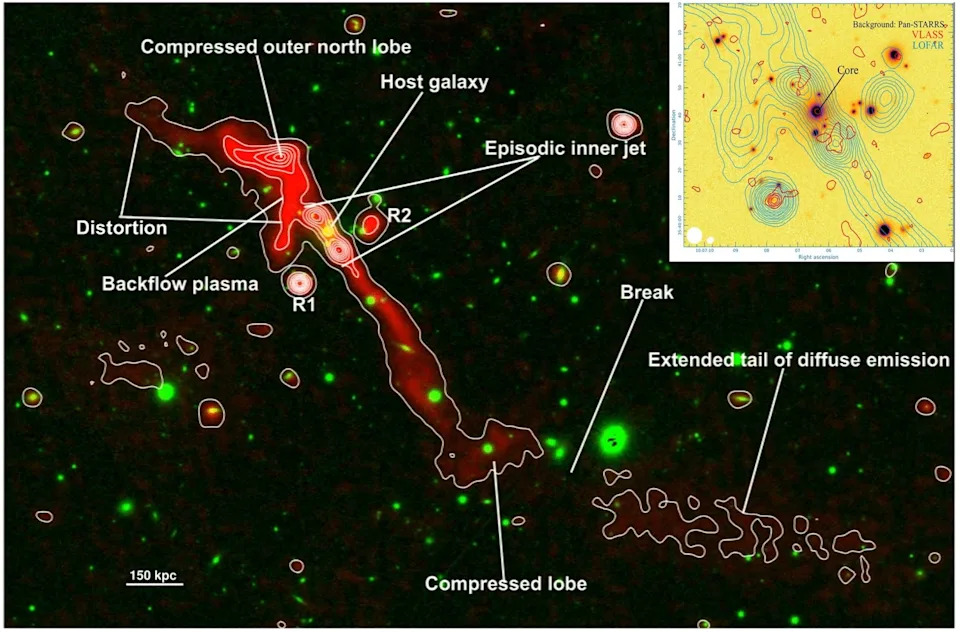
The same images with labels showing the compressed northern lobe, curved backflow signature of plasma and the inner jet of the black hole. Credit:LOFAR / Pan-STARRS / Kumari et al.
“It’s like watching a cosmic volcano erupt again after ages of calm — except this one is big enough to carve out structures stretching nearly a million light-years across space,” said Kumari.
Layered Outbursts and Cluster Interaction
These nested structures — young, bright jets embedded within older, exhausted lobes — are the hallmark of an episodic active galactic nucleus (AGN) that turns on and off over cosmic timescales. The surrounding galaxy cluster also plays a major role: extremely hot, high-pressure gas in the cluster is compressing, bending and distorting the plasma jets as they expand outward. LOFAR imaging shows a compressed northern lobe that curves under the influence of the cluster gas, while uGMRT data reveal a very steep radio spectrum consistent with aged, weakened particles.
“J1007+3540 is one of the clearest and most spectacular examples of episodic AGN with jet–cluster interaction,” added Surajit Paul, a coauthor from the Manipal Center for Natural Sciences.
Next Steps
Kumari, Paul and collaborators plan higher-resolution follow-up observations to probe the black hole’s core and better trace how the reinvigorated jets propagate through the cluster environment. Those observations will help determine the timing and frequency of episodic reactivations and reveal how cluster gas shapes the long-term evolution of these enormous outflows.
Help us improve.