
Researchers have discovered J1218/1219+1035, a rare triple galaxy merger about 1.2 billion light-years away in which all three central supermassive black holes are actively accreting and radio-bright. Initial WISE data showed two overlapping AGN separated by ~74,000 light-years; follow-up work found a third active galaxy ~316,000 light-years away connected by a gas tail. This is the first known triple merger in which every nucleus emits strong radio jets, and astronomers plan multiwavelength follow-ups to study how mergers fuel black hole growth.
Three Radio-Bright Supermassive Black Holes Caught Merging in Rare Triple Galaxy Collision

Three Supermassive Black Holes Discovered on Collision Course in a Cosmic First
About 1.2 billion light-years from Earth, astronomers have identified a rare and dramatic cosmic event: three galaxies slowly coalescing in a single merger, cataloged as J1218/1219+1035.
What makes this system extraordinary is that each galaxy hosts a supermassive black hole that is actively accreting material and emitting strong radio waves. All three nuclei are radio-bright active galactic nuclei (AGN), making J1218/1219+1035 the first known triple galaxy merger in which every component is radio-loud.
"Triple active galaxies like this are incredibly rare, and catching one in the middle of a merger gives us a front-row seat to how massive galaxies and their black holes grow together," said Emma Schwartzman of the US Naval Research Laboratory.
The system was first flagged in data from the Wide-field Infrared Survey Explorer (WISE). Initial images suggested a pair of overlapping galaxies, each hosting an AGN separated by roughly 74,000 light-years. Follow-up observations then revealed a third galaxy with a blazing AGN about 316,000 light-years away. Astronomers also detected a stream or tail of gas that appears to link the third galaxy to the other two, confirming they are interacting parts of the same system.
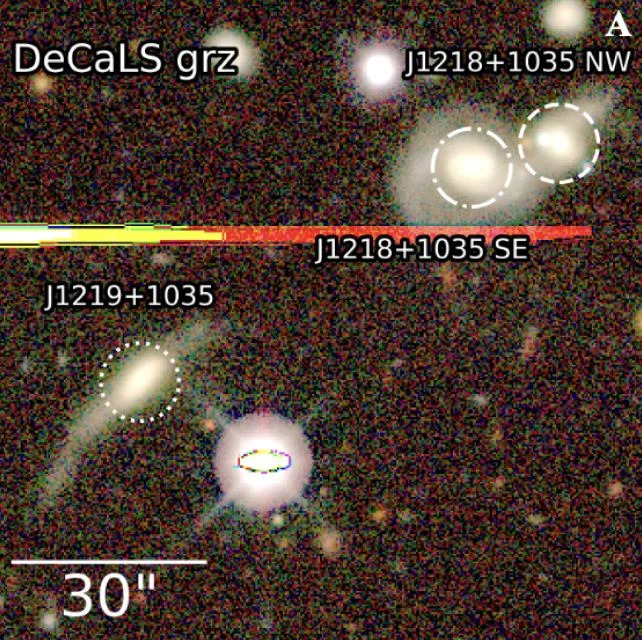
An optical image of the system taken with theDark EnergyCamera Legacy Survey (DECaLS). The three galaxies are circled. (Schwartzman et al.,ApJL, 2025)
Galaxy mergers are an important driver of growth for galaxies and their central black holes. While two-galaxy mergers are relatively common and well documented in the nearby Universe, simultaneous triple mergers are much rarer. Finding a triple system in which all three nuclei are actively accreting and radio-bright is exceptionally uncommon: this is only the third triple-AGN system identified in the nearby Universe and the first where every AGN emits strongly at radio wavelengths.
"By observing that all three black holes in this system are radio-bright and actively launching jets, we've moved triple radio active galactic nuclei (AGN) from theory into reality and opened a new window into the life cycle of supermassive black holes," the research team writes.
Astronomers plan multiwavelength follow-up observations — from X-ray to radio — to map the dynamics, study gas flows and jet activity, and measure how the merger fuels black hole growth. These campaigns will also help refine search strategies so more such rare systems can be found and studied in detail.
The team's results have been published in The Astrophysical Journal Letters.


