XRISM, a high‑resolution X‑ray observatory launched in 2023, detected echoes of powerful flares from Sagittarius A* in a nearby molecular cloud, revealing the Milky Way’s central black hole was highly active over the last 1,000 years. Precise spectral measurements allowed researchers to trace gas motion and rule out cosmic rays as the cause of the emission. The result, led by Stephen DiKerby (Michigan State University), highlights XRISM’s power to uncover hidden chapters of cosmic history and is accepted for publication in The Astrophysical Journal Letters.
XRISM Reveals a Violent Thousand‑Year History of the Milky Way’s Black Hole
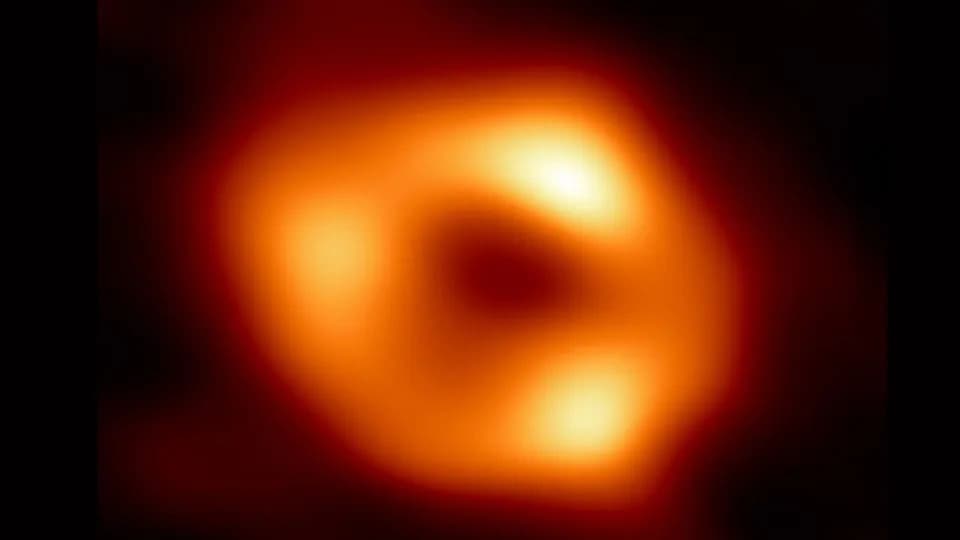
Sagittarius A* as seen by the Event Horizon Telescope may be quiet now, but it wasn't always so peaceful. | Credit: Event Horizon Telescope collaboration
A sensitive international X‑ray observatory has discovered that the supermassive black hole at the center of the Milky Way, long regarded as mostly dormant, underwent powerful flaring activity over the past 1,000 years.
The result comes from XRISM (X‑Ray Imaging and Spectroscopy Mission), a joint mission led by the Japan Aerospace Exploration Agency (JAXA) with contributions from NASA and the European Space Agency (ESA). Launched in 2023, XRISM’s high‑resolution spectroscopy allowed astronomers to read subtle X‑ray signatures in unprecedented detail.
Cosmic Mirrors Reveal Past Outbursts
Team leader Stephen DiKerby of Michigan State University and colleagues targeted a large molecular cloud near the galaxy’s center. In XRISM’s detailed spectra, the cloud behaved like a cosmic mirror, reflecting X‑rays from earlier powerful flares of Sagittarius A* (Sgr A*), the supermassive black hole that has a mass roughly equivalent to 4 million suns.
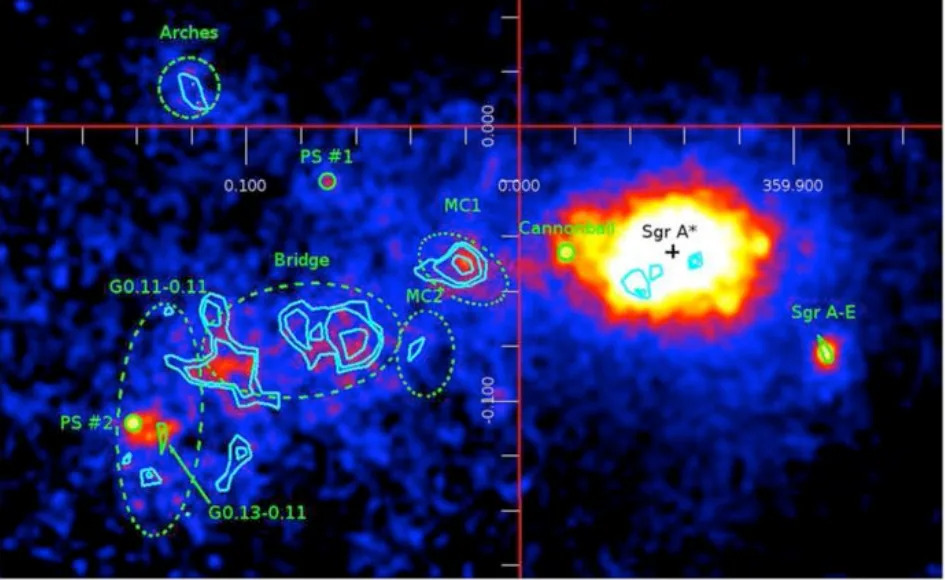
A larger map of the galactic center showing Sgr A* (the supermassive black hole) and several notable molecular clouds. | Credit: Mori et al. 2015
Because the reflected emission carries spectral fingerprints and Doppler shifts, the team could measure the energies and shapes of the X‑ray lines, trace motion within the cloud, and exclude alternative explanations such as cosmic rays as the dominant source of the glow.
"Nothing in my professional training as an X‑ray astronomer had prepared me for something like this," DiKerby said. "This is an exciting new capability and a brand‑new toolbox for developing these techniques."
The findings show that Sgr A* has not been uniformly quiet over human timescales: instead, it experienced dramatic episodes of activity within the last millennium. These past outbursts likely released enough high‑energy radiation to light up surrounding gas clouds, leaving echoes that XRISM can now detect and analyze.
Why This Matters
Understanding the variability of supermassive black holes is central to models of how they grow and how they influence their host galaxies. XRISM’s ability to perform precise X‑ray spectroscopy opens a new window onto black hole history and the physical processes that drive episodic flaring.
The team’s research has been accepted for publication in The Astrophysical Journal Letters.
Help us improve.