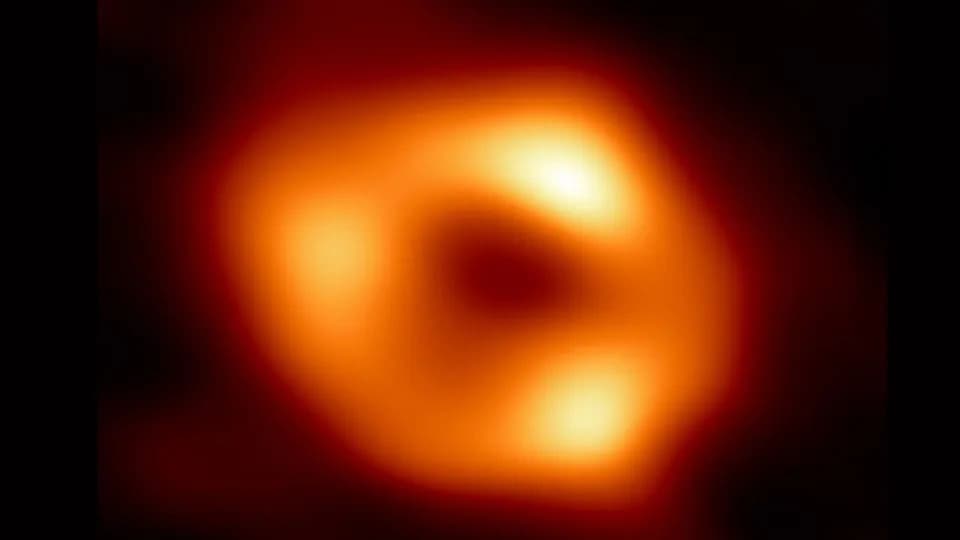
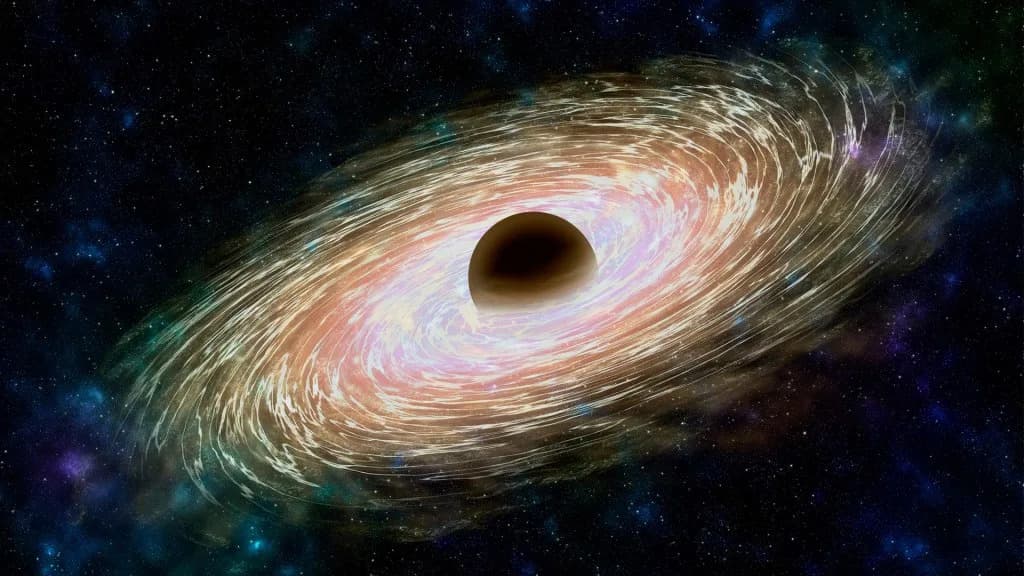
The Milky Way’s central black hole, Sagittarius A*, appears far dimmer today than it was in the recent past. XRISM observations of molecular clouds near the Galactic Center—acting as a “cosmic mirror”—reconstruct a historic x-ray outburst up to 10,000 times brighter than present levels, possibly occurring a few hundred years ago. The findings were presented at an American Astronomical Society meeting and accepted by Astrophysical Journal Letters; the trigger for the ancient bright phase is still unknown.
Sagittarius A* May Have Been Up To 10,000× Brighter A Few Centuries Ago, New XRISM Study Finds

New observations from the X-Ray Imaging and Spectroscopy Mission (XRISM) suggest that Sagittarius A* (Sgr A*), the supermassive black hole at the center of the Milky Way, was far more active in the recent past than it is today. While Sgr A* currently emits only a faint trickle of radiation, reflected x-rays from nearby molecular clouds indicate its accretion disk may once have shone up to 10,000 times brighter in x-rays.
Probing the Black Hole’s Recent Past
Researchers led by postdoctoral scientist Steve DiKerby used XRISM to study molecular gas clouds near the Galactic Center. These clouds act like a cosmic mirror, scattering and re-emitting x-rays that originated near the black hole at earlier times. Because the clouds are located at different distances, they encode a time-delayed record of Sgr A*'s past x-ray output—allowing astronomers to probe its activity over centuries.
“We can not only know how bright Sagittarius A* is today but also how bright it appeared 100 years ago and 1,000 years ago,” DiKerby explains.
The team’s analysis, presented at a recent meeting of the American Astronomical Society and accepted for publication in Astrophysical Journal Letters, indicates that Sgr A*’s accretion flow could have produced x-ray luminosities roughly four orders of magnitude higher than observed now—potentially as recently as a few hundred years ago.
Context And Implications
For perspective, the brightest x-ray flare recorded from Sgr A* in modern monitoring occurred in 2013; that flare reached only about 1% of the luminosity implied by the XRISM-based reconstruction of the historic outburst. The implied rapid change in activity over just centuries is a significant new constraint on the recent behavior of our Galaxy’s central engine.
Joseph Michail, a postdoctoral researcher at the Center for Astrophysics | Harvard & Smithsonian, called the work “very important,” noting that it fills a gap in our understanding of Sgr A*’s recent history. What triggered the dramatic bright phase remains unknown: possibilities include a temporary increase in the supply of gas, tidal disruption of a star, or other accretion instabilities.
What’s Next?
Follow-up observations and modeling will aim to refine the timing and magnitude of the past outburst and to test scenarios that could explain such a rapid transition from bright to quiescent. XRISM’s high-resolution spectroscopy of the Galactic Center region—and complementary data from other observatories—will be crucial for building a clearer timeline of Sgr A*’s activity.
Bottom line: XRISM’s observations of molecular clouds around the Galactic Center act as a time machine, revealing that the Milky Way’s central black hole may have been dramatically brighter only a few centuries ago. The cause of that intense phase remains an open and important question for astronomers.
Help us improve.