
The Flatiron Institute team used two supercomputers to run the most detailed simulations yet of stellar-mass black hole accretion, coupling magnetohydrodynamics with full radiative transfer in general relativity. Their models show that thick accretion disks trap radiation and redirect energy into winds and jets, while narrow polar funnels produce beamed radiation visible only from certain angles. Magnetic-field geometry strongly shapes both inflows and outflows. The work may also inform models of supermassive black holes and faint X-ray sources called "little red dots."
Supercomputers Reveal What Really Happens at the Edge of Black Holes

Bright line of yellow light across two purple flashes
The regions just outside black holes are extreme and chaotic: matter rushes inward while intense radiation, magnetic fields and relativistic effects push back. A new study from the Flatiron Institute uses two powerful supercomputers to produce the most comprehensive simulations yet of how stellar-mass black holes accrete and eject matter across a wide range of rates.
Unlike many earlier efforts, this work minimizes simplifying assumptions. The team combined survey observations of accretion flows with measured estimates of black-hole spin and magnetic-field properties, and then modeled the coupled dynamics of gas, magnetic fields and radiation within the framework of general relativity.
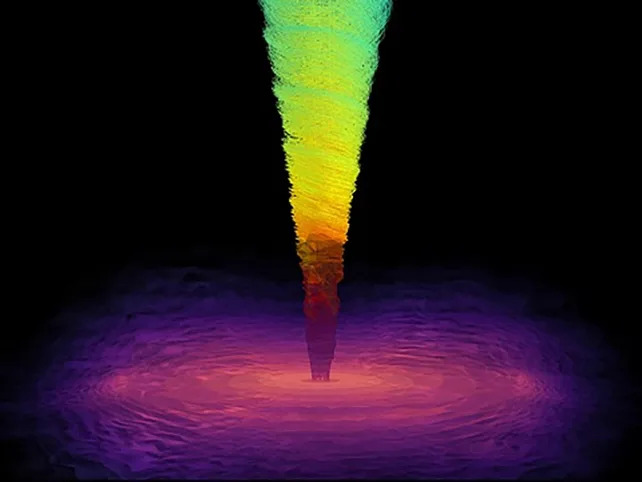
Simulations showed that the gas disk around a fast-spinning, rapidly accreting black hole gets denser towards the middle, while a powerful jet of gas shoots outwards, guided by magnetic fields. ((Zhang et al.,ApJ, 2025)
"This is the first time we've been able to see what happens when the most important physical processes in black hole accretion are included accurately," says astrophysicist Lizhong Zhang of the Flatiron Institute.
The simulations focus on stellar-mass black holes—objects a few to several tens of times the Sun's mass—and follow photon propagation in curved spacetime while solving the magnetohydrodynamics (MHD) of the plasma. The result is a self-consistent picture of how radiation, magnetic fields and gas interact close to the event horizon.
Key findings include the formation of thick accretion disks that trap much of the released radiation and instead channel energy outward via powerful winds and relativistic jets. The models also show narrow polar funnels that can focus outgoing radiation into beams visible only from certain viewing angles, helping explain why some sources appear much brighter when viewed along those directions.

Subscribe to ScienceAlert's free fact-checked newsletter
Magnetic-field geometry emerges as a major control on behavior: field strength and configuration influence how gas flows inward and how energy is launched outward as winds and jets. The authors report that their algorithm treats radiation consistently within general relativity and that their methods reproduce expected solutions for linear waves and shocks when coupled to the fluid.
Next steps for the team include testing whether the same approach applies to other classes of black holes, including the supermassive Sagittarius A* at the center of the Milky Way, and investigating whether their results can explain recently discovered faint X-ray sources nicknamed "little red dots." The researchers note that although their opacities were tuned for stellar-mass systems, many of the qualitative features should carry over to larger black holes.
The study has been published in The Astrophysical Journal.


