Archaeologists in West Norfolk have uncovered a remarkably complete 2,000‑year‑old carnyx — a Celtic animal‑headed war trumpet — as part of an Iron Age hoard dated to the first century C.E. The hoard also includes possible fragments of a second carnyx, five shield bosses, an unidentified iron object and a bronze boar head from a military standard, the first of its kind found in Britain. Removed as an intact soil block and examined by X‑ray and CT scanning, the fragile finds are undergoing careful conservation in coordination with Historic England and national museums. The dating overlaps the period of Boudica’s revolt, making the discovery especially significant for studies of Iron Age warfare and ritual.
Remarkably Preserved 2,000‑Year‑Old Celtic War Trumpet (Carnyx) Unearthed in Norfolk Hoard
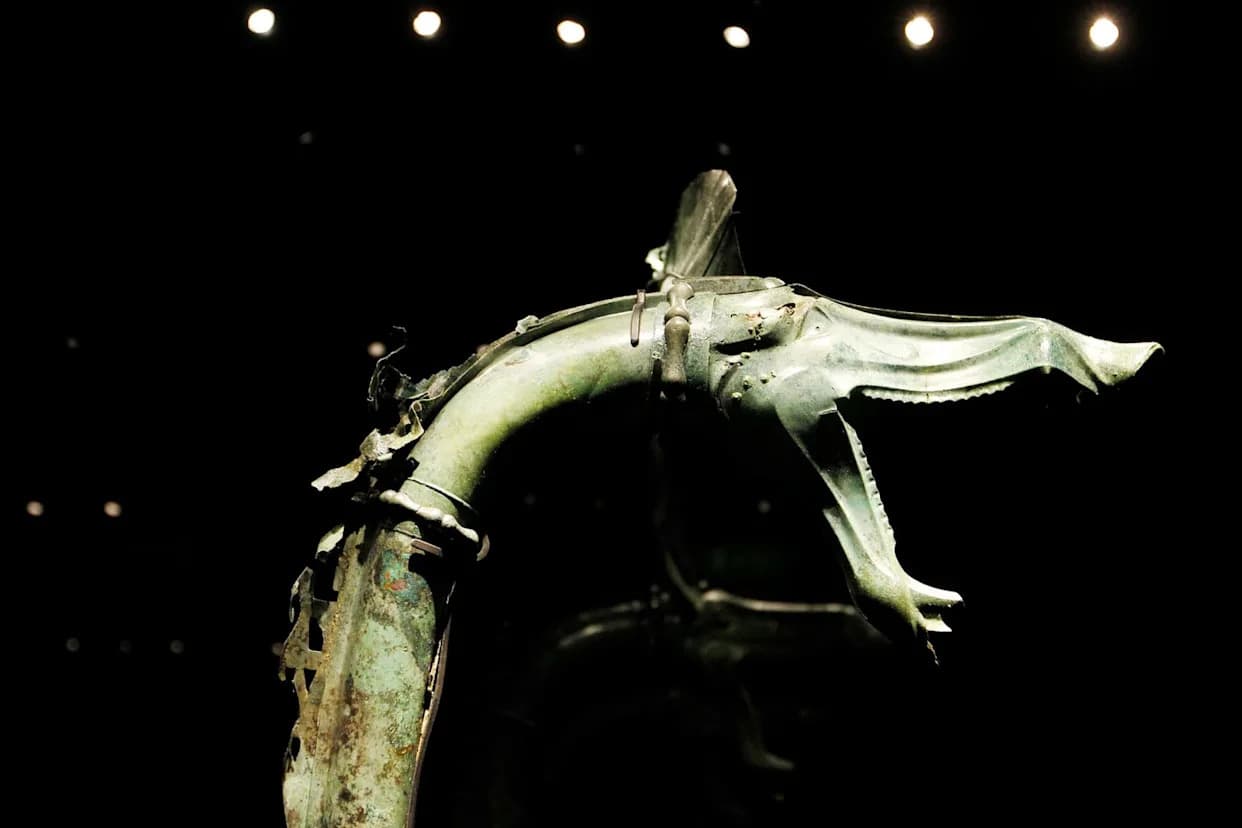
Archaeologists Found a Celtic Instrument of WarFRANCOIS GUILLOT - Getty Images
Archaeologists excavating an Iron Age hoard in West Norfolk have recovered a rare, animal‑headed Celtic war trumpet known as a carnyx — one of the most complete examples found in Europe and only the third recorded in Britain.
What Was Found
The assemblage, dated to the first century C.E., includes an unusually intact carnyx with its pipe, mouthpiece and bell preserved; fragments that may belong to a second carnyx; five shield bosses (decorative central fittings from shields); an unidentified iron object; and a bronze sheet embossed with a boar’s head that appears to have been part of a military standard — the first boar‑standard piece of this type recorded in Britain.
Context and Significance
Pre‑Construct Archaeology described the group of finds as an “internationally significant Iron Age hoard.” The dating places the hoard within the same broad period as the Iceni revolt led by Queen Boudica against Roman rule, raising the possibility — though not proving — a connection to that conflict. The Romans are known to have seized and displayed carnyces as trophies, which makes this discovery especially intriguing for military and cultural history.
Recovery and Conservation
To preserve archaeological context, the excavation team removed the hoard as an intact block of soil. Conservators used non‑invasive X‑ray and CT scanning to examine the contents before beginning careful stabilization and conservation. Work is being coordinated by Historic England, Norfolk Museums Service, National Museums Scotland and Pre‑Construct Archaeology.
“Finds of this kind are exceptionally rare in Britain and across Europe,” Pre‑Construct Archaeology wrote. Gary Trimble, senior project officer, told the BBC that locating a carnyx is “extraordinarily rare” and a boar standard “even rarer.”
About the Carnyx
The carnyx functioned as a psychological weapon between roughly 300 B.C.E. and 200 C.E. It is built from a long, narrow bronze tube bent at right angles with a flared bell often fashioned into an animal head, frequently a boar. Played upright so the animal’s head projected skyward, the instrument produced a loud, disorienting, reverberating sound intended to intimidate and confuse opponents. Roman historian Diodorus Siculus described Celtic trumpets as “peculiar and barbaric,” producing a harsh, echoing noise suitable for the chaos of battle.
Fraser Hunter, Iron Age and Roman curator at National Museums Scotland, noted that full research and conservation of these fragile remains will help reshape our understanding of sound, music and warfare in the Iron Age.
Historic England has made the discovery available to the BBC for its Digging for Britain series so the find and the conservation process can be shared with the public.
Help us improve.