
GUARD Archaeology uncovered a Bronze Age mass burial near Twentyshilling Hill, Dumfries and Galloway, dated to 1439–1287 BCE. Excavators found five ceramic urns containing the cremated remains of at least eight individuals, likely from a single social group. The deposits show reused mounds but no clear ritual traces, suggesting a sudden catastrophe such as famine or disease. Nearby Late Neolithic pits (c.2867 and 2504 BCE) indicate the site was revisited across millennia, underlining its long-term significance.
Rare Bronze Age Mass Burial Near Twentyshilling Hill Suggests Sudden Catastrophe

TWENTYSHILLING BARROW as it was first uncovered. (photo credit: GUARD Archaeology)
Archaeologists from GUARD Archaeology, carrying out preparatory work for a wind farm, have uncovered a rare Bronze Age mass burial near Twentyshilling Hill in Dumfries and Galloway, southwest Scotland. The discovery offers a striking glimpse into a sudden and tragic episode more than 3,000 years ago.
Key Findings
Radiocarbon dating places the burial between 1439 and 1287 BCE. Excavators recovered five ceramic urns that contained the cremated remains of at least eight individuals, who were likely members of a single family or close social group. The larger landscape around the site is already known for evidence that bodies were sometimes left exposed for a period before cremation—an established Bronze Age practice in the region.
Researchers observed that older burial mounds had been reopened and reused for these deposits. Crucially, the new deposits show no clear signs of ritual activity, which contrasts with expected ceremonial practices. Instead, the pattern of multiple interments concentrated in a short timeframe suggests the community experienced a rapid, severe event.
Possible Causes and Interpretation
Archaeologists propose that the burial pattern is consistent with a sudden calamity—such as severe famine or an infectious disease—that could have caused multiple deaths in a brief period. This interpretation differs from the more gradual funerary sequences commonly seen in Bronze Age contexts, where delayed cremation and multi-generational mound reuse are typical.
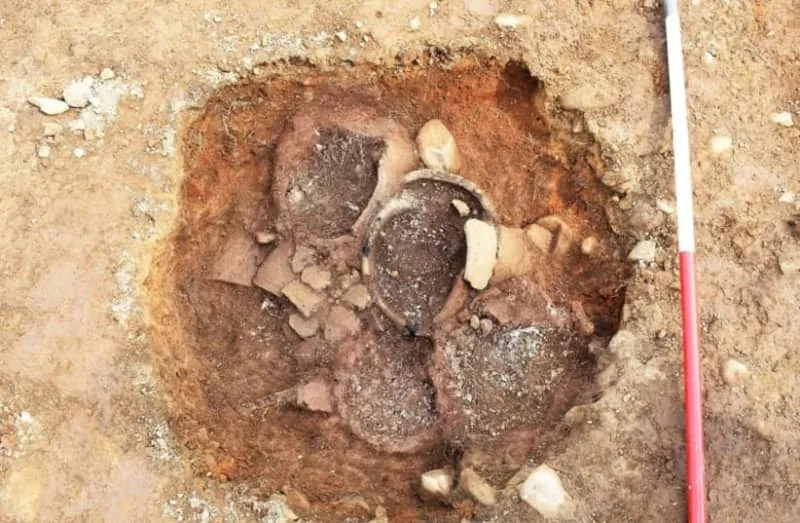
THE CENTRAL PIT beneath the barrow contained five tightly packed burial urns. (credit: GUARD Archaeology)
Earlier Occupation of the Landscape
Nearby excavations also revealed a small group of much earlier pits from the Late Neolithic, dated to roughly 2867 and 2504 BCE. These features demonstrate that people returned to this location across millennia, suggesting long-term significance—perhaps preserved through ancestral memory—rather than continuous settlement.
Significance and Next Steps
The find provides a rare, intimate snapshot of prehistoric life and mortality, offering fresh evidence of community stress in ancient Scotland. Further laboratory analyses, including detailed osteological and isotopic study of the cremated remains and environmental sampling, may help clarify the cause of the deaths and shed light on the health, diet, and mobility of the people involved.
Discovery Context: The site was found during wind farm preparatory works, illustrating how development-led archaeology can produce important new insights into the deep past.
Note: While the evidence points toward a concentrated episode of deaths, the precise cause (for example, famine, epidemic, or another catastrophe) cannot be confirmed without additional scientific analyses.


