The American Cancer Society’s 2026 report finds that 70% of Americans diagnosed with cancer now survive at least five years, a dramatic rise from 49% in the mid-1970s. Survival gains are especially large for myeloma, liver, late-stage lung, melanoma and rectal cancers, and overall mortality has fallen 34% since 1991 (≈4.8M fewer deaths). However, the report warns that American Indian, Alaska Native and Black communities still face far higher death rates, and experts urge continued research funding plus culturally tailored education and screening to sustain progress.
US Cancer Five-Year Survival Reaches 70% — But Racial, Tribal And Educational Gaps Threaten Progress
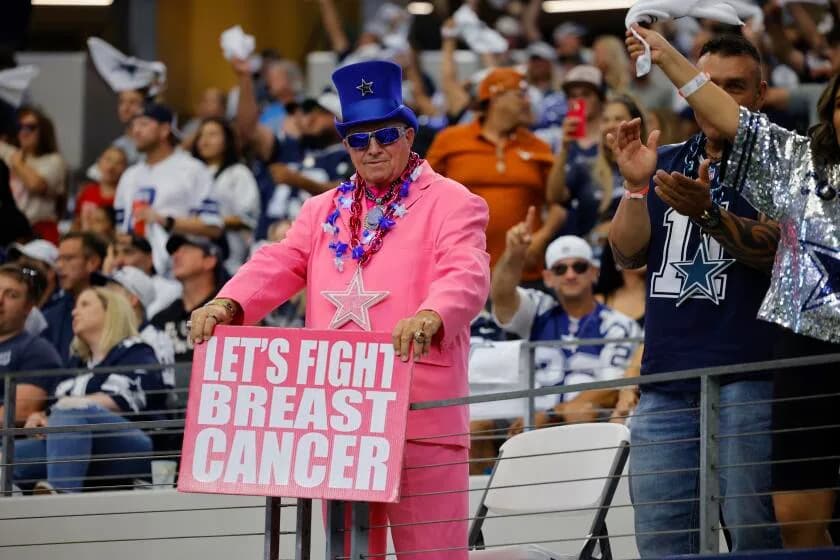
A fan holds a breast cancer awareness sign before an NFL game in Arlington, Texas, in 2024.(Gareth Patterson / Associated Press)
The American Cancer Society’s 2026 Cancer Statistics report documents a historic improvement in U.S. cancer outcomes: for the first time, 70% of people diagnosed with cancer can expect to live at least five years, up from about 49% in the mid-1970s. The gains reflect decades of research, better screening and expanded access to effective treatments — but experts warn that persistent disparities and potential funding cuts could undermine this progress.
Major Survival Gains
Researchers analyzed national cancer registry and death-record data from 2015 through 2021. The report highlights striking improvements for several hard-to-treat cancers compared with survival in the mid-1990s, including:
- Myeloma: Five-year survival rose from 32% to 62%.
- Liver cancer: Survival roughly tripled, from 7% to 22%.
- Late-stage lung cancer: Five-year survival increased from 20% to 37%.
- Melanoma: Survival climbed from 16% to 35%.
- Rectal cancer: Survival improved from 8% to 18%.
Across all cancer types, five-year survival more than doubled since the mid-1990s (from 17% to 35%). The report also attributes a 34% decline in cancer mortality since 1991 — an estimated 4.8 million fewer cancer deaths between 1991 and 2023 — to public investment in research, prevention, screening and treatment.
“This stunning victory is largely the result of decades of cancer research that provided clinicians with the tools to treat the disease more effectively, turning many cancers from a death sentence into a chronic disease,”
Rebecca Siegel, senior scientific director and lead author at the American Cancer Society, said.
Survivors’ Quality Of Life And Ongoing Needs
As more people survive cancer, attention is shifting to life after treatment. Survivors and caregivers face physical, emotional and financial burdens. Dr. William Dahut, the society’s chief scientific officer, emphasized that innovation must be paired with stronger support systems and policies so survivors “not only [have] more days, but better days.”
Uneven Progress: Who’s Being Left Behind
The report makes clear that benefits are not equally shared. American Indian and Alaska Native communities now have the highest cancer death rates in the U.S., with deaths from kidney, liver, stomach and cervical cancers roughly double those of white Americans. Black Americans also face persistent disparities: Black women have higher mortality from breast and uterine cancers than non-Black women, and Black men have the highest overall cancer rates of any U.S. demographic group.
Researchers link these gaps to long-standing structural issues — income inequality, historic discrimination (including redlining) and differential exposure to environmental carcinogens — that affect where people live and how readily they can access prevention and early-detection resources.
Local Example: Los Angeles
Dr. René Javier Sotelo, a urologic oncologist at Keck Medicine of USC, notes that in Southern California the challenge often centers on educational and cultural barriers. Even where insurance and care options are relatively available, many community members lack clear information about risk factors, screening and early warning signs. Sotelo points to penile cancer rates that are higher among Latino men in L.A. as an example driven more by awareness gaps — such as limited knowledge about HPV vaccination and hygiene — than by access alone.
“We need to insist on the importance of education and screening,”
Sotelo said, adding that helplines and culturally tailored materials must be made widely available.
Policy Risks And A Call To Action
The American Cancer Society warns that proposed federal cuts to cancer research funding and reductions in health insurance coverage could halt or even reverse recent gains. Shane Jacobson, the society’s CEO, urged continued investment: “We can’t stop now.”
Maintaining and expanding research, protecting access to care, and investing in culturally competent education and screening programs are key steps to ensure improvements in survival benefit everyone, not just the privileged.
Originally published in the Los Angeles Times.
Help us improve.