The Supreme Court’s recent order backing Texas’ congressional map — on the grounds it was driven by partisanship rather than race — is central to a split federal panel’s decision not to block California’s voter-approved Proposition 50. A three-judge panel declined to enjoin the map, with the majority finding Prop 50 was a partisan gerrymander and the dissent arguing plaintiffs proved illegal racial gerrymandering and identified alternative maps. The divided ruling sets up a likely appeal to the U.S. Supreme Court, which must decide whether to treat the two cases consistently before the 2026 midterms.
Split Panel Cites Texas Ruling as It Lets California’s Prop 50 Map Stand

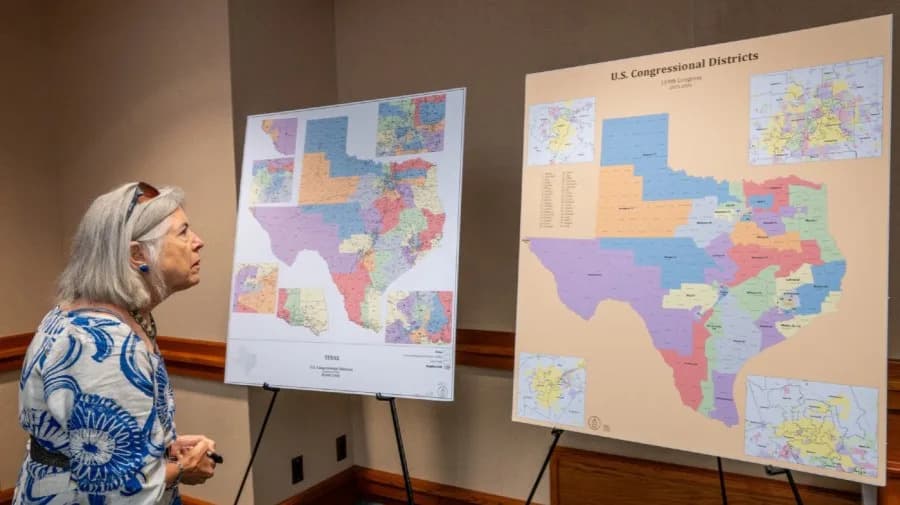
Last month, the U.S. Supreme Court’s Republican-appointed majority issued an unsigned order approving Texas’ new congressional map, saying the redrawing was motivated by partisan politics rather than improper racial considerations. The order observed that, ahead of the 2026 midterm elections, “Texas adopted the first new map, then California responded with its own map for the stated purpose of counteracting what Texas had done.” Justice Samuel Alito, in a concurrence, wrote that the driving force behind both maps was “partisan advantage pure and simple.”
Against that background, California’s voter-approved plan — Proposition 50 — is now at the center of a closely watched legal fight. Prop 50, approved by California voters, is likely to flip five congressional seats from Republicans to Democrats in the state.
On Wednesday, a divided three-judge federal panel declined to block the California map, setting up a likely Republican appeal to the U.S. Supreme Court. Both judges in the two-judge majority (appointed by Democratic presidents) and the dissenting judge (a Trump appointee) relied on the Supreme Court’s Texas ruling to justify their opposing conclusions.
Majority Finding
“Having carefully reviewed and weighed the relevant evidence, we find that the evidence presented reflects that Proposition 50 was exactly what it was billed as: a political gerrymander designed to flip five Republican-held seats to the Democrats. In other words, the ‘impetus for the adoption’ of the Proposition 50 Map was ‘partisan advantage pure and simple.’”
The majority opinion, written by Judge Josephine Staton, concluded that the evidence shows Prop 50 was motivated by partisan objectives.

SACRAMENTO, CALIFORNIA - NOVEMBER 04: California Gov. Gavin Newsom speaks during an election night gathering at the California Democratic Party headquarters on November 04, 2025 in Sacramento, California. California voters approved Proposition 50, a measure that will replace the state’s current congressional district map with new, legislature-drawn lines from 2026 through 2030. (Photo by Justin Sullivan/Getty Images)(Justin Sullivan / Getty Images)
Dissenting View
Judge Kenneth Lee dissented, raising what he called “the elephant in the room”: why the Supreme Court’s stay of a district court order enjoining Texas’ map should not control the California litigation. Lee sought to distinguish the two cases, arguing that plaintiffs in California have "rebutted the presumption of good faith" owed to the state, demonstrated illegal racial gerrymandering, and identified viable alternative maps — facts he says were not present in the Texas litigation. On that basis, Lee argued the panel majority erred by refusing to enjoin Prop 50 and was therefore “defying the rationale of the Supreme Court’s order.”
Implications
Lee’s dissent effectively lays out a potential roadmap for the Supreme Court’s conservative majority if it chooses to apply the same principles to both disputes: treating the Texas and California maps differently could be seen as inconsistent unless the Court accepts the factual distinctions Lee emphasizes. Practically speaking, a ruling that allows Texas-style maps but blocks California’s could permit one party to redraw a key map while preventing the other from doing the same ahead of the 2026 midterms — a political outcome the high court appeared to narrow when it stayed the Texas injunction.
The case is likely to be appealed to the Supreme Court, which will ultimately decide whether to apply the Texas rationale consistently across redistricting disputes.
Help us improve.