
The discovery of a rare seventh‑century gold hoard near Donington‑on‑Bain in Lincolnshire has puzzled researchers. Found in spring 2023, the assemblage—four gold‑and‑garnet pendants and a brooch fragment—was scattered on a hill with no burial context and shows extensive wear. One brooch had its central element removed before deposition, suggesting reuse, a smith's hoard, or even ritualized destruction. The study argues the find sheds light on how high‑value jewellery was circulated, recycled and deposited in Anglo‑Saxon England.
Rare 7th‑Century Gold Hoard Found in Lincolnshire Raises Possibility of 'Ritual Killing'

Portable Antiquities Scheme
Researchers are puzzling over an exceptionally rare collection of seventh‑century gold objects recovered from the English countryside. A new study in the Oxford Journal of Archaeology examines why the high‑value items were deposited and what their unusual context can tell us about Anglo‑Saxon society.
Discovery
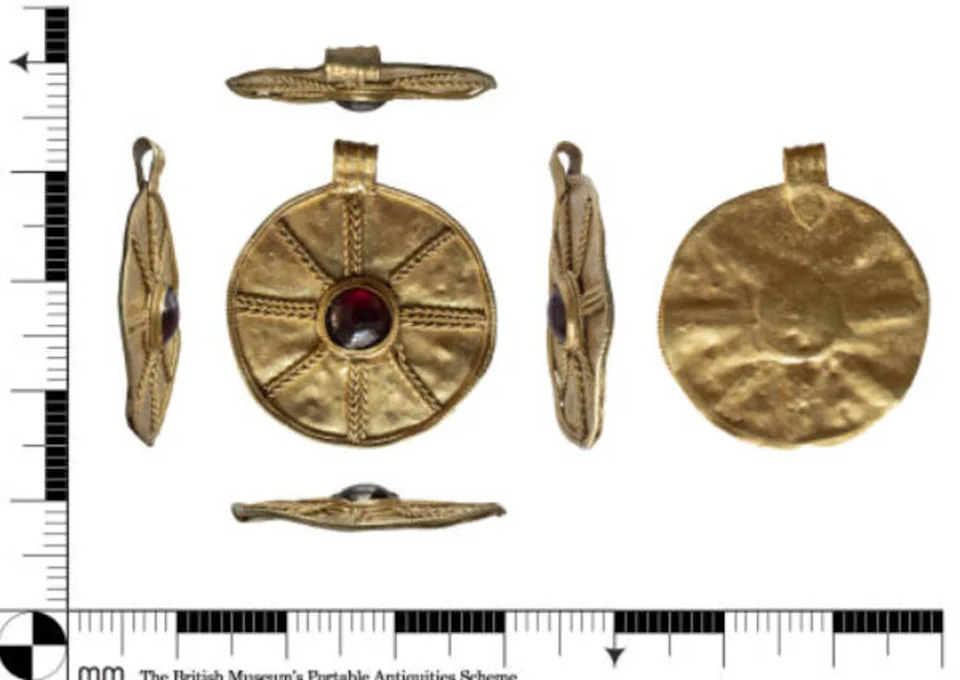
The cache was unearthed in spring 2023 by two metal detectorists on a hill near Donington‑on‑Bain in Lincolnshire, roughly 125 miles north of London. Recorded through the Portable Antiquities Scheme, the assemblage includes four gold‑and‑garnet pendants and a fragment of a gold‑and‑garnet brooch, all dated to the seventh century.
Why This Find Is Unusual
Unlike most high‑status Anglo‑Saxon jewelry finds, these objects were scattered across the hillside rather than concentrated in or beside a burial. Gold‑and‑garnet pendants were typically worn by elite women and represented some of the finest contemporary craftsmanship. Yet the pieces show extensive wear, damage, and modification, suggesting they were decades old when deposited.
Portable Antiquities Scheme
Puzzling Details And Interpretations
One brooch had its circular central element removed before deposition — a form of reuse rarely seen in known Anglo‑Saxon graves. The authors outline several leading explanations:
- Smith's Hoard: A jeweller may have gathered older pieces to recycle the gold and garnet for new work.
- Ritual Killing Or Deliberate Deposition: The intentional damage or removal of elements could reflect ritualized treatment of objects associated with a violent or ceremonial act.
- Hidden By Owners: Local women might have buried or hidden valuables during social upheaval and never recovered them.
- Grave Robbery And Recycling: Widespread looting of high‑status female burials and material scarcity could have driven reuse and redistribution of jewels.
Significance
Although the exact reason for the deposition remains unresolved, the hoard offers valuable evidence about the circulation, reuse, and deposition of high‑value jewellery in early medieval England. The mix of wear, modification and context broadens our understanding of how precious objects moved between personal use, craft workshops and ritual or practical concealment.
Recorded by the Portable Antiquities Scheme and discussed in the Oxford Journal of Archaeology, the find was first reported in the popular press by Men's Journal.
Further research and careful archaeological analysis may help narrow the interpretations, but for now the Donington‑on‑Bain hoard remains a rare and intriguing glimpse into seventh‑century material culture.


