RX J0528+2838, a white dwarf 730 light-years away, is associated with a bow-shaped shock and expanding nebula that has been growing for at least 1,000 years. The system lacks an accretion disc, yet spectroscopy with MUSE on ESO’s Very Large Telescope traced the structure back to the white dwarf. Researchers identified a strong magnetic field that may channel material from the companion and drive outflows, but current estimates of the field strength cannot fully account for the nebula’s age. The discovery challenges standard models of discless binary mass transfer and prompts further observations and theory.
Dead White Dwarf Powers Unexplained Bow Shock for More Than 1,000 Years
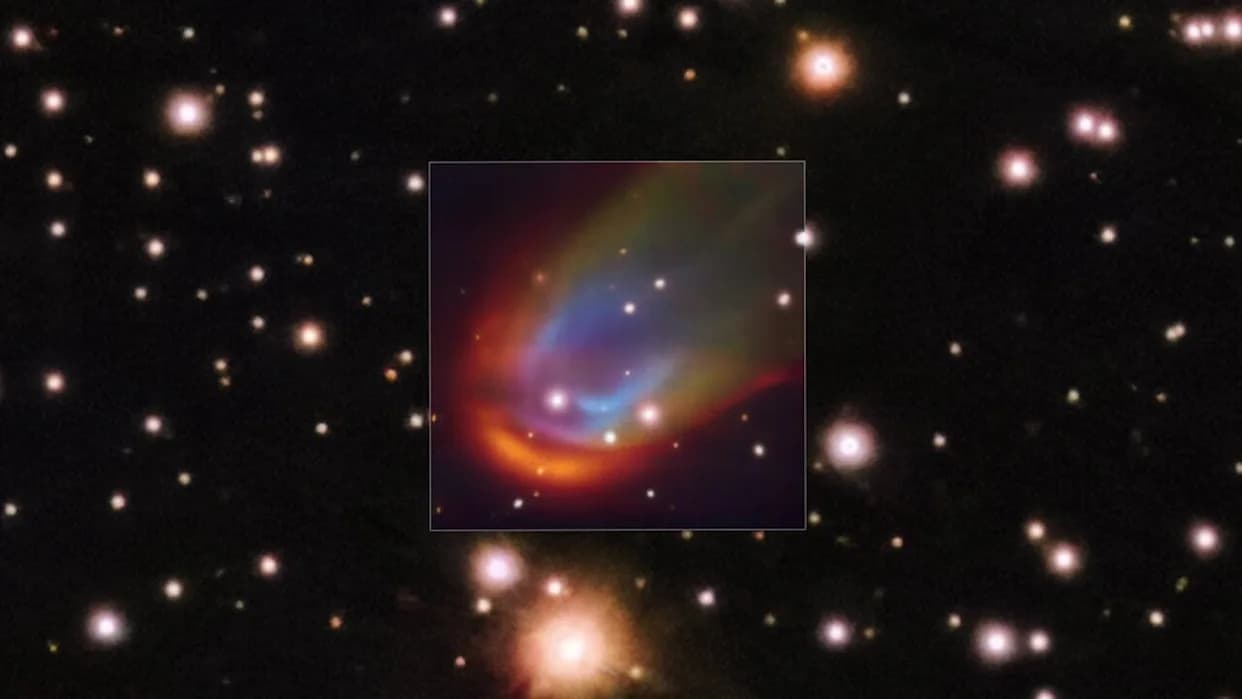
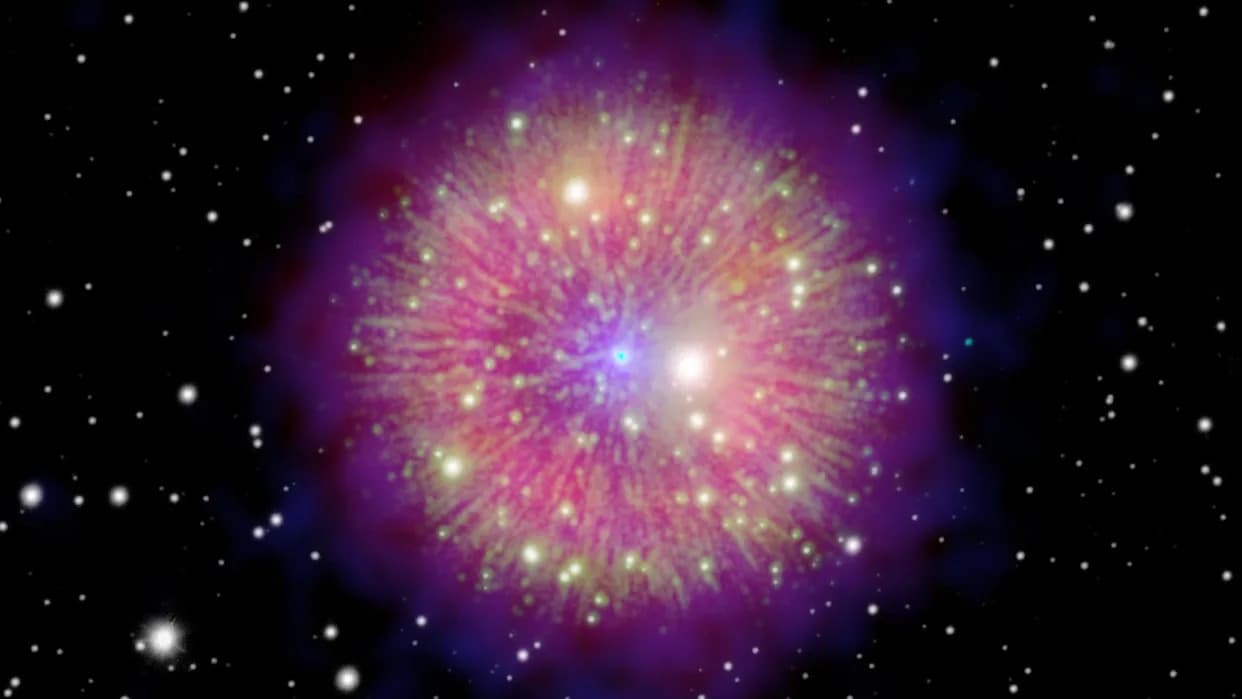
The central square image, taken with the MUSE instrument on ESO’s Very Large Telescope, shows shock waves around the dead star RXJ0528+2838.
A white dwarf—normally a compact, inactive stellar remnant—appears to be driving a powerful, bow-shaped shock and nebula that has been expanding for at least 1,000 years. The object, RX J0528+2838, lies about 730 light-years from Earth and sits in a binary system with a Sun-like companion. The discovery challenges current models for how discless binary systems behave.
How the Surprise Was Found
Researchers first noticed unusual emission while inspecting images from Spain's Isaac Newton Telescope. Follow-up observations with the Multi-Unit Spectroscopic Explorer (MUSE) on the European Southern Observatory's Very Large Telescope allowed the team to map the shock in detail, measure its composition, and trace the structure back to the white dwarf rather than to an unrelated cloud of gas or dust.
Why This Is Unexpected
In many binaries, matter transferred from a companion forms an accretion disc around the white dwarf; some of that material is then expelled as outflows that can produce shock structures. RX J0528+2838, however, shows no accretion disc, yet it is clearly associated with a curved, bow-shaped shock and an expanding nebula. The outflow’s age—at least 1,000 years—makes it particularly puzzling.
“We found something never seen before and, more importantly, entirely unexpected,” said Simone Scaringi of Durham University. “The surprise that a supposedly quiet, discless system could drive such a spectacular nebula was one of those rare ‘wow’ moments.”
Magnetism and Open Questions
Spectroscopy reveals that the white dwarf hosts a substantial magnetic field. The researchers propose that magnetically channeled accretion from the companion could produce outflows even without a conventional disc. Still, estimates of the current magnetic strength suggest it should power an outflow for only a few hundred years—shorter than the observed age of the nebula—so the full mechanism remains unresolved.
“Our finding shows that even without a disc, these systems can drive powerful outflows, revealing a mechanism we do not yet understand,” said Krystian Iłkiewicz of the Nicolaus Copernicus Astronomical Center. The team plans continued monitoring and theoretical work to determine how magnetism, binary interaction, and past activity produced the long-lived structure.
Why It Matters
The result forces astronomers to rethink how matter is transferred and expelled in compact binaries and highlights the role magnetic fields can play in shaping circumstellar environments. RX J0528+2838 provides a nearby laboratory—at 730 light-years—where we can observe processes that may occur elsewhere but have previously gone unnoticed.
Help us improve.