Researchers have achieved the first direct mass measurement of a candidate rogue planet by combining ground-based microlensing data with observations from the Gaia spacecraft. The large separation between Earth and Gaia provided a parallax that allowed astronomers to separate the object's distance and mass, similar to stereoscopic vision. The lensing object has a mass roughly equivalent to Saturn’s, confirming it as a planet. This dual-view technique opens a new avenue to discover and confirm many more free-floating planets across the galaxy.
Astronomers Weigh a Rogue Planet for the First Time Using Gaia and Ground Telescopes
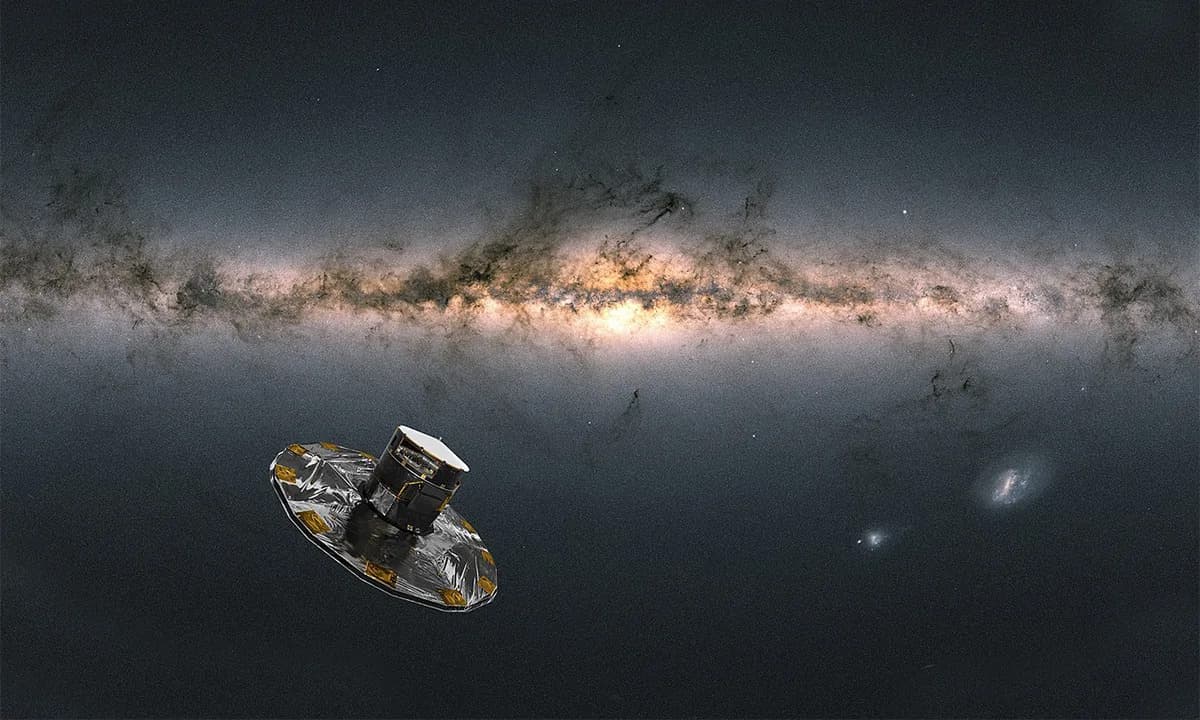
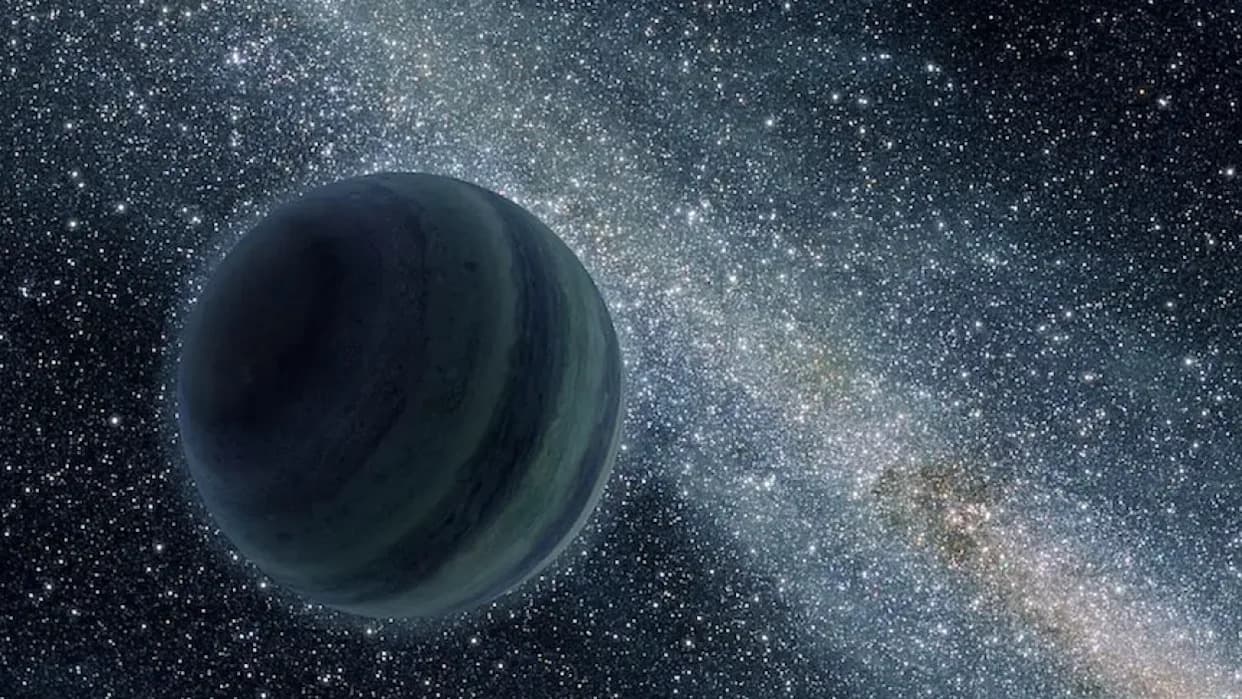
Lead image: Spacecraft: ESA/ATG medialab; Milky Way: ESA/Gaia/DPAC; CC BY-SA 3.0 IGO.
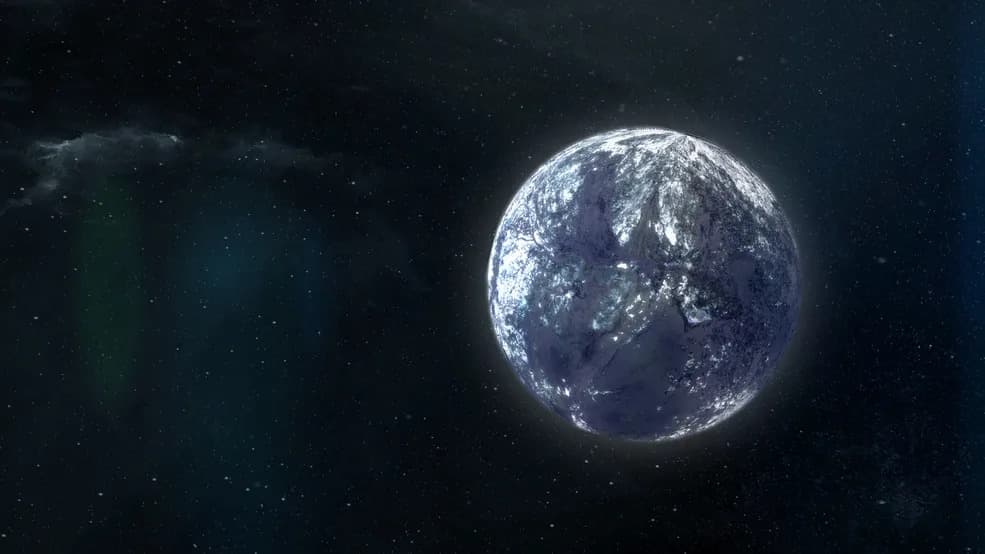
For the first time, astronomers have directly measured the mass of a candidate rogue planet — a world that has been ejected from its star system and drifts alone through interstellar space. An international team led by Dong Subo of Peking University combined ground-based microlensing observations with data from the European Space Agency’s Gaia spacecraft to pin down the object’s mass and distance.
How The Measurement Worked
When a compact object (like a planet) passes in front of a background star, its gravity bends and briefly magnifies the star’s light in a phenomenon called gravitational microlensing. A microlensing lightcurve observed from a single location often cannot separate the lens’s mass from its distance. The team overcame this by comparing the event as seen from Earth and from Gaia, which was more than 930,000 miles (about 1.5 million kilometers) away at the time.
That large separation provided a measurable parallax between the two viewpoints. Combining the parallax information with the microlensing signal allowed the researchers to disentangle distance and mass the same way two eyes give depth perception.
“We are able to use the same principle to extract the distance information of this rogue planet candidate, finding the mass and distance separately,” Dong Subo said, noting that while human eyes are separated by only centimeters, Gaia was roughly 1.5 million kilometers from Earth.
Results And Implications
Using this dual-perspective method, the team determined the object’s mass is roughly equivalent to Saturn’s — comfortably within the planetary mass range — allowing them to confirm it as a bona fide planet rather than a brown dwarf or other compact object. “We know for sure it's a planet,” Dong said.
The success of this technique demonstrates a practical path to confirm and measure more free-floating planets. The researchers say their result strengthens the idea that the Milky Way may host large numbers of planets that were likely ejected from their original systems, and that future coordinated observations between Earth and space telescopes could reveal many more such wanderers.
Published In: Science. Lead Author: Dong Subo (Peking University). Key Instruments: Multiple ground-based telescopes and ESA’s Gaia spacecraft.
Help us improve.