
Gaia, ESA's astrometric observatory launched in 2013, ended operations in early 2025 after making roughly 3 trillion measurements of about 2 billion stars. Its highly precise positions, distances and motions have produced the most detailed dynamical map of the Milky Way, revealing structures such as the 9,000-light-year Radcliffe Wave and the remnants of ancient mergers like Gaia Enceladus/Sausage. Gaia data have also refined the mass of the Large Magellanic Cloud, yielded exoplanets and brown-dwarf candidates discovered via astrometry, and will continue to drive discoveries through major data releases in 2026 and around 2030.
How Gaia Unveiled the Milky Way: A Billion-Star Survey That Changed Galactic Astronomy

Credit: On March 27, 2025, operators in Darmstadt, Germany, sent their final commands to the Gaia spacecraft, instructing it to shut down its computer and communications systems, then move from L2 into its retirement orbit around the Sun. ESA
On Jan. 15, 2025, the European Space Agency's Gaia observatory captured its final image. Over the next weeks the spacecraft completed a final series of engineering checks, used its thrusters to depart Earth's vicinity, settled into a solar orbit and was powered down on March 27. After more than a decade of operations and roughly 3 trillion measurements of about 2 billion stars, Gaia's observing campaign is complete — but its scientific legacy is only beginning.
Mission Overview
Launched in December 2013, Gaia was designed to produce the most precise, three-dimensional, dynamical map of the Milky Way ever assembled. Building on ESA's earlier Hipparcos mission, Gaia measured positions, distances and motions for over a billion stars, improving sample size by roughly three orders of magnitude and delivering typical precisions far better than its predecessor.
How Gaia Measured the Galaxy
The spacecraft carried two nearly identical telescopes whose fields of view were fixed 106.5° apart. As Gaia slowly rotated and precessed, the twin telescopes repeatedly swept the entire sky so that each target was observed about 14 times per year. The observatory combined three instruments: an astrometric instrument for positions and proper motions, a photometer for colors (temperature and composition proxies) and a spectrograph for radial velocities.
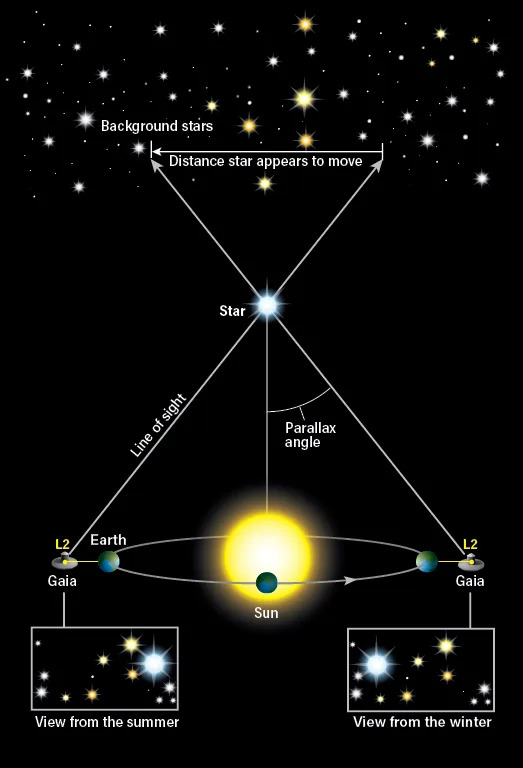
Distance was determined directly by parallax — the tiny apparent shift of a nearby star against distant background objects as Gaia moved around the Sun. From its location near the Earth–Sun L2 point, Gaia's annual baseline allowed parallax measurements down to at the level of a few microarcseconds for the brightest stars, enabling precise distances across large swaths of the Galaxy.
Major Discoveries and Scientific Impact
Gaia's catalogue has transformed our view of the Milky Way and its environment:
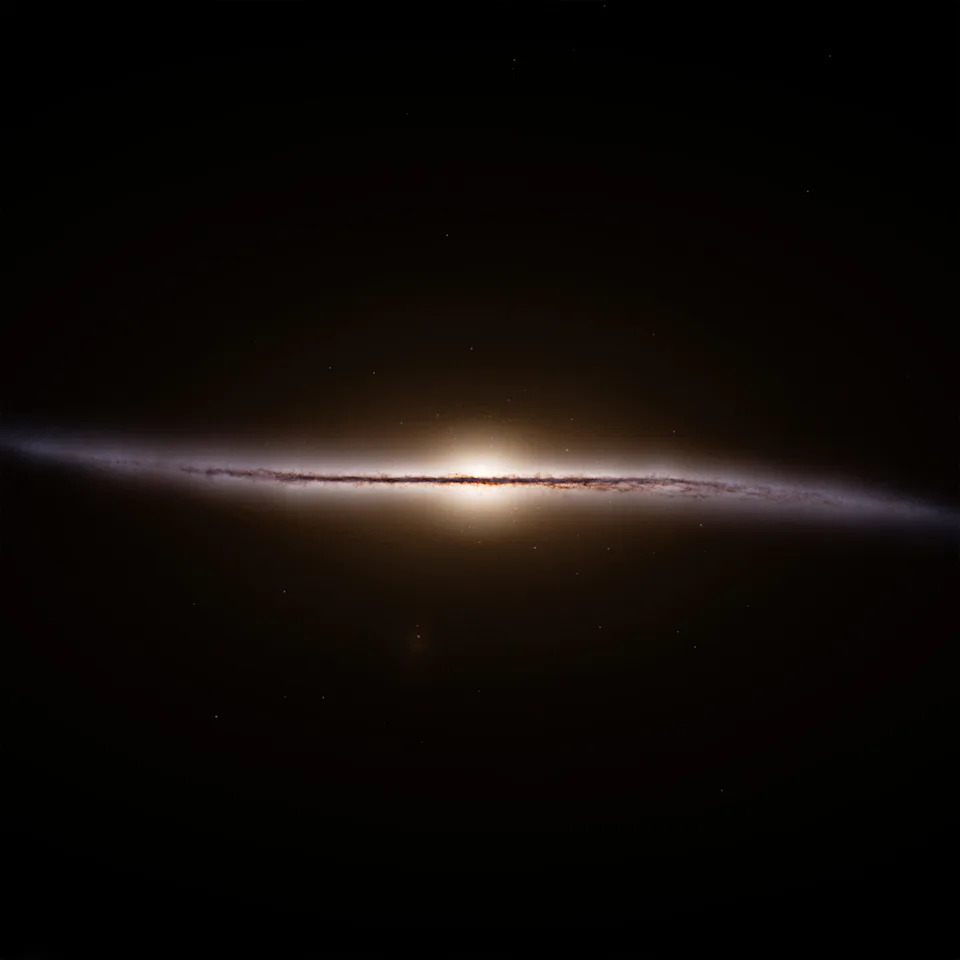
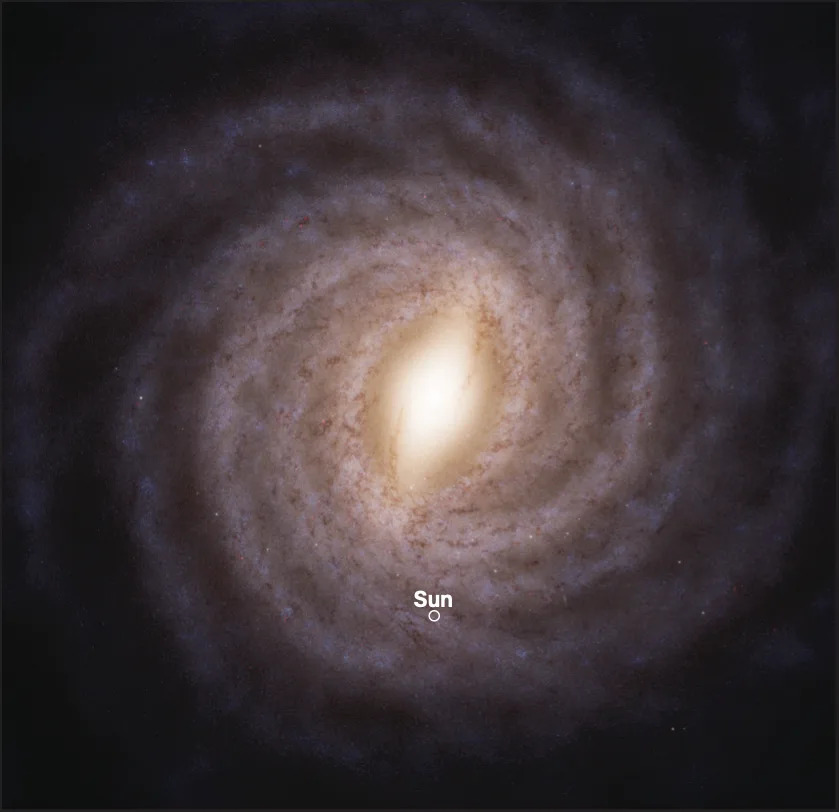
- Galactic Structure: Gaia produced the most accurate global maps of the Galaxy to date, revealing that the Milky Way is a barred spiral whose disk is warped and asymmetrical. The mission also measured the warp's precession, favoring external perturbations (such as interactions with dwarf galaxies) as the likely cause.
- Radcliffe Wave: Using Gaia distances, researchers traced a vast, 9,000-light-year-long undulating ribbon of gas in the local arm — the Radcliffe Wave — which replaced older, more limited views of the nearby Gould Belt and highlights large-scale influences on star formation.
- Galactic Archaeology: Gaia uncovered the remnants of major past mergers, including the Gaia Enceladus/Sausage event and other populations (Arjuna/Sequoia/I'itoi). By combining precise motions and distances, astronomers can now reconstruct ancient collisions that built the Galaxy's halo.
- Disk Substructure: The survey revealed ghostly filaments and ripples in the outer disk — possible signatures of tidal excitations from past encounters — and enabled detailed mapping of stellar streams and clusters across the sky.
- Satellite Galaxies and Dark Matter: Observations of the Large Magellanic Cloud and roughly 40 nearby dwarf galaxies show many are on high-velocity, likely first-encounter trajectories rather than long-term, settled satellites. That finding requires a reassessment of how dark matter is distributed in small galaxies and in the Galactic neighborhood.
- Hypervelocity Stars and a Potential LMC Black Hole: Kinematic tracing of some hypervelocity stars suggests they were launched from the Large Magellanic Cloud. If confirmed, their trajectories imply the LMC may host a central massive black hole — a major revision of previous assumptions.
- Exoplanets and Substellar Objects: Teams using Gaia data reported the first exoplanet detections based solely on Gaia astrometry, including Gaia-4 b (near 12 Jupiter masses) and a brown dwarf candidate Gaia-5 b (around 21 Jupiter masses). These results demonstrate Gaia's power to find massive, long-period companions from the minute wobble they imprint on host stars.
Data Releases and What’s Next
Gaia's Data Release 3 arrived in June 2022. Two major releases remain: one expected in 2026 (covering about 5.5 years of observations) and a later release around 2030 that will include the full multi-year baseline. The 2026 catalog will provide epoch-by-epoch measurements for roughly 2 billion sources and an extensive exoplanet candidate list, while the final release aims to realize Gaia's full exoplanet yield (estimates suggest tens of thousands) and deliver the cleanest possible astrometric, photometric and spectroscopic products.
The full Gaia archive totals on the order of a petabyte and requires extensive calibration and processing to separate tiny astrophysical signals from instrumental effects. That work is ongoing and will power a steady flow of scientific papers and discoveries for years to come.
Legacy
Although Gaia is no longer collecting new science data, its catalogs have already become foundational for modern astronomy — a backbone for studies from exoplanets to black holes to Galactic evolution. As project scientist Johannes Sahlmann put it, new results continue to pour forth at a prodigious rate, and the most exciting discoveries still lie ahead as researchers mine the full dataset.
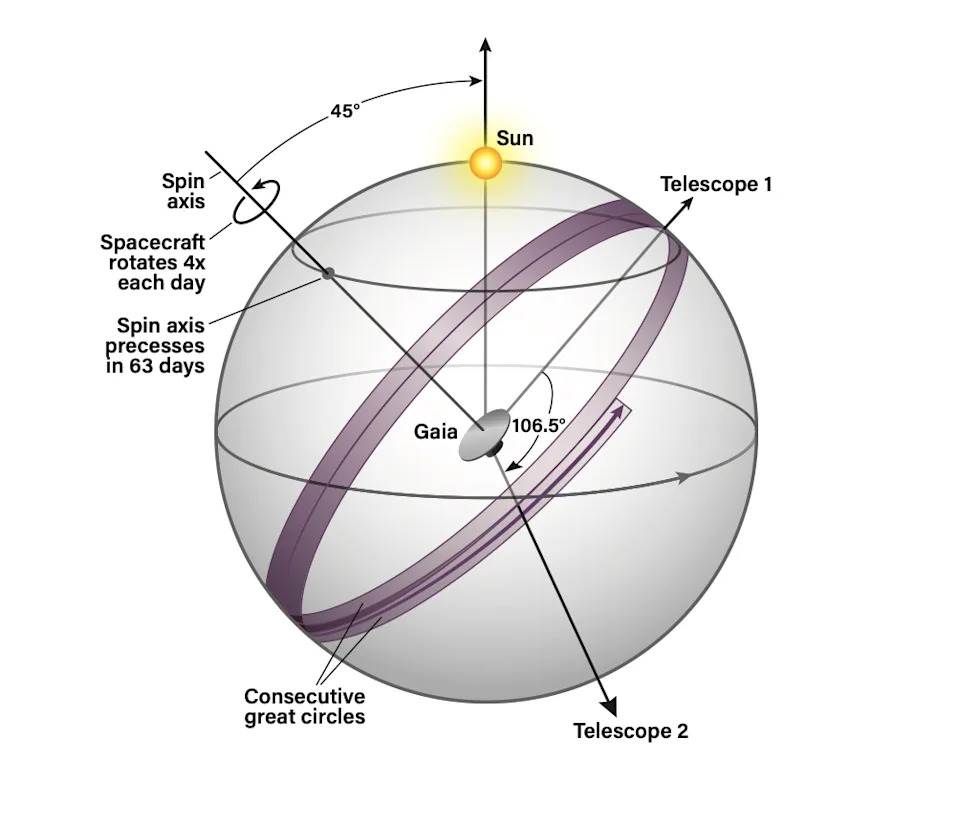
Gaia carried two identical telescopes, which pointed 106.5° apart on the sky and sent light to the craft's three instruments. These instruments recorded objects' positions, colors, and motions along the line of sight. The spacecraft spun slowly around its axis four times a day, scanning along a path called a great circle; as it did so, objects drifted from the field of view of one telescope to the other. The craft maintained an angle of 45° between the Sun and its spin axis to shade the telescopes while still allowing the solar panels to draw power. Additionally, the spacecraft's spin axis precessed, tracing out a complete circle on the sky every 63 days, allowing Gaia to see the entire sky over time. Credit: Astronomy: Roen Kelly, after ESA
Credit: Astronomy: Roen Kelly
Credit: ESA/Gaia/DPAC, Stefan Payne-Wardenaar – CC BY-SA 3.0 IGO
Credit: ESA/Gaia/DPAC, Stefan Payne-Wardenaar – CC BY-SA 3.0 IGO
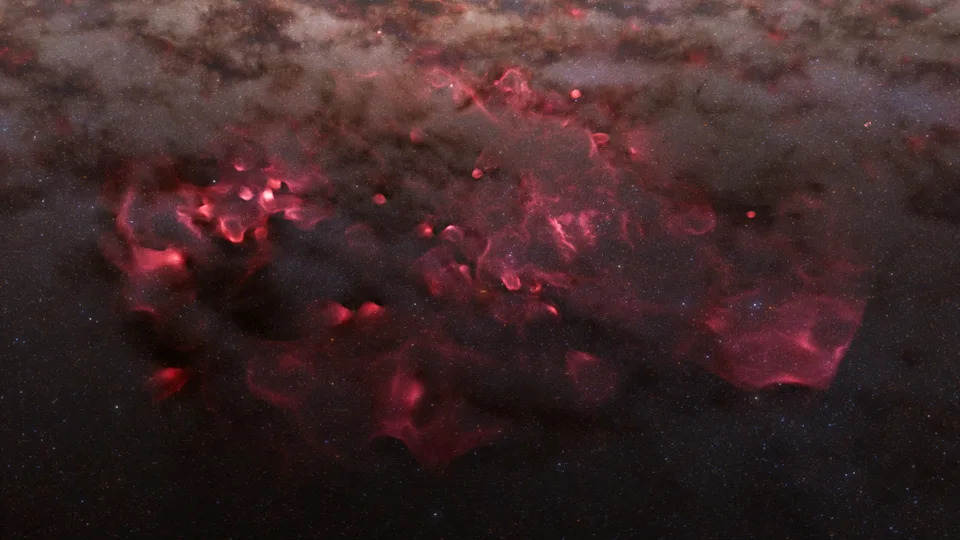
This still from an animation shows the three-dimensional distribution and structure of star-forming regions within 4,000 light-years of the Sun, colored in red. The view is from just above the plane of our local spiral arm, whose dust appears as dark streaks toward the top of the image. Mapping out such regions in 3D to study their structure is incredibly difficult, but Gaia's precise measurements have allowed researchers to begin charting these regions in such a way for the first time. These maps are based on information gathered from some 44 million stars. Credit: ESA/Gaia/DPAC, S. Payne-Wardenaar, L. McCallum et al (2025)
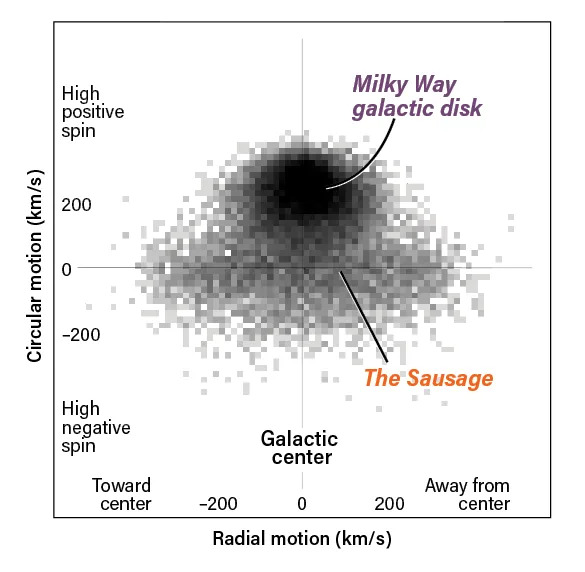
Credit: Astronomy: Roen Kelly, after V. Belokurov (Cambridge, UK and CCA, New York, US) and Gaia/ESA
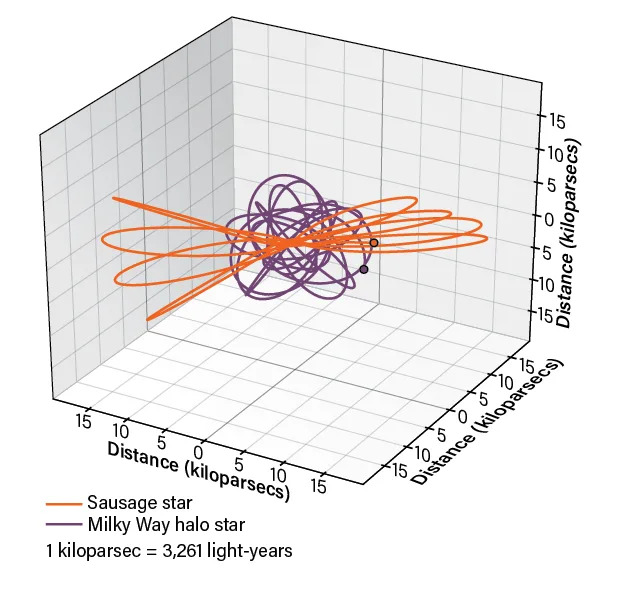
Credit: Astronomy: Roen Kelly, after A. Deason (Durham, UK), SDSS and Gaia/ESA
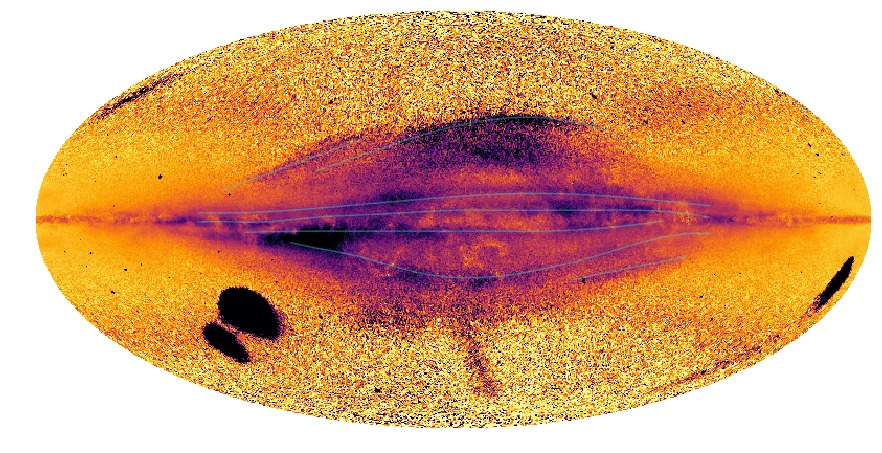
This all-sky motion map created with Gaia data shows stars with high motions in black and purple, and those with little motion in yellow. The two dark regions at lower left are the Magellanic Clouds; the Sagittarius Dwarf Galaxy is the elongated black and purple curve at right. Traced out by blue lines are several filaments along which stars share similar motions. These structures may be the remnants of spiral arms excited into being along the galactic plane by past interactions between the Milky Way and other galaxies. Credit: Laporte et al. (CC BY 4.0)
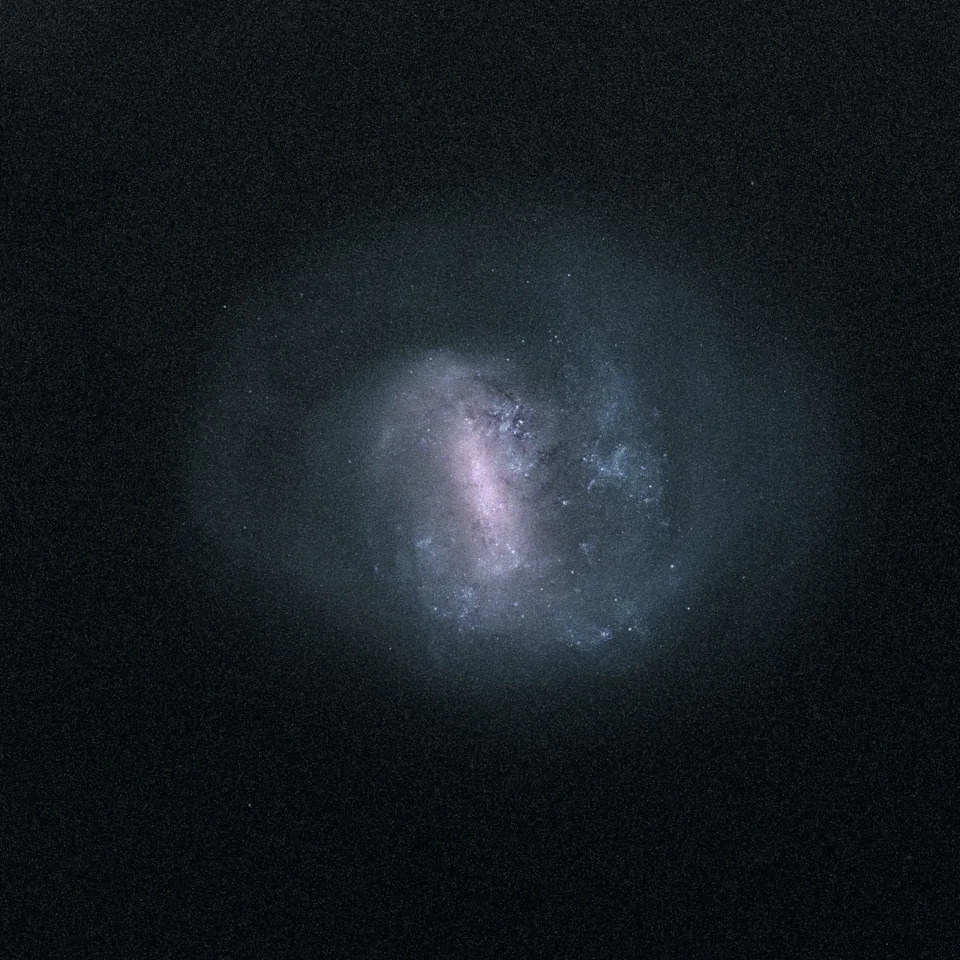
This "image" of the Large Magellanic Cloud is not a photo, but a combination of Gaia's measurements of stars' brightness and color (using various filters) to create a view of this Milky Way satellite. Gaia data have strongly indicated the LMC hosts a supermassive black hole in its center, much like larger galaxies do. Credit: ESA/Gaia/ DPAC, CC BY-SA 3.0 IGO. Acknowledgement: Gaia Data Processing and Analysis Consortium (DPAC); A. Moitinho/A. F. Silva/M. Barros/C. Barata, University of Lisbon, Portugal; H. Savietto, Fork Research, Portugal
Credit: ESA/Gaia/DPAC; CC BY-SA 3.0 IGO


