The Saudi-backed PLC says it has retaken Hadramout and al-Mahra from the STC, which has been dissolved and whose leader fled abroad. President Rashad al-Alimi announced a Supreme Military Committee and urged armed groups to disarm, while Saudi Arabia plans a southern conference to address autonomy and resource grievances. The move strained Saudi-UAE ties after the UAE withdrew forces, and analysts warn the Houthis’ hold in the northwest and southern divisions make a lasting reunification uncertain. The biggest near-term risks are a northward shift in fighting and whether the Riyadh talks yield a viable political settlement.
Yemen: Saudi-Backed Government Retakes South as STC Collapses — What Comes Next?
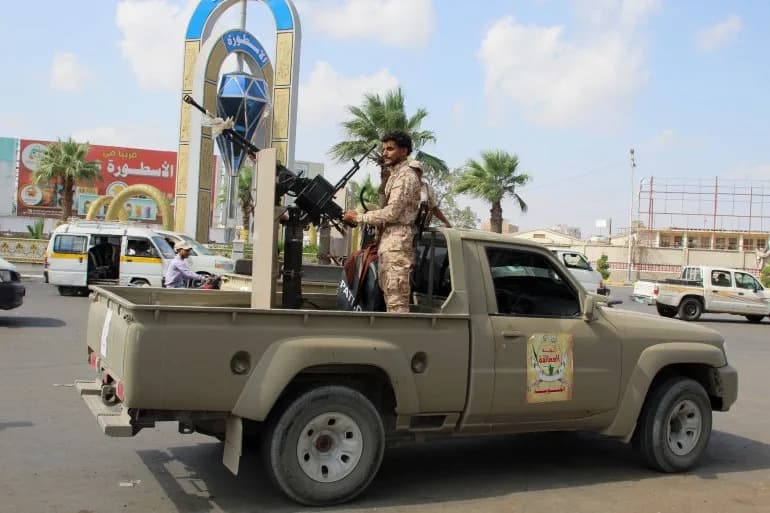
The Giants Forces, which were part of the STC, have switched sides throwing their weight behind the PLC [Fawaz Salman/Reuters]
The Saudi-backed Presidential Leadership Council (PLC) says government forces have retaken full control of southern Yemen — including the oil-rich provinces of Hadramout and al-Mahra — from the Southern Transitional Council (STC). The STC has been declared dissolved and its leader, Aidarous al-Zubaidi, has fled abroad, according to Saudi and PLC statements.
Latest Developments
In a televised address, PLC head Rashad al-Alimi announced the recapture of the two provinces and the creation of a Supreme Military Committee to organise and prepare state forces for the next phase of the conflict. He urged armed groups to surrender weapons and rejoin state institutions, warning the Houthi movement to negotiate or face possible military action.
“As the president of the country and the high commander of the armed forces, I want to assure you of the recapture of Hadramout and al-Mahra,” Rashad al-Alimi said.
Background
The STC, a separatist movement backed by the United Arab Emirates, has controlled significant parts of southern Yemen for years and briefly seized Hadramout and al-Mahra. Saudi Arabia intervened last month, citing threats to its national security after the STC captured the two border provinces. The STC’s advance followed local unrest, including a tribal seizure of the PetroMasila oil facility in Hadramout.
Political Implications
Saudi Arabia says it will host a conference of southern political factions to address demands on autonomy, resource distribution and local grievances that date back to the 1990 unification of north and south Yemen. Riyadh and PLC officials present the move as a step toward reconstituting state authority in the south and reducing fragmentation.
PLC actions include removing Al-Zubaidi from his PLC post, stripping his immunity and charging him with high treason and incitement to internal strife. Saudi statements say Al-Zubaidi travelled by boat to Somalia before flying to Abu Dhabi.
Regional and Security Consequences
The south’s reconsolidation under the PLC has strained ties between Saudi Arabia and the UAE. Riyadh ordered UAE forces to withdraw; Abu Dhabi pulled its counterterrorism units after conducting a review of its Yemen role. The STC’s loss of Emirati backing diminishes its military prospects but not necessarily its political influence.
Analysts warn the conflict could shift northward. The Houthis, who control Sanaa and large parts of northwest Yemen and are accused by Riyadh of Iran links, reject the PLC’s legitimacy. Observers say a renewed confrontation between PLC-aligned forces and the Houthis is a distinct risk if diplomacy stalls.
What To Watch
- Details and timing of the Saudi-hosted southern conference and whether it produces durable political agreements on autonomy or federalism.
- Responses from the Houthi leadership to the PLC’s demands and the formation of the Supreme Military Committee.
- How Saudi-UAE relations evolve after the episode and whether external support for local actors changes.
- Local stability in Hadramout and al-Mahra, especially around oil and port facilities that are strategically important to the region and to Riyadh.
While the PLC claims a restored central authority in the south, deep divisions, competing external influences and the Houthis’ control of the northwest mean national reunification remains uncertain and fragile.
Help us improve.