ALMA observations of Gomez’s Hamburger (GoHam) reveal layered gas and dust in a very large, nearly edge‑on protoplanetary disk and show the first signs of planet formation in its outer regions. The disk spans roughly 2,000 AU across and contains an unusually large dust mass, implying strong potential to grow multiple giant planets. Asymmetries, a possible vortex that may trap solids, a photoevaporative wind, and a dense clump called GoHam b — likely collapsing under gravity — all point to active processes that could produce distant giant planets.
ALMA Finds Planet-Forming Clues in Giant 'Gomez’s Hamburger' Disk
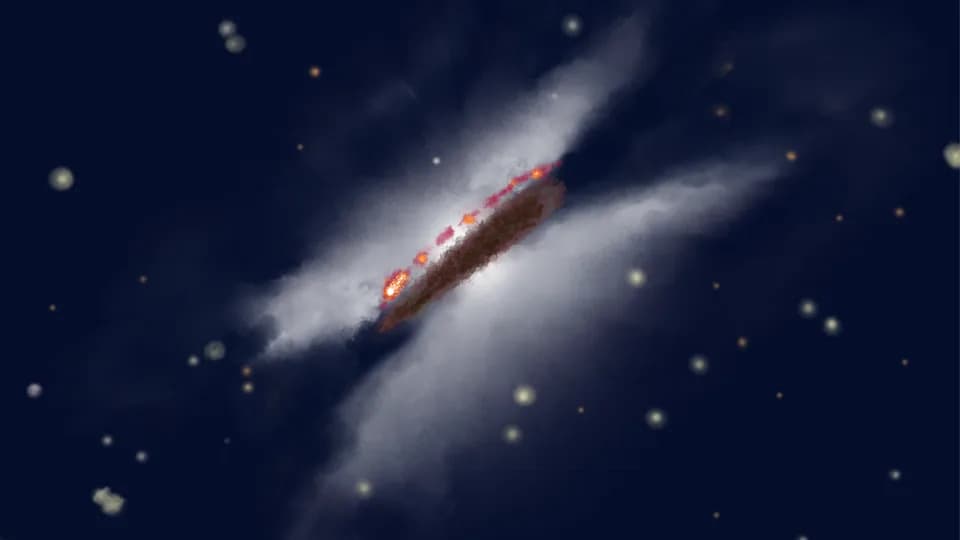
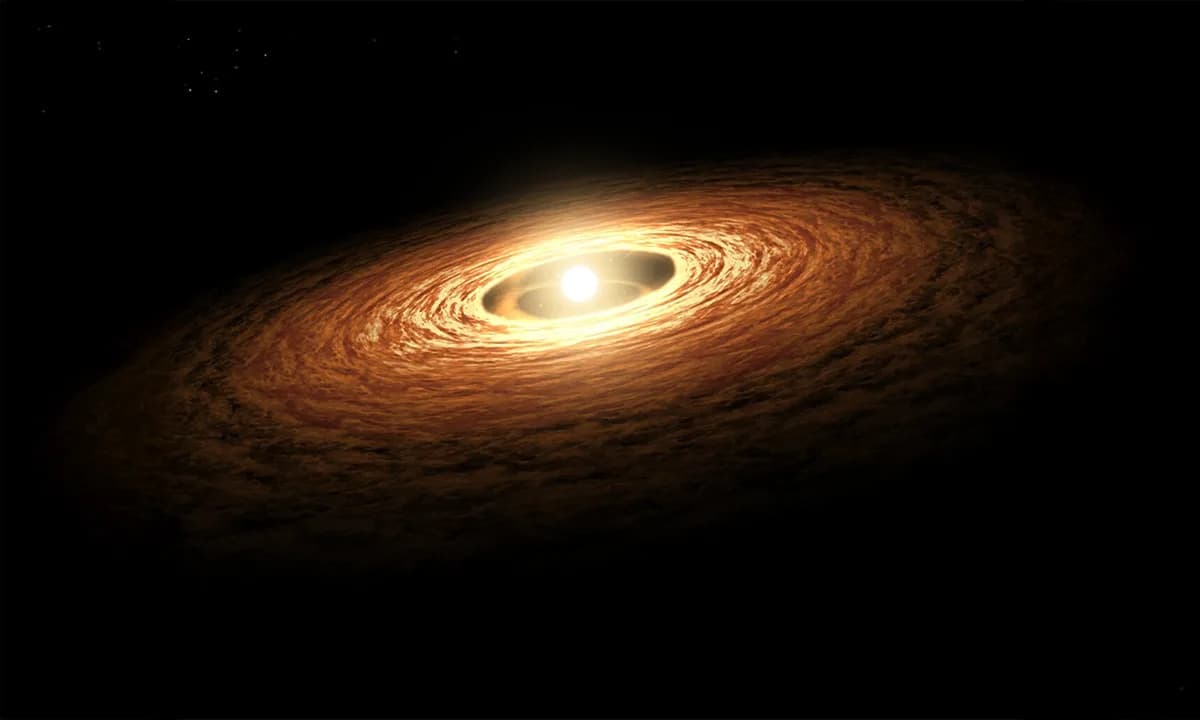
An illustration of Gomez’s Hamburger with its stacked layers of gas and dust swirling around a young star. | Credit: NSF/AUI/NSF NRAO/P.Vosteen
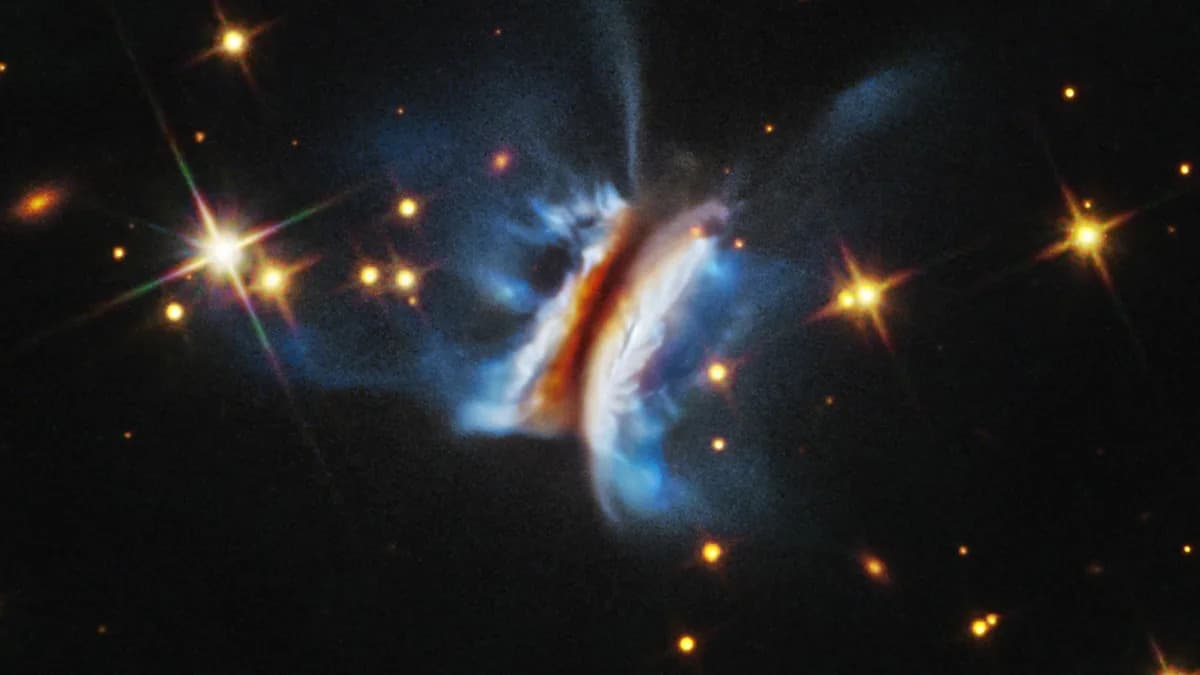
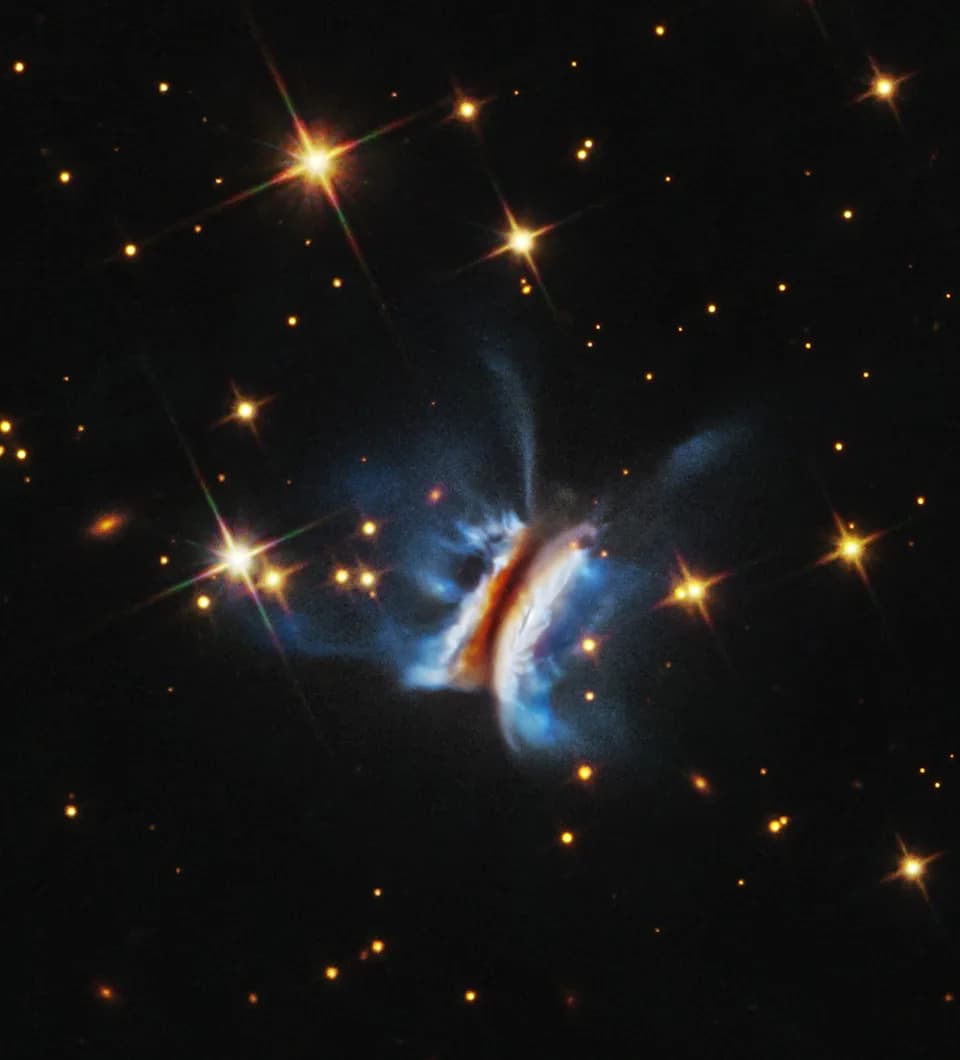
A team of astronomers using the Atacama Large Millimeter/submillimeter Array (ALMA) has found the first signs of planet formation in the dense gas layers of one of the largest known protoplanetary disks: Gomez’s Hamburger ("GoHam"). Nicknamed for its layered, edge‑on appearance, GoHam offers a rare, clear view of how gas and dust are arranged around a young star — and how giant planets might form far from their parent star.
ALMA Observations and Key Findings
ALMA, an array of 66 radio antennas in northern Chile, mapped the disk’s dust and multiple molecular species with high precision. The observations identified two isotopologues of carbon monoxide (CO) and several sulfur‑bearing molecules, including sulfur monoxide (SO). These tracers reveal a pronounced vertical stratification: lighter molecular species extend above the disk midplane, intermediate‑mass species occupy intermediate layers, and the heaviest molecules remain close to the midplane — matching theoretical expectations for a large, structured protoplanetary disk.
“GoHam gives us a rare and clear view of the vertical and radial structure of a very large, nearly edge‑on disk,” said Charles Law (University of Virginia). “The combination of extreme disk size, strong asymmetries, winds, and potential planet formation makes it the perfect laboratory for understanding how giant planets can form far from their star.”
Whereas larger solids and dust grains are concentrated near the midplane, the gaseous component is extremely extended: the disk spans a radial width of roughly 2,000 astronomical units (≈2,000 times the Earth–Sun distance) and reaches heights of several hundred astronomical units. That scale places GoHam among the largest protoplanetary disks observed to date.
GoHam also contains an unusually large dust mass — estimated to be many times greater than that of comparable young disks — providing a substantial reservoir from which giant planets could form. Combined with its size, this abundance suggests the disk could potentially grow multiple giant planets on wide orbits.
Asymmetries, Winds, and a Candidate Protoplanet
The disk is asymmetric: one side shows extended, brighter dust emission that may indicate a disturbance such as a vortex. Such vortices can trap solids and speed the growth of planetesimals — the building blocks of planets. On the northern side, the team detected signs of a photoevaporative wind, in which intense starlight drives gas away from the disk.
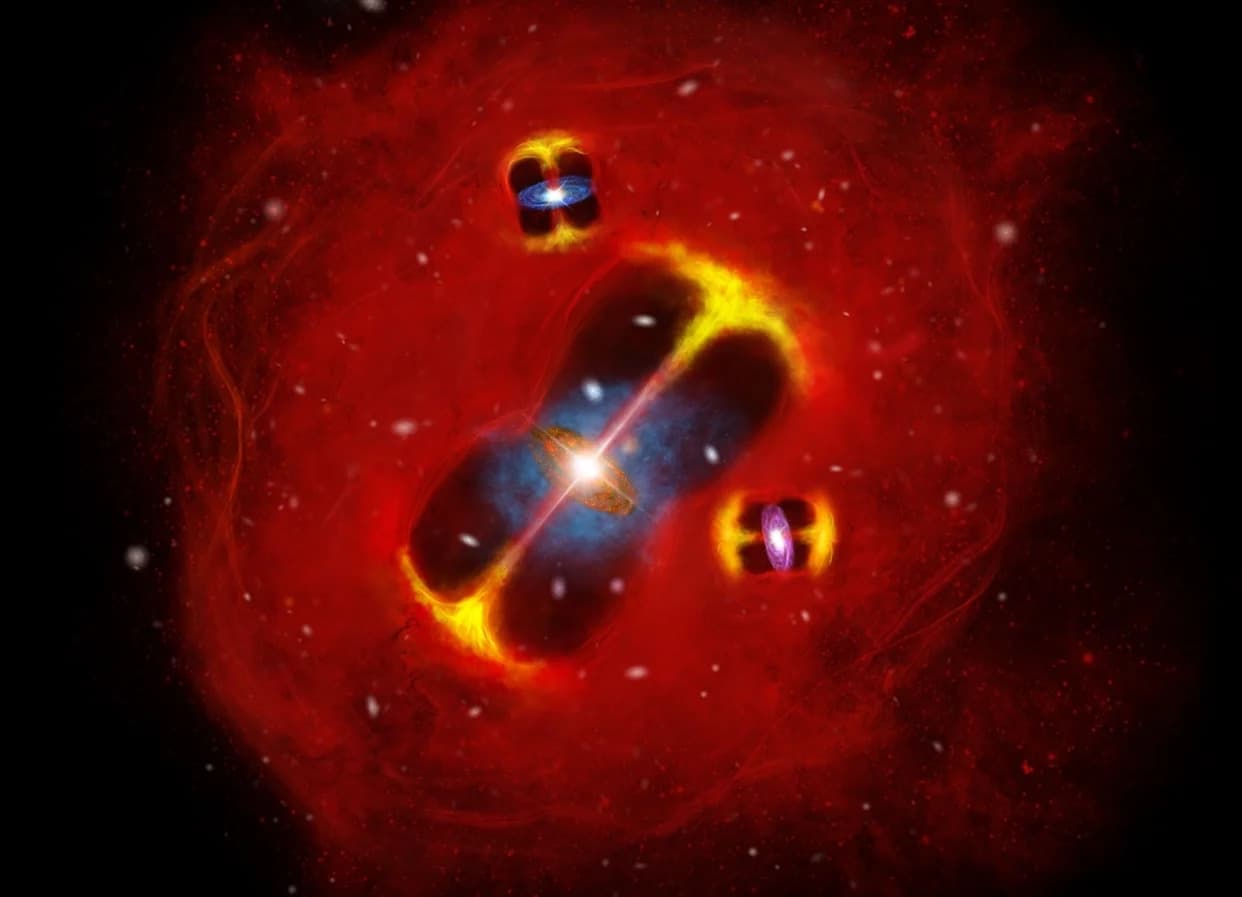
Beyond the dusty region, ALMA imaged an arc of sulfur monoxide seen only on one side of the disk. This arc lines up with a dense clump labeled "GoHam b," which the researchers interpret as a region of material possibly collapsing under its own gravity. If GoHam b continues to contract, it may represent the earliest stage of a giant planet forming at a wide orbital distance from its star.
Why GoHam Matters
Because GoHam is viewed nearly edge‑on, it provides an unusually direct view of both vertical and radial disk structure. That makes it an excellent natural laboratory for testing models of disk evolution, gas–dust interactions, and the formation of giant planets far from their parent stars.
Help us improve.