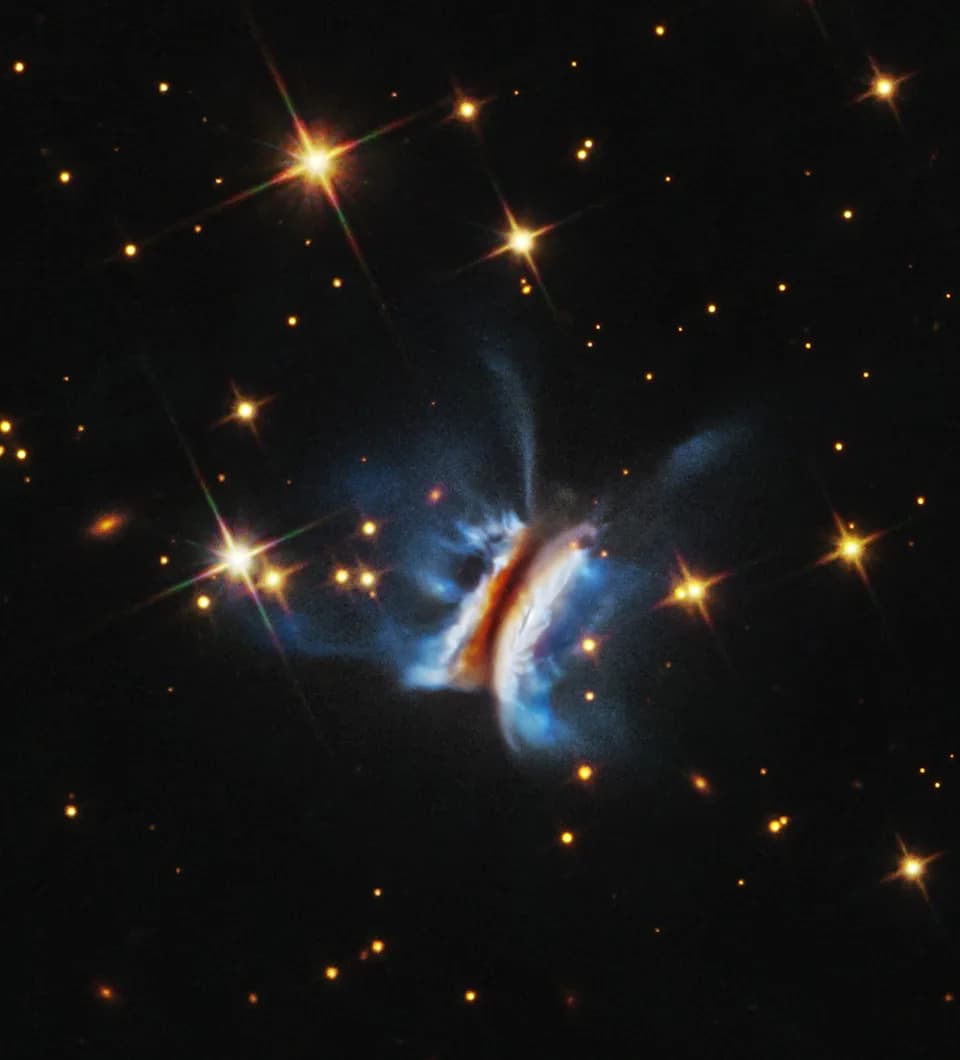
Hubble has imaged IRAS 23077+6707 — nicknamed "Dracula's Chivito" — revealing the largest protoplanetary disk yet seen and an unusually chaotic, asymmetric structure. The disk spans roughly 644 billion kilometres and lies about 1,000 light-years from Earth. Extended gas filaments feed one side while the other side is sharply truncated, and the disk contains enough mass to form an estimated 10–30 Jupiter-mass planets. These observations provide a rare laboratory to study planet formation in violent, non-standard conditions.
Hubble Captures Turbulent 'Dracula's Chivito' — The Largest Protoplanetary Disk Yet
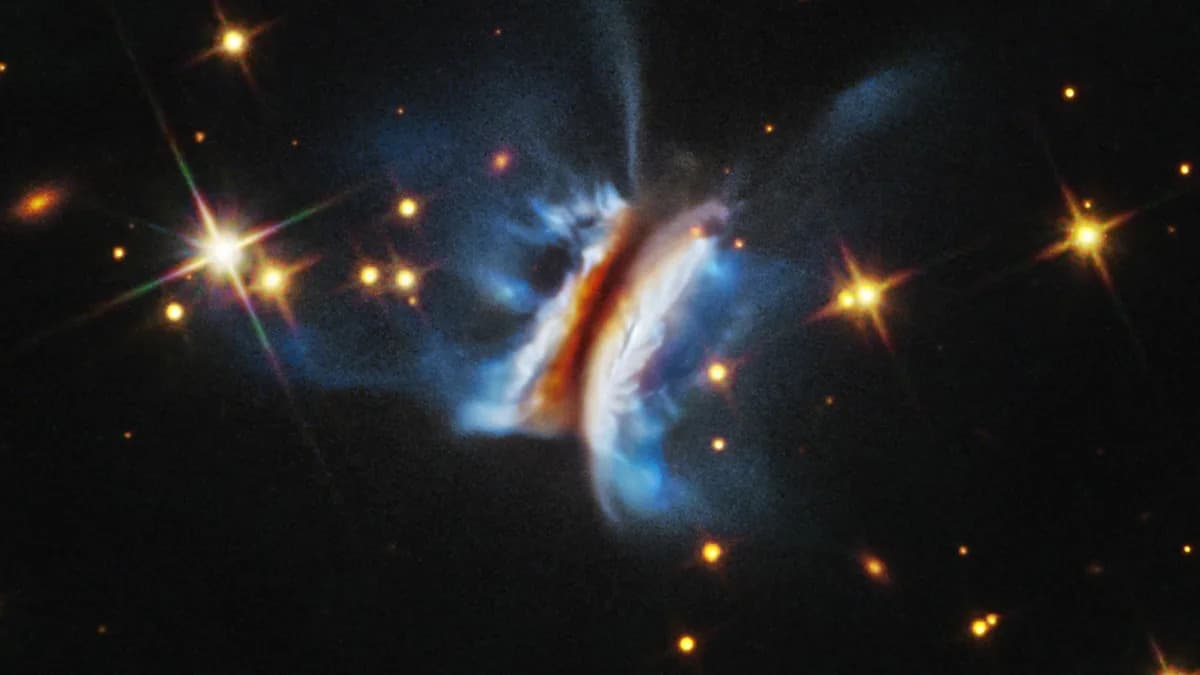
Draculas Chivito system
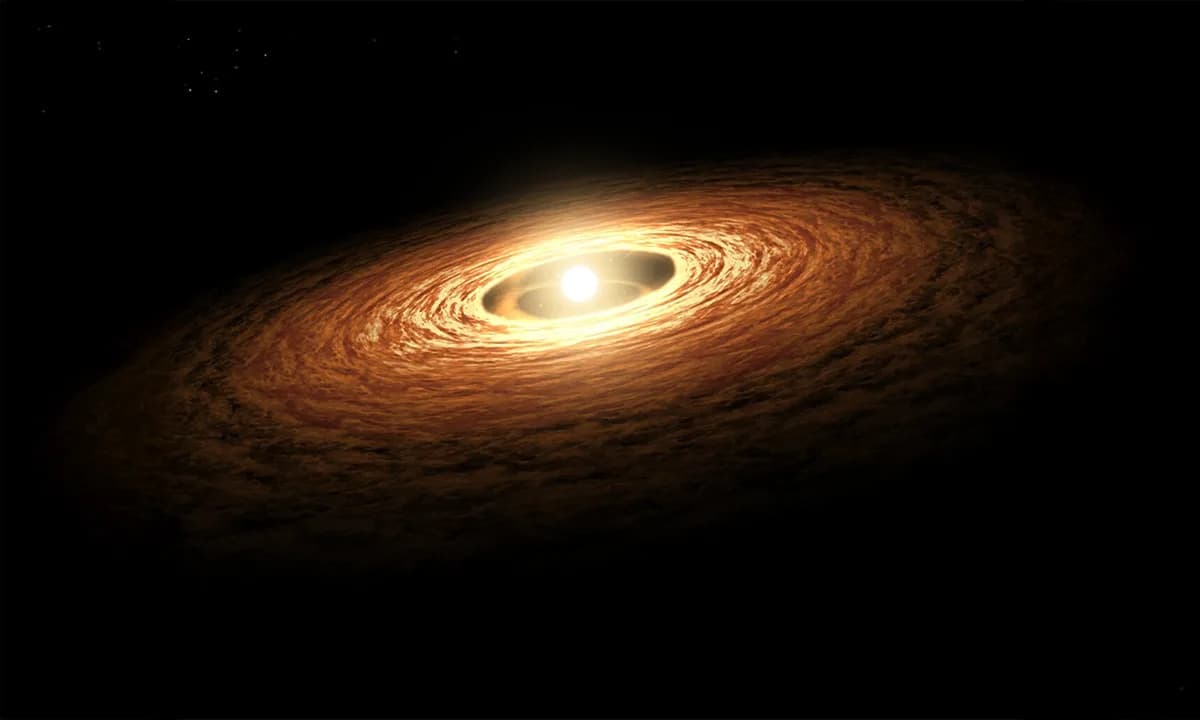
As young stars form, they are surrounded by rotating disks of dust and gas called protoplanetary disks, the birthplaces of planets. New visible-light observations from the Hubble Space Telescope reveal extraordinary detail in IRAS 23077+6707 — nicknamed "Dracula's Chivito" — showing a vast, chaotic disk unlike the tidy textbook examples.
An Unusually Large and Chaotic Disk
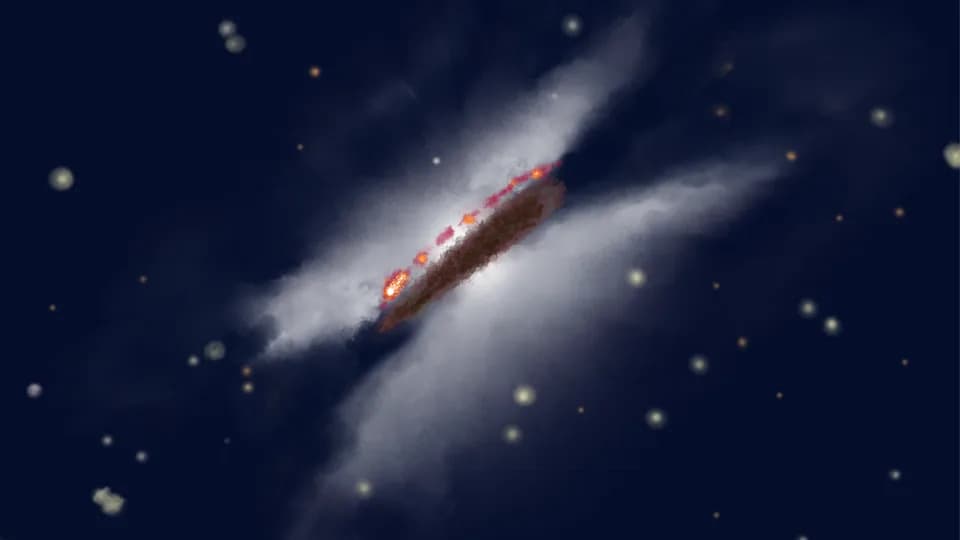
First identified last year, IRAS 23077+6707 lies roughly 1,000 light-years from Earth and spans nearly 644 billion kilometres (about 400 billion miles) — more than 100 times the distance between the Sun and Pluto. The disk is observed nearly edge-on, which highlights wispy upper layers and dramatic asymmetries in visible light.
Asymmetry, Filaments, and Possible Drivers
Hubble's images reveal extended, filamentary streams of gas feeding the disk from large distances on one side, while the opposite side exhibits a much sharper boundary and far less surrounding material. Scientists suggest several possible causes for this lop-sided structure: interactions with surrounding interstellar gas, the action of stellar winds from the central star, or motion of the system through its environment.

Subscribe to ScienceAlert's free fact-checked newsletter
"Both Hubble and NASA's James Webb Space Telescope have glimpsed similar structures in other disks, but IRAS 23077+6707 provides us with an exceptional perspective — allowing us to trace its substructures in visible light at an unprecedented level of detail," says astrophysicist Kristina Monsch of the Center for Astrophysics.
The team emphasizes that further observations and modelling are required to determine which mechanisms dominate and how these processes influence planet formation in such an extreme environment.
What This Means For Planet Formation
Preliminary mass estimates indicate the disk contains enough material to form roughly 10–30 Jupiter-mass planets, making IRAS 23077+6707 a compelling laboratory for studying planet formation in turbulent, non-standard conditions. Although planet formation takes millions of years, the system's dynamic features may allow astronomers to capture useful short-term snapshots of evolution and interactions as the disk settles.
"Hubble has given us a front-row seat to the chaotic processes that are shaping disks as they build new planets — processes that we don't yet fully understand but can now study in a whole new way," says astrophysicist Joshua Bennett Lovell of the CfA.
The new results, produced by a team including researchers from the US and UK, are reported in The Astrophysical Journal. Continued monitoring with Hubble, complementary observations from facilities like JWST, and theoretical work will help clarify how such extreme disks form and evolve.
Help us improve.