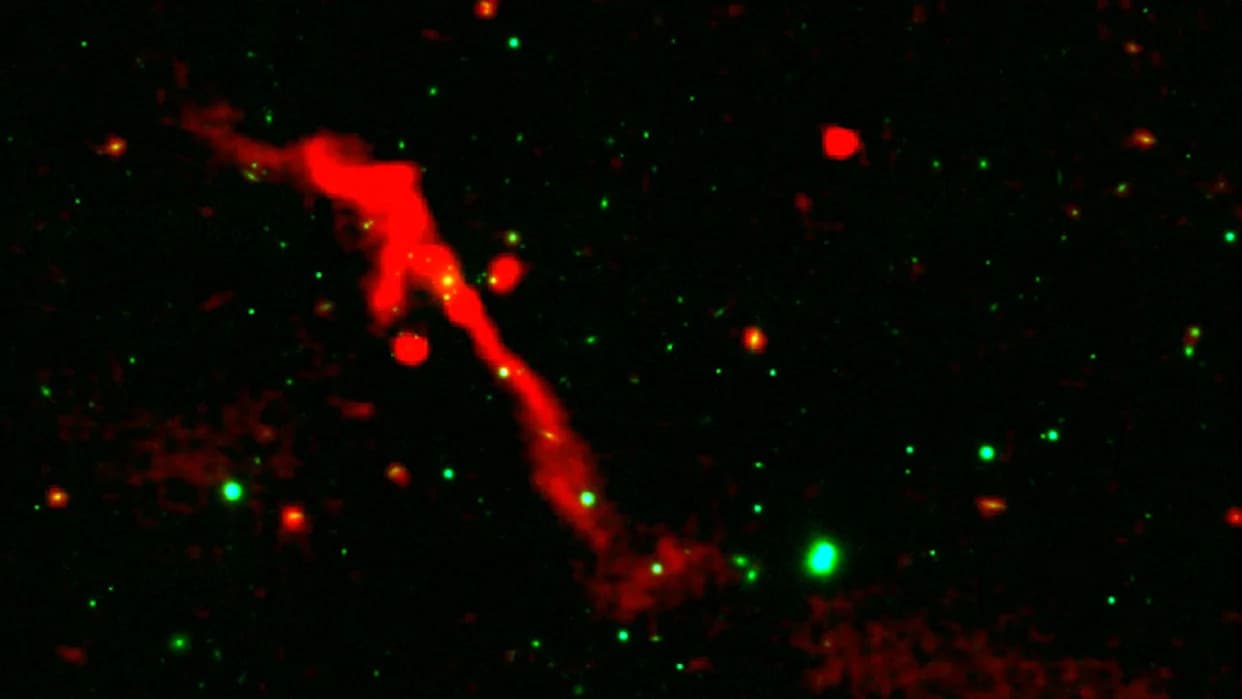
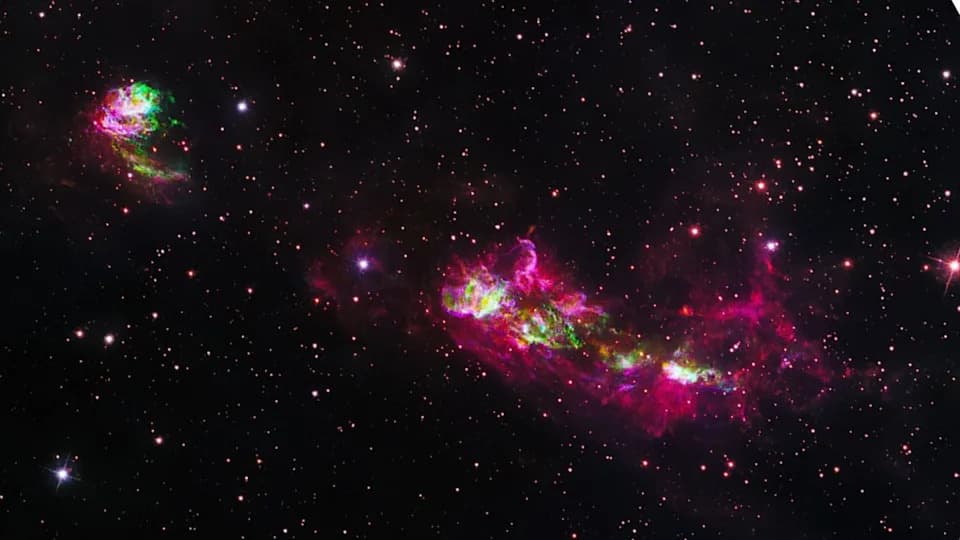
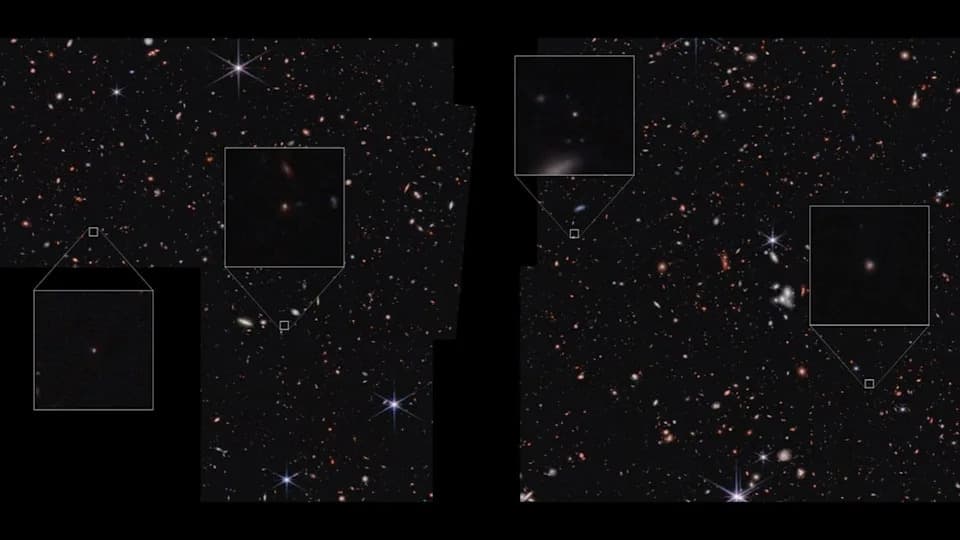
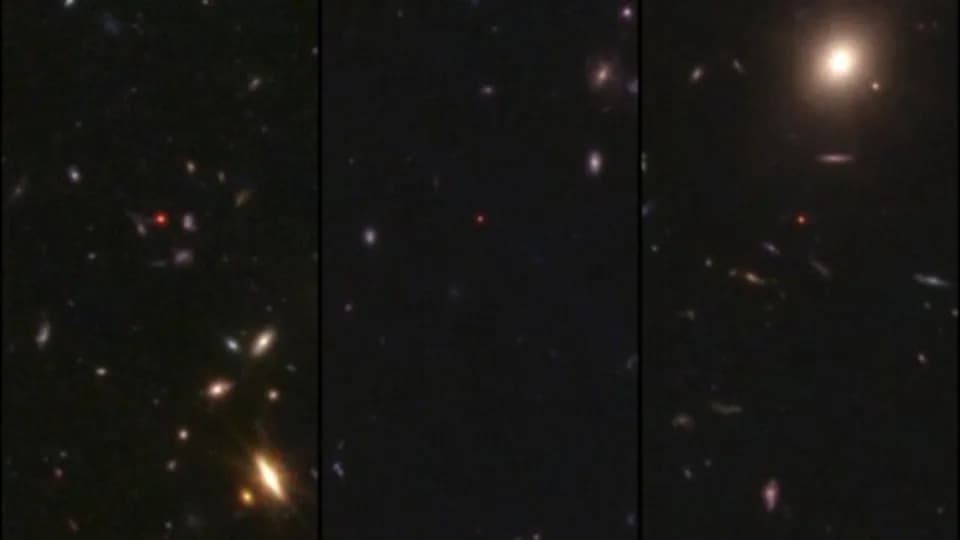
A survey using the GMRT and the TGSS has uncovered 53 Giant Radio Quasars with jets reaching up to 7.2 million light‑years, about 50 times the Milky Way's diameter. These objects are part of 369 radio quasars identified in the survey, and roughly 14% are located in galaxy groups, clusters, or along cosmic filaments. Low‑frequency observations were crucial to detecting the aged radio lobes, and the team reports that environmental density appears to shape jet growth and asymmetry. The study was published Nov. 13 in The Astrophysical Journal Supplement Series.
Astronomers Discover 53 Giant Radio Quasars — Jets Stretch 7.2 Million Light‑Years

A team of astronomers has identified 53 new Giant Radio Quasars (GRQs) whose relativistic jets extend up to 7.2 million light‑years — roughly 50 times the diameter of the Milky Way. These objects are part of a larger catalogue of 369 radio quasars found in the TIFR GMRT Sky Survey (TGSS) using data from the Giant Metrewave Radio Telescope (GMRT), an array of 30 dishes near Pune, India.
"The sizes of these radio jets are not comparable to our solar system or even our galaxy. We are talking about 20 to 50 Milky Way diameters placed side by side," said Souvik Manik of Midnapore City College.
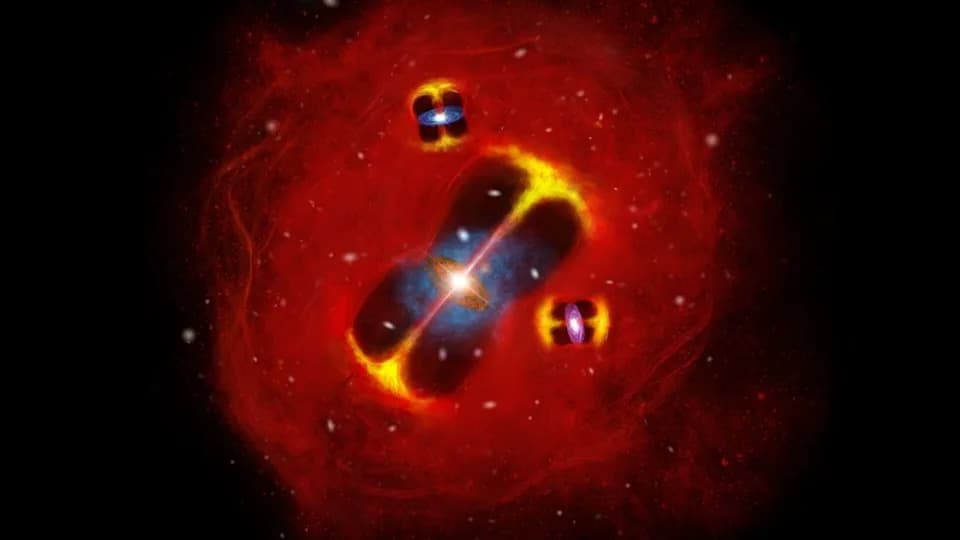
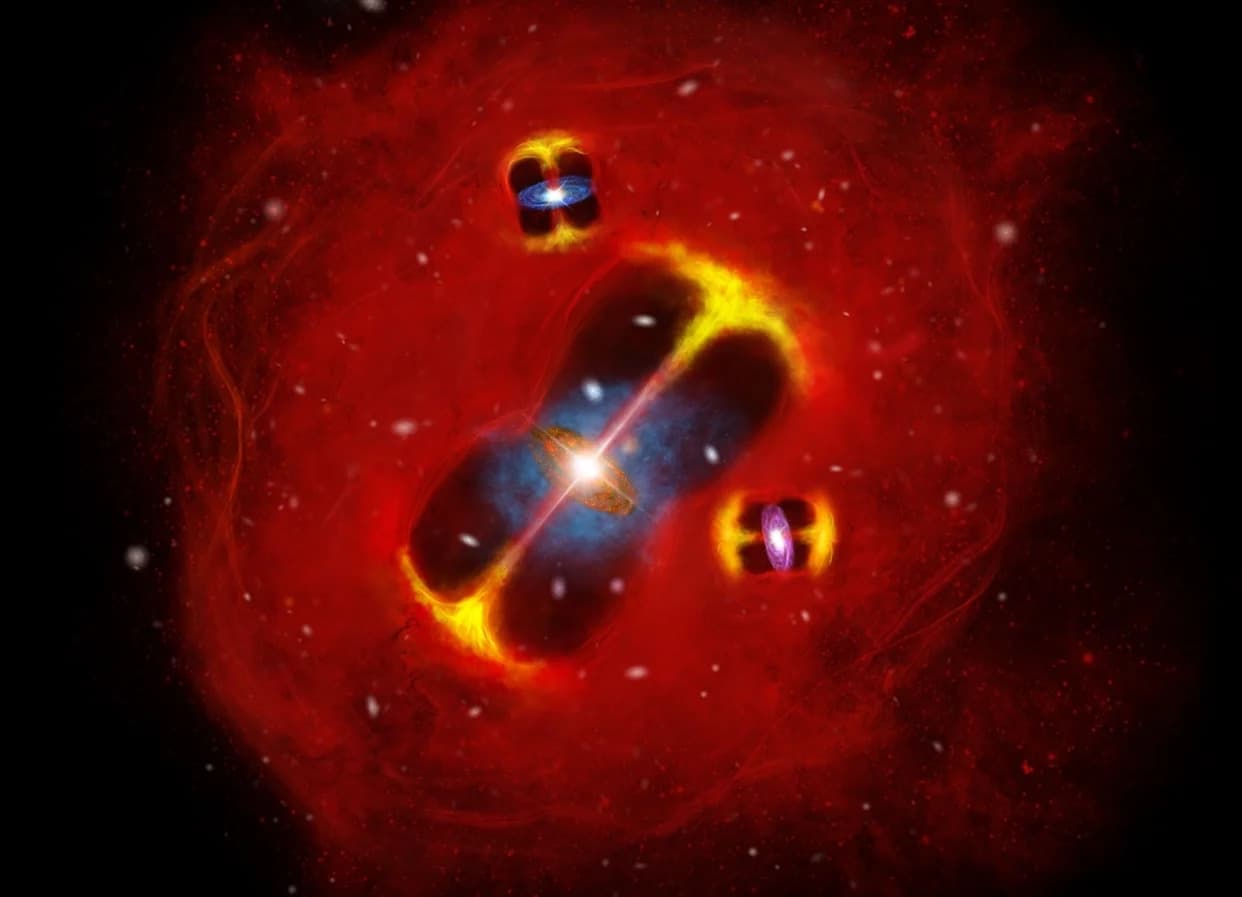
Quasars are powered by supermassive black holes at the centers of galaxies. When abundant gas and dust feed the black hole, an accretion disk forms and releases intense radiation as material spirals inward. Strong magnetic fields can channel some ionized gas into narrow, oppositely directed jets that travel at near light speed. Over millions of years these jets inflate into extended radio-emitting lobes that can reach far beyond their host galaxies.
The GRQs in this study stand out because of their extreme sizes and the clarity with which their radio lobes can be traced at low frequencies. Low-frequency radio surveys like the TGSS are particularly effective at revealing aged synchrotron plasma in extended lobes, which often emits more strongly at lower radio frequencies and can otherwise fade below detection limits.
"Their enormous radio jets make these quasars valuable for understanding both the late stages of their evolution and the intergalactic medium in which they expand," said team leader Sabyasachi Pal of Midnapore City College. "However, finding such giants is not easy."
The researchers report that roughly 14% of the newly identified GRQs lie in galaxy groups, clusters, or along cosmic filaments. This environmental association suggests surrounding gas and dark matter influence jet propagation: jets in denser regions may be slowed, bent, or disrupted, while those in sparser regions can grow more freely.
Many of the observed GRQs also show pronounced jet asymmetry — unequal lengths or brightness between the two jets. Team members Netai Bhukta and Sushanta K. Mondal note that such asymmetry often indicates jets interacting with uneven intergalactic gas, with one side encountering denser material that slows or dims it relative to the other side.
Intriguingly, the team finds that more distant GRQs tend to display greater asymmetry than nearby examples. Because observing more distant objects looks further back in time, this trend may reflect the denser, more chaotic conditions of the early universe that affected jet growth and stability.
The research led by astronomers at Midnapore City College and Sidho Kanho Birsha University was published on Nov. 13 in The Astrophysical Journal Supplement Series. The discovery highlights the power of wide-area, low-frequency radio surveys for revealing the largest active structures in the universe and offers new probes of how jets interact with the intergalactic medium.
Help us improve.