
The Big Bang predicts ~5% of the universe is ordinary atoms, but much of it was missing from galactic inventories. A June 2025 study using 69 fast radio bursts observed with 110 radio dishes finds ~76% of baryons in the intergalactic medium, 15% in galaxy halos and 9% in stars/cold gas. This result completes the census of ordinary matter and confirms a key Big Bang prediction, while dark matter and dark energy remain unsolved.
Most Ordinary Matter Hides Between Galaxies — New Radio Study Completes the Census

An illustration of concentrated dark matter at the heart of a spiral galaxy . | Credit: Robert Lea (created with Canva)
When you scan the sky you see billions of galaxies, each with stars, planets and usually a central black hole. Those spectacular objects feel like they should contain most of the universe's matter — but cosmology and observations tell a different story.
Where the Ordinary Matter Is
The Big Bang predicts that roughly 5% of the universe's total energy density is ordinary (baryonic) matter: atoms made of protons, neutrons and electrons. For decades astronomers could only account for a fraction of those atoms inside stars and galaxies, leaving a long-standing “missing baryons” problem.
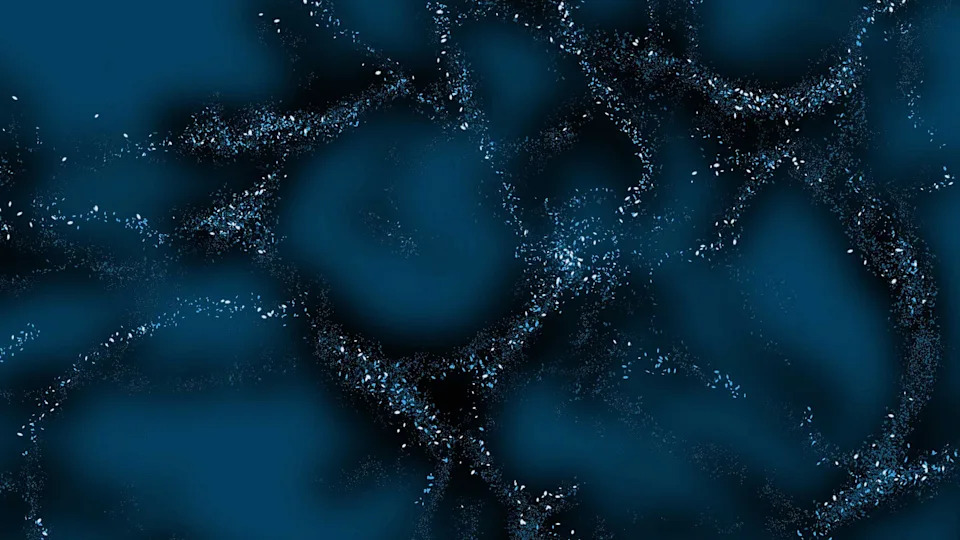
The cosmic web is an underpinning structure to our universe. | Credit: RubinObs/NOIRLab/SLAC/NSF/DOE/AURA/J. Pinto, CC BY 4.0
Recent work using fast radio bursts (FRBs) has now completed the census. In a June 2025 study, researchers analyzed 69 FRBs observed with an array of 110 radio dishes in California and found that about 76% of ordinary matter resides in the intergalactic medium (IGM), 15% in galaxy halos, and only 9% inside stars and cold gas within galaxies.
How Fast Radio Bursts Reveal Hidden Gas
FRBs are millisecond-long flashes of radio waves originating in distant galaxies. Their pulses become ``dispersed'' as they travel: free electrons in ionized gas slow longer wavelengths more than shorter ones, spreading the signal in time. By measuring that dispersion — the dispersion measure — astronomers can estimate how much ionized gas the burst passed through on its way to Earth.
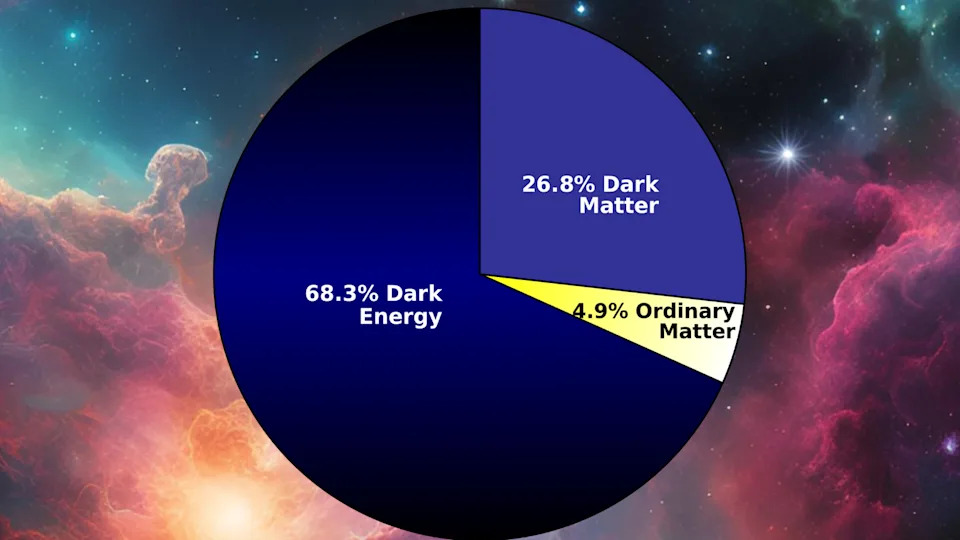
A pie chart showing the universe's matter-energy budget | Credit: Robert Lea (created with Canva)
Although the exact emission mechanism of FRBs is still under study, evidence from early 2025 points to magnetized regions near ultra-compact neutron stars called magnetars as a likely source. Regardless of the source details, FRBs are powerful probes of the otherwise faint, hot gas that fills cosmic space.
The Intergalactic Medium
The IGM is extremely diffuse — about one atom per cubic meter on average — and very hot (millions of degrees). Such gas primarily emits at X-ray wavelengths, which are challenging to detect with current X-ray telescopes. But because the observable universe spans roughly a 92-billion-light-year diameter, even this tenuous medium makes up the majority of ordinary atoms.
Why This Matters
Recovering the expected amount of ordinary matter provides a strong empirical confirmation of Big Bang predictions for baryon abundance. It also opens a new era for cosmology: as FRB detection rates rise (future arrays may find ~10,000 per year), these events will enable three-dimensional mapping of the cosmic web and more precise studies of how gas feeds galaxies and evolves over time.
What remains unanswered: Most of the universe's mass–energy is still dark matter and dark energy. Dark matter appears to outweigh ordinary matter by more than a factor of five, and its particle nature remains unknown. Meanwhile, dark energy drives cosmic acceleration and is also poorly understood.
Bottom line: Astronomers have now located most of the universe's ordinary atoms — not in stars, but spread through the hot, diffuse web between galaxies — while the deeper mysteries of dark matter and dark energy remain.


