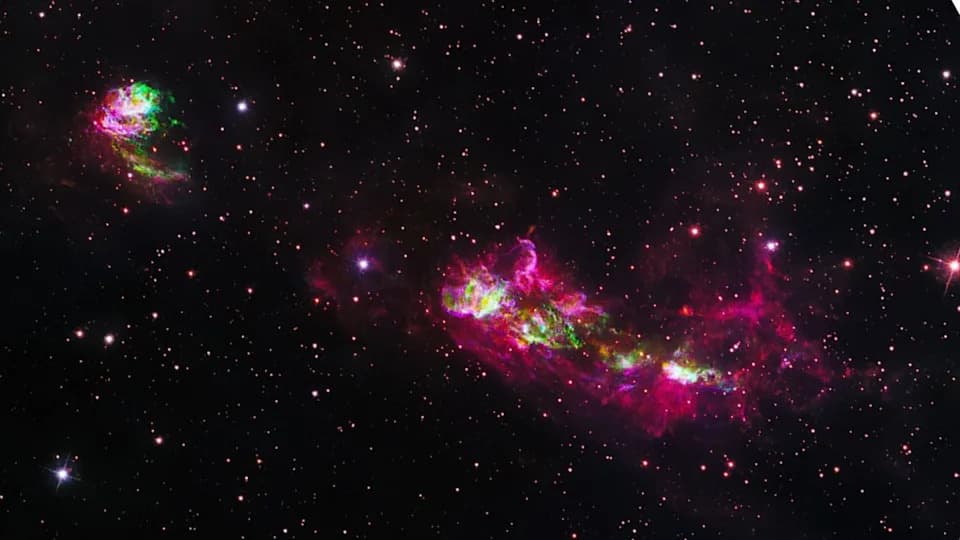
The Lion Nebula (Sh2-132), about 10,000 light‑years away in Cepheus, was photographed by Ronald Brecher from Ontario under a near‑full moon. He amassed just over 35 hours of exposure with a Sky‑Watcher Esprit 70 EDX and narrowband filters to capture the glowing gas sculpted by two ~20‑solar‑mass stars. From the same data he produced a Hubble‑palette rendition and a richer Foraxx palette, demonstrating how processing choices shape deep‑sky imagery.
Astrophotographer Captures 'Rampaging Lion' Nebula in Stunning Deep‑Sky Portrait

Astrophotographer Ronald Brecher captured a striking view of the nebula Sh2-132—commonly called the Lion Nebula—during an October session from his home in Ontario, Canada. Shot under a near‑full moon, the final images give the interstellar cloud the unmistakable silhouette of a rampaging lion as its glowing gases sweep across the frame.
The Lion Nebula sits roughly 10,000 light‑years away in the constellation Cepheus and is visible high above the northern horizon in the hours after sunset through November. Within the cloud lie two massive stars, each about 20 times the mass of the Sun; their intense radiation has ionized and sculpted the surrounding dust and gas, producing the bright, filamentary structures seen in Brecher’s photographs.
Brecher recorded just over 35 hours of exposure using a Sky‑Watcher Esprit 70 EDX refractor paired with an astronomy camera and a suite of narrowband filters chosen to isolate specific wavelengths of light. Careful stacking and post‑processing of the data revealed faint nebular details despite the challenge of a near‑full moon.
Two Artistic Interpretations from the Same Data
From the same dataset Brecher produced two distinct renderings. One uses the Hubble palette, which maps selected narrowband wavelengths to colors in a way that echoes many space‑telescope images. The other employs the Foraxx palette, offering a richer, more saturated interpretation that emphasizes contrast and color depth. The pair highlights how processing choices—palette selection, color mapping and contrast adjustments—can shape our perception of the same astronomical data.
Brecher’s images showcase both the technical dedication (more than 35 hours of exposure and careful filtering) and the artistic choices behind modern deep‑sky astrophotography. They are a reminder that astrophotography sits at the intersection of science and visual storytelling: identical light can produce very different impressions depending on how it’s presented.
Photographer: Ronald Brecher
Help us improve.