Astrophotographer Joel Martin captured a detailed view of the Orion Nebula (M42) from Del Mar, California, revealing how young stars sculpt its gas and dust. He imaged the nebula for three hours in December 2025 with a 6-inch Newtonian reflector and narrow-band filters, then processed the data in PixInsight (OIII → green/blue; SII + H-alpha → red). The nebula’s cavity has been partially carved by the four-star Trapezium, and Hubble has revealed protoplanetary disks there similar to our early solar system. January is an excellent time to spot M42 near Orion’s Belt and Orion’s Sword.
Stunning Orion Nebula Photo From Del Mar Will Make You Grab A Telescope This Week

An image of the Orion Nebula captured by Joel Martin in December 2025. | Credit: Joel Martin
Astrophotographer Joel Martin produced a striking image of the Orion Nebula (M42), the stellar nursery about 1,500 light-years from Earth, while it hung over the winter sky above Del Mar, California. His photo reveals intricate structure and vivid detail in the nebula’s gas and dust, sculpted by powerful radiation from newly formed stars.
Martin’s image emphasizes the nebula’s turbulent, radiation-carved appearance, showing how cosmic gas and dust are continually reshaped by the thousands of energetic young stars forming within the region. The nebula’s central cavity has been partly excavated by ultraviolet radiation from a compact group of four massive young stars collectively known as the Trapezium, named for their roughly geometric arrangement.
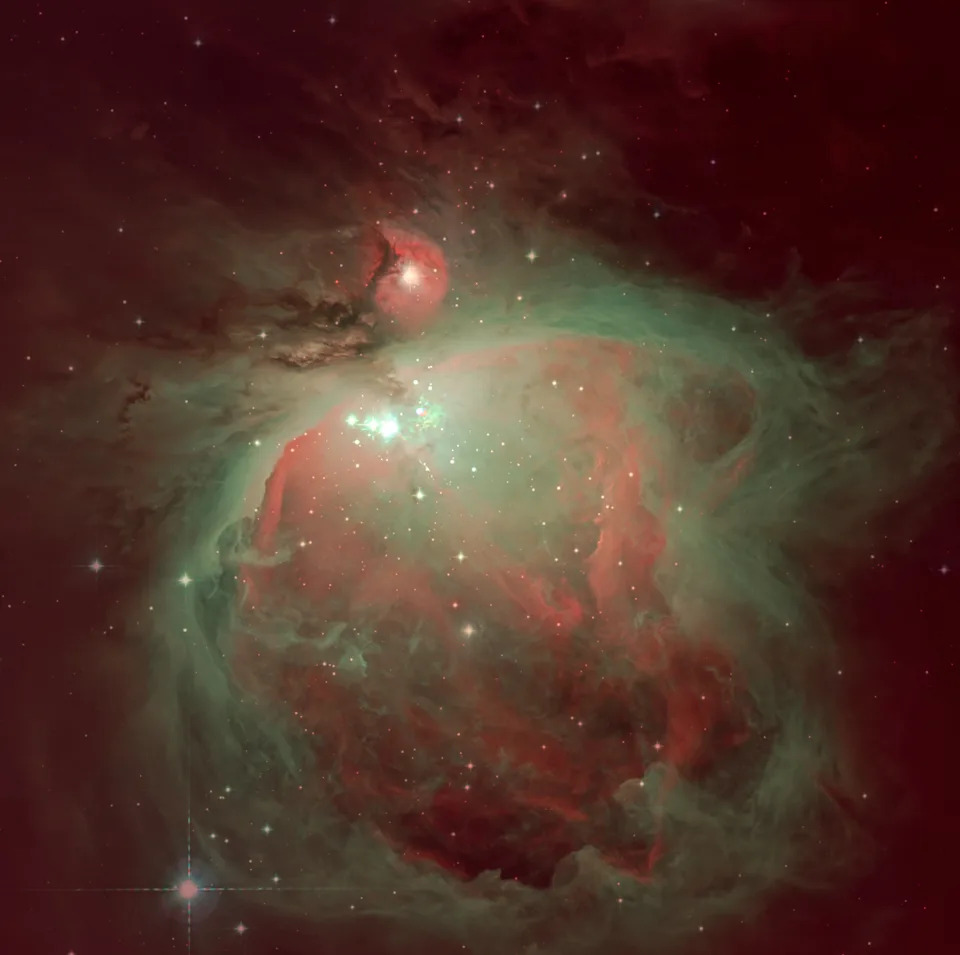
An image of the Great Orion Nebula captured by Joel Martin in December 2025. | Credit: Joel Martin
Because the Orion Nebula lies relatively nearby, astronomers have long used it to study the environments where sun-like stars form. Powerful observatories, including the Hubble Space Telescope, have imaged protoplanetary disks around newborn stars in M42 — disks similar to the one that gave rise to our own solar system some 4.5 billion years ago.
How the Photo Was Taken and Processed
Martin recorded the nebula’s light over a three-hour session in December 2025 using a 6-inch (157 mm) Newtonian reflector and a set of narrow-band filters that isolate specific emission wavelengths. He described racing to capture the skies between storms: “There has been a staggering amount of rain in Southern California and I had to grab the few hours of clear skies when I could, so I was battling light pollution, clouds, dew and the moon,” he told Space.com.
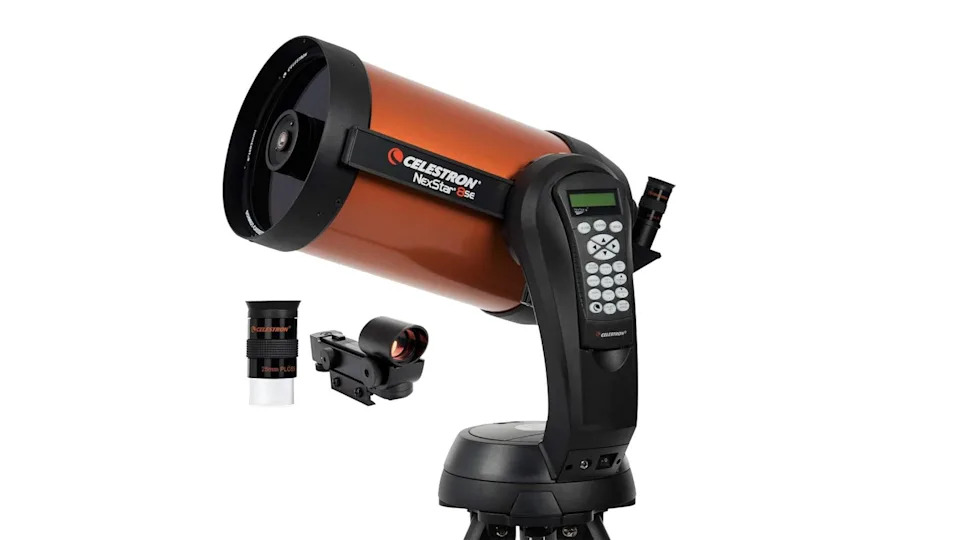
Celestron NexStar 8SE
During post-processing, each filter’s data was mapped to a color channel in the astrophotography software PixInsight. To achieve a natural appearance, Martin used the average OIII signal for the green and blue channels and combined SII and H-alpha for the red channel, producing a balanced, true-to-sensor rendering of the nebula.
When And Where To See The Orion Nebula
January is an ideal month to observe the Great Orion Nebula, because the constellation rises high in the winter sky. After sunset in mid-January, scan the southeastern horizon to find Orion’s familiar outline. Start with the three stars of Orion’s Belt, then look roughly 5 degrees (about the width of three middle fingers held at arm’s length) down and to the lower right of the belt’s lowest star, Alnitak. The fuzzy glow surrounding the middle star of that small line of three — known as Orion’s Sword — is the Orion Nebula, visible to the naked eye on clear, dark nights.
Want To Try It Yourself?
If Martin’s image inspires you to observe or photograph M42, even modest backyard telescopes and entry-level cameras can show the nebula’s beauty. For guidance, see expert roundups of recommended telescopes, cameras and lenses for astrophotography, and follow basic tips for dealing with light pollution, dew and moonlight.
Editor’s Note: If you’d like to share your deep-space astrophotography with Space.com’s readers, please send your photo(s) and comments along with your name and location to spacephotos@space.com.
Help us improve.