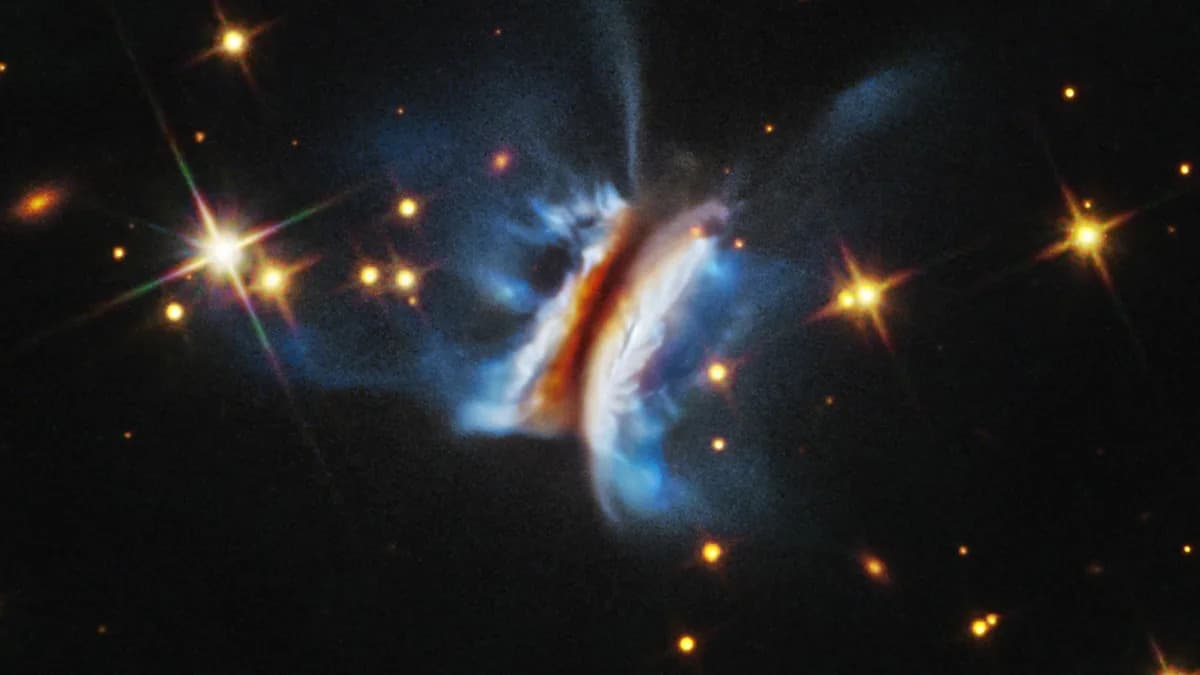
The Hubble Space Telescope imaged IRAS 23077+6707 — nicknamed "Dracula's Chivito" — a record-setting protoplanetary disk about 978 light-years away in Cepheus. Spanning nearly 400 billion miles (640 billion km), the disk is more than 100 times wider than our inner solar system and was first identified in 2016. Hubble's detailed view reveals strong asymmetry and chaotic, vertically extended filaments on one side, suggesting dynamic processes driven by a hot massive star or a binary at the center.
Hubble Reveals 'Dracula's Chivito' — The Largest Planet-Forming Disk Ever Seen
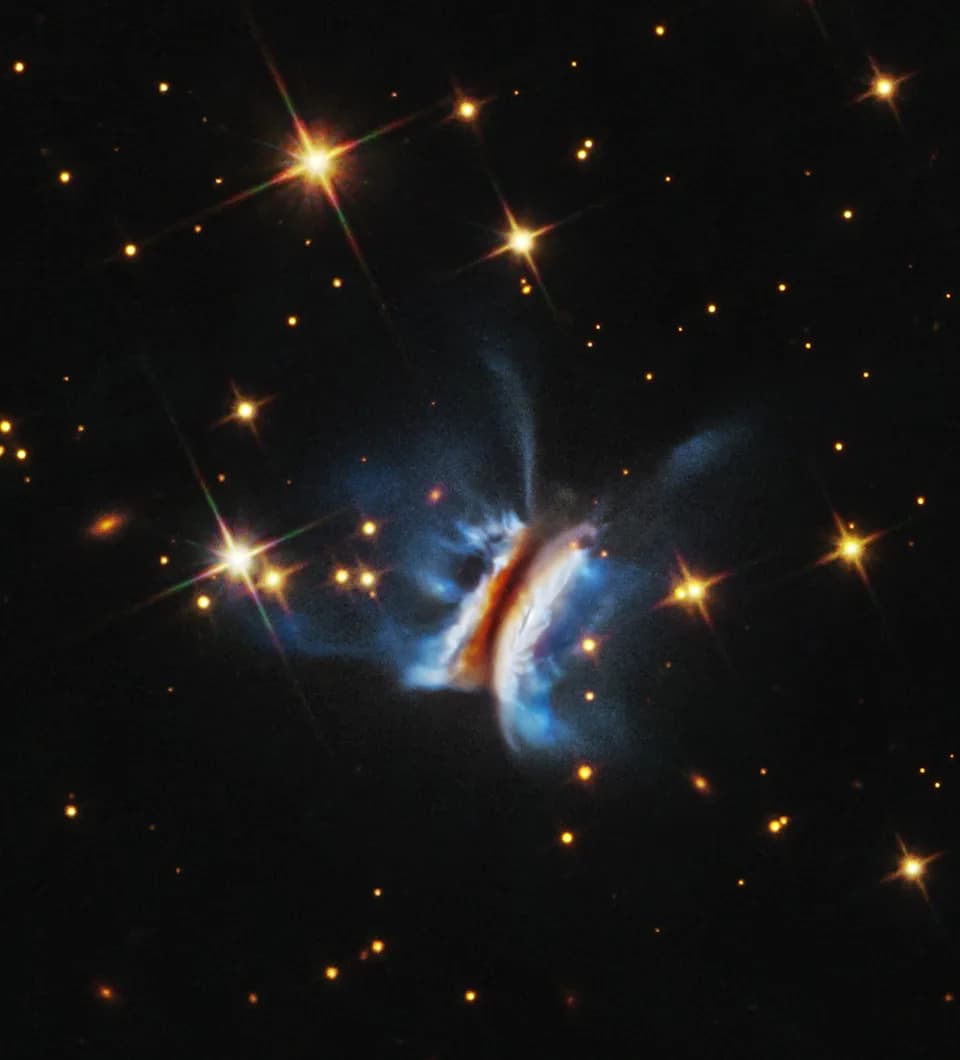
This Hubble Space Telescope image shows the largest planet-forming disk ever observed around a young star. | Credit: NASA, ESA, STScI, Kristina Monsch (CfA); Image Processing: Joseph DePasquale (STScI)
The Hubble Space Telescope has captured a striking new image of the biggest and most unusual protoplanetary disk yet observed around a single star. Cataloged as IRAS 23077+6707 and nicknamed "Dracula's Chivito," the system resembles a layered cosmic sandwich of gas and dust and lies about 978 light-years away in the constellation Cepheus.
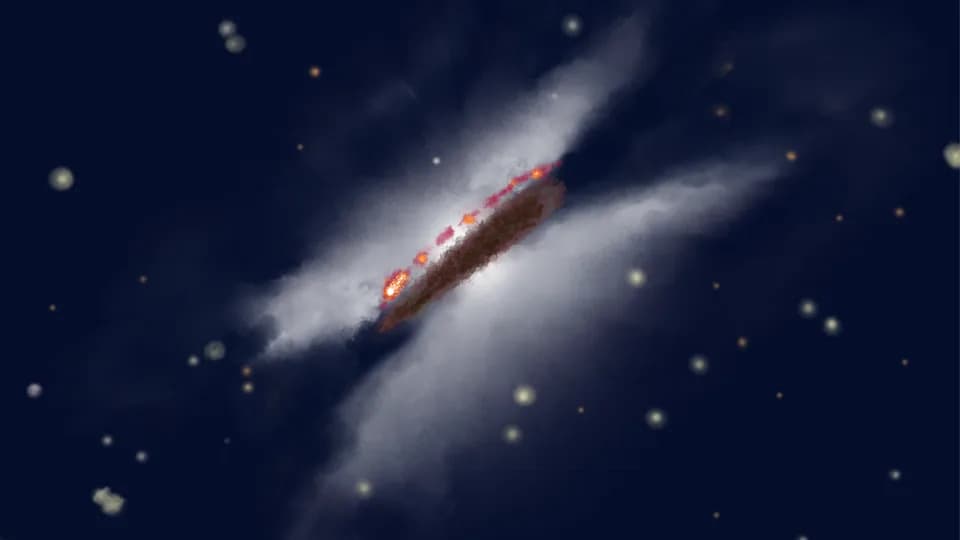
A giant planet nursery: Protoplanetary disks are the birthplaces of planets — both rocky worlds like Earth and gas giants like Jupiter. According to a paper published in The Astrophysical Journal, this disk spans nearly 400 billion miles (approximately 640 billion kilometers), more than 100 times the diameter of our inner solar system where the known planets orbit. First identified in 2016, the object is tilted nearly edge-on from Earth and has now been confirmed as an enormous planet-forming structure.
Striking asymmetry and chaotic filaments: Observers report unexpected complexity. One side of the disk displays bright, vertically stretched filaments of gas extending well above and below the disk plane, while the opposite side terminates in a much sharper edge. This pronounced asymmetry and the presence of bright wisps suggest highly dynamic processes shaping the disk as it evolves.
Central star(s): The team believes a hot, massive star — or possibly a close pair of stars — lies at the system's center, providing the energy that illuminates and sculpts the surrounding material. Despite the disk’s vast size, these localized energetic sources and interactions appear to drive the chaotic features Hubble revealed.
"The level of detail we're seeing is rare in protoplanetary disk imaging. These new Hubble images show that planet nurseries can be much more active and chaotic than we expected," said Kristina Monsch of the Harvard & Smithsonian Center for Astrophysics, lead author of the study. — Joshua Bennett Lovell, co-investigator, added that Hubble "has given us a front-row seat to the chaotic processes that are shaping disks as they build new planets — processes that we don't yet fully understand but can now study in a whole new way."
The image and paper open fresh opportunities to study how massive disks evolve and how asymmetries and filaments influence planet formation. For more remarkable astronomy images, see the Space Photo of the Week archives.
Help us improve.