Hubble imaged the dwarf galaxy Markarian 178 in Ursa Major, revealing bright blue star clusters and a distinct red-tinged region. The red glow traces massive, short-lived Wolf–Rayet stars whose strong emission lines indicate very recent star formation. At about 13 million light-years away, Mrk 178 serves as a local analogue to early-universe starburst galaxies and offers clues to how galaxies assemble mass and spread heavy elements.
Hubble Reveals Markarian 178 — A Nearby Dwarf Ablaze With Massive Wolf–Rayet Stars
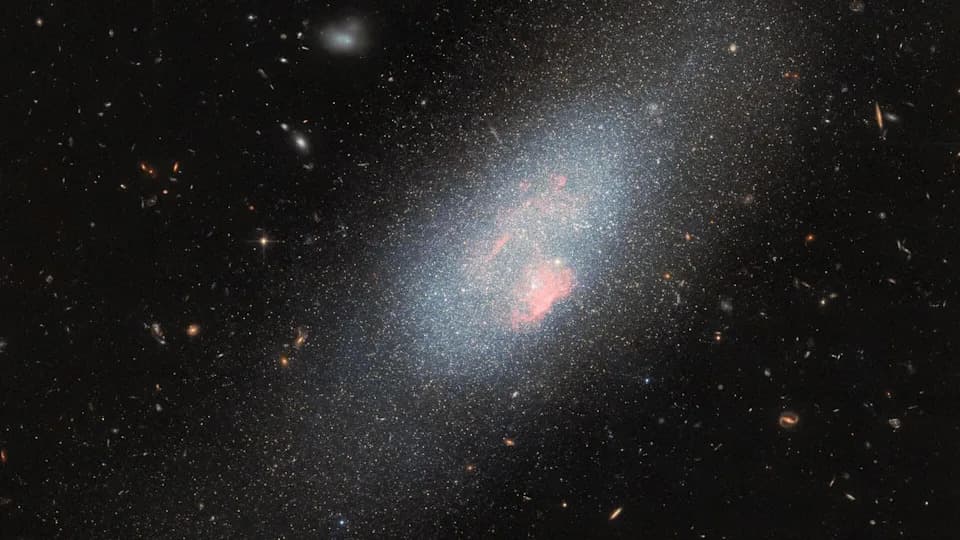
Dwarf galaxy Markian 178 was recently seen by the Hubble Space Telescope. | Credit: ESA/Hubble & NASA, F. Annibali, S. Hong
The Hubble Space Telescope has captured a vivid image of the dwarf galaxy Markarian 178 (Mrk 178), located in the northern constellation Ursa Major. This compact system is one of more than 1,500 so-called Markarian galaxies first catalogued by Armenian astrophysicist Benjamin Markarian for their unusually strong ultraviolet emission.
From Hubble's perspective, Mrk 178 appears as a glittering, cloud-like object dominated by tight clusters of young, hot, blue stars. Interspersed among this blue starlight is a striking red-tinged region that contrasts sharply with the surrounding stellar populations.
What Causes the Red Glow?
That reddish glow is the hallmark of massive Wolf–Rayet stars — short-lived, extreme stars undergoing violent mass loss. Having exhausted hydrogen in their cores, Wolf–Rayet stars blow off their outer layers in powerful stellar winds and flood their surroundings with intense radiation. The winds and radiation produce strong emission lines (notably from ionized hydrogen and oxygen) that show up as red when isolated through Hubble's specialized filters.
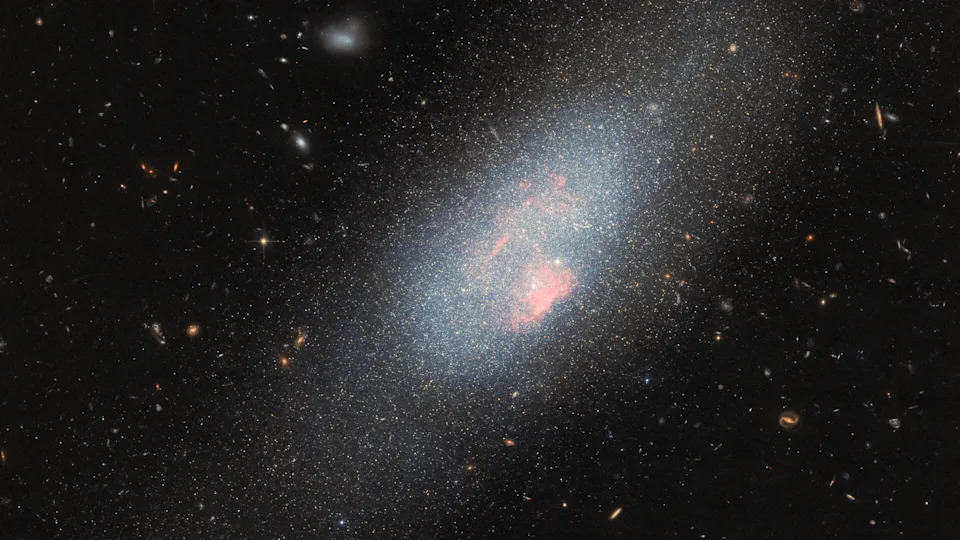
A mystery surrounding Mrk 178's Wolf-Rayet stars is a headscratcher. | Credit: ESA/Hubble & NASA, F. Annibali, S. Hong
Why This Matters
Wolf–Rayet stars live only a few million years, so their presence in Mrk 178 signals very recent, vigorous star formation. Astronomers find this especially intriguing because Mrk 178 shows no obvious large neighbor whose gravitational interaction might have triggered the starburst. That lack of an obvious external trigger makes the galaxy a useful laboratory for studying internal processes that can spark intense star formation.
At roughly 13 million light-years away, Mrk 178 is a nearby analogue of the compact, rapidly star-forming galaxies that were common in the early universe. By studying objects like Mrk 178 with Hubble and complementary ground-based telescopes, astronomers can better understand how the first galaxies built up mass and how heavy elements were dispersed through space over cosmic time.
Learn more: ongoing multiwavelength observations of Mrk 178 are helping to map its stellar populations, gas flows, and chemical enrichment, shedding light on the powerful processes that shape galaxy evolution.
Help us improve.