The International Space Station's Expedition 73 crew photographed striking airglow above Earth's limb alongside the Large Magellanic Cloud on Nov. 28, 2025. Captured with a Nikon Z9 and a 50 mm lens, the image shows layered blue, yellow, green and faint red airglow at the horizon with the LMC—a dwarf galaxy about 160,000 light-years away—rising beyond. The LMC is a nearby laboratory for star-formation studies and was the site of Supernova 1987A, whose aftermath continues to inform astrophysical research.
ISS Captures Vivid Airglow and the Large Magellanic Cloud — Stunning Photo from Nov. 28, 2025
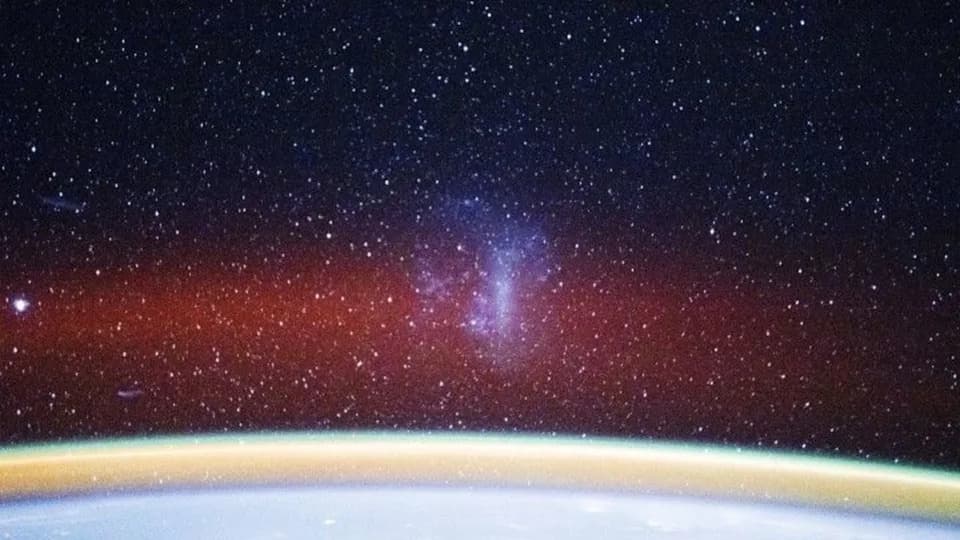
A look at the Large Magellanic Cloud, along with the phenomenon airglow, from space. . | Credit: NASA's Expedition 73 crew
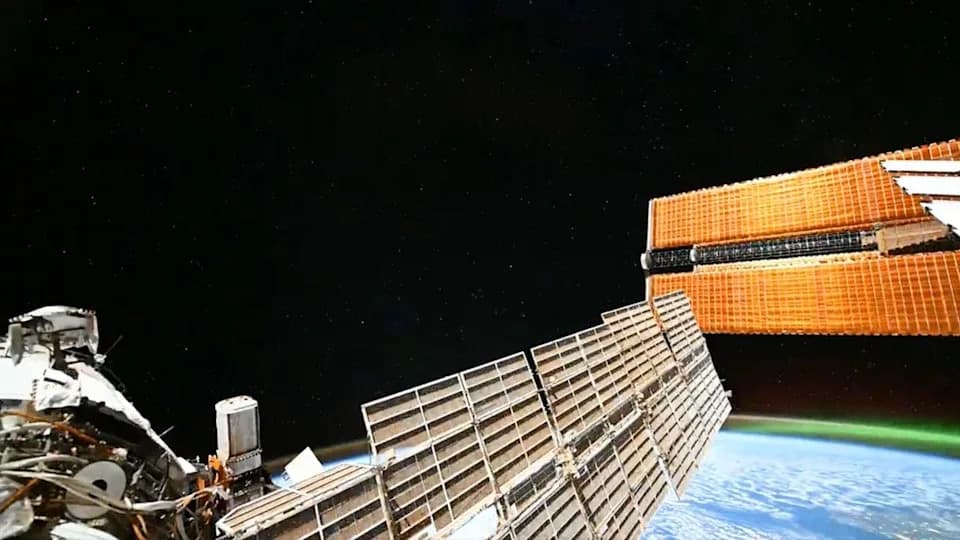
From low Earth orbit the sky changes: the atmospheric veil that softens starlight on the ground falls away, and delicate phenomena become visible. On Nov. 28, 2025, members of Expedition 73 aboard the International Space Station photographed a spectacular view that combined Earth's airglow with the glow of one of the Milky Way's nearest companions.
The image was taken with a Nikon Z9 and a 50-millimeter focal length. Along the lower edge of the frame Earth's horizon curves in brilliant blue and is topped by layered bands of yellow, green and a faint red—the telltale colors of airglow. This natural luminescence arises when atoms and molecules high in the atmosphere release energy after being excited by sunlight and chemical reactions.

Front view of the Nikon Z9 on a white backtround.
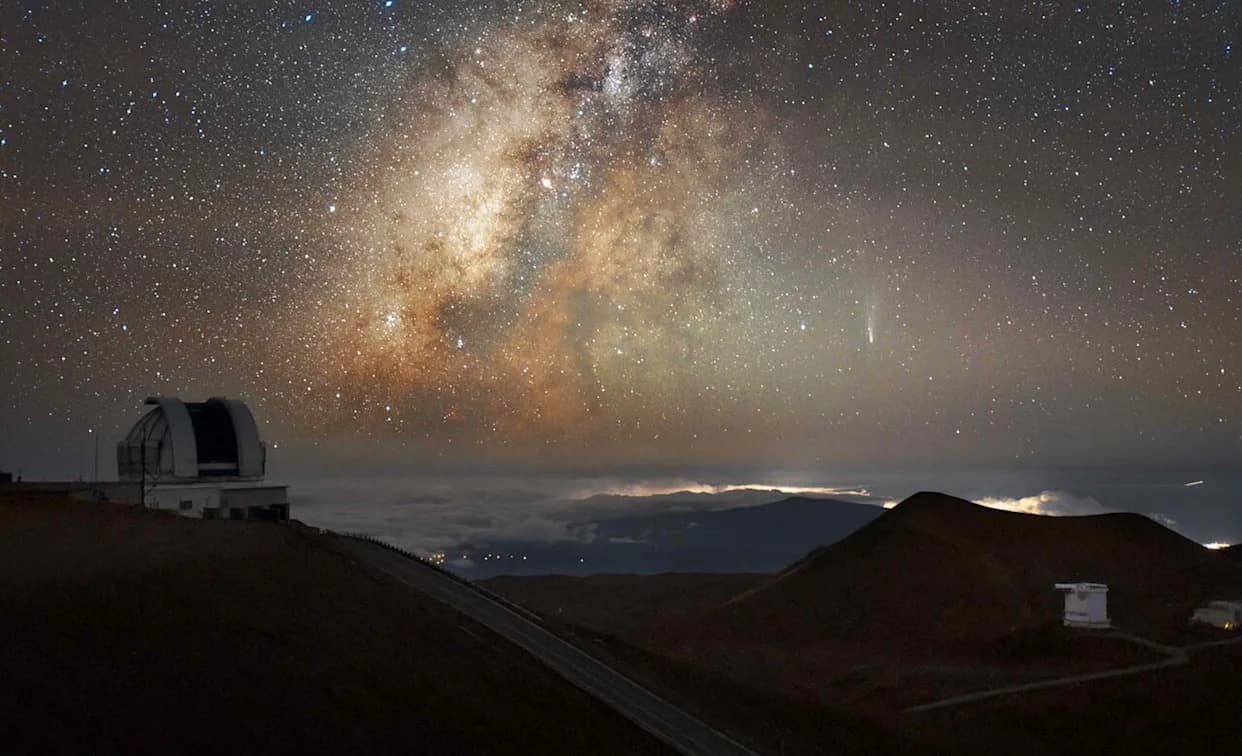
Above that thin luminous rim the field of stars opens up. Near the center of the photo sits the Large Magellanic Cloud (LMC), an irregular dwarf galaxy roughly 160,000 light-years away. To southern observers under dark skies, the LMC appears as a faint, cloudlike smudge because billions of stars, nebulae and interstellar gas are packed together; at modest focal lengths these many lights blend into a soft haze.
Why This View Matters
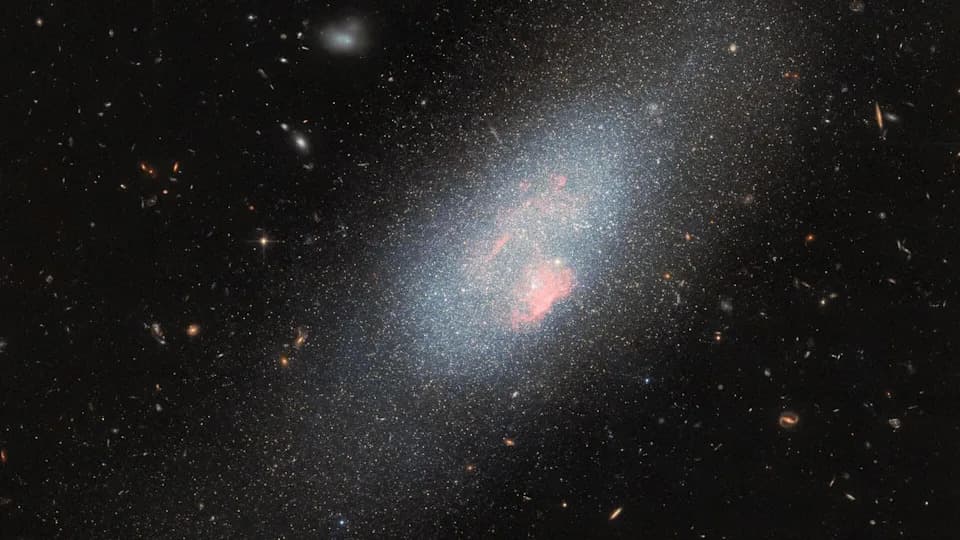
The photograph captures two very different kinds of glow at once: a local atmospheric phenomenon lighting Earth's limb and the distant, stellar glow of another galaxy. The LMC is an important nearby laboratory for astrophysics because it hosts intense star-forming regions that are easier to study than many parts of the Milky Way's crowded disk.
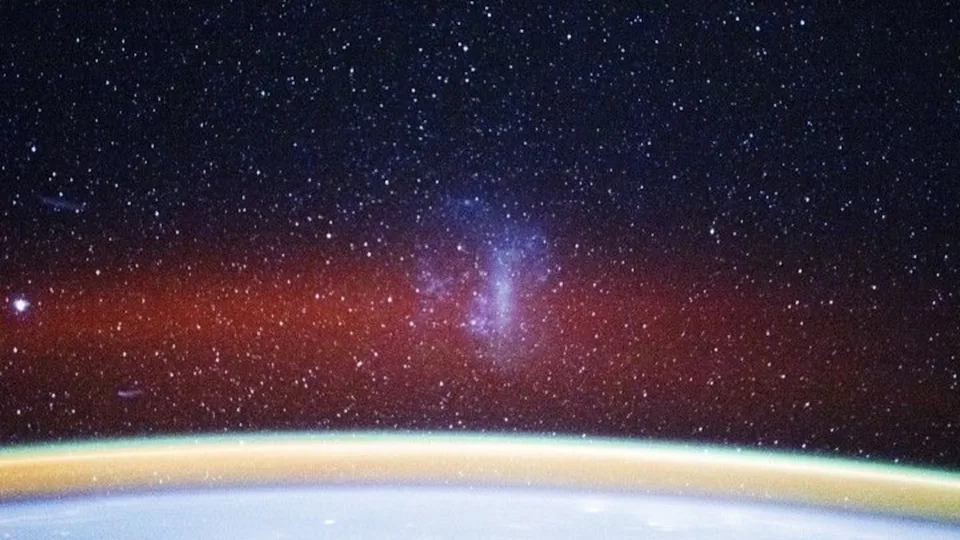
The purple shape in the center of the image is the Large Magellanic Cloud, seen through the reddish hue of airglow produced by Earth's atmosphere. | Credit: NASA's Expedition 73 crew
Scientific highlight: The LMC was the site of Supernova 1987A, the closest observed supernova in modern times. That explosion provided an unprecedented opportunity to track how a stellar blast interacts with surrounding material and how dust forms in supernova remnants—material that can later seed new stars and planets.
The photograph was taken from the International Space Station, which orbits at an average altitude of about 248 miles (400 kilometers). Shots like this demonstrate how orbital photography can reveal both atmospheric effects and astrophysical targets in a single frame.
For readers who want to learn more: explore resources on airglow, the Large Magellanic Cloud, and Supernova 1987A to understand how observations from both ground and space advance our knowledge of star formation and cosmic evolution.
Help us improve.