Researchers reported the first direct observation of a superfluid turning into a suspected supersolid and then reverting back, capturing a spontaneous, reversible quantum phase transition. The experiment used two closely spaced graphene sheets, a strong magnetic field and cooling to about 1.5–4 K above absolute zero to form excitons that condensed into distinct phases. Unlike earlier experiments that imposed order, this transition appears to occur naturally; researchers are now developing tools to confirm and map the new state's properties.
Physicists Watch a Superfluid Become a Supersolid — And Reverse — For The First Time
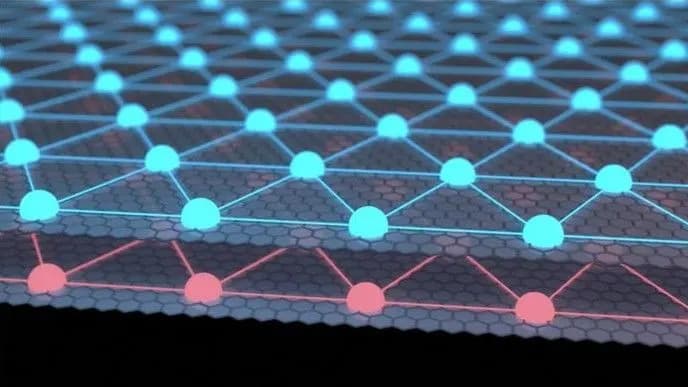
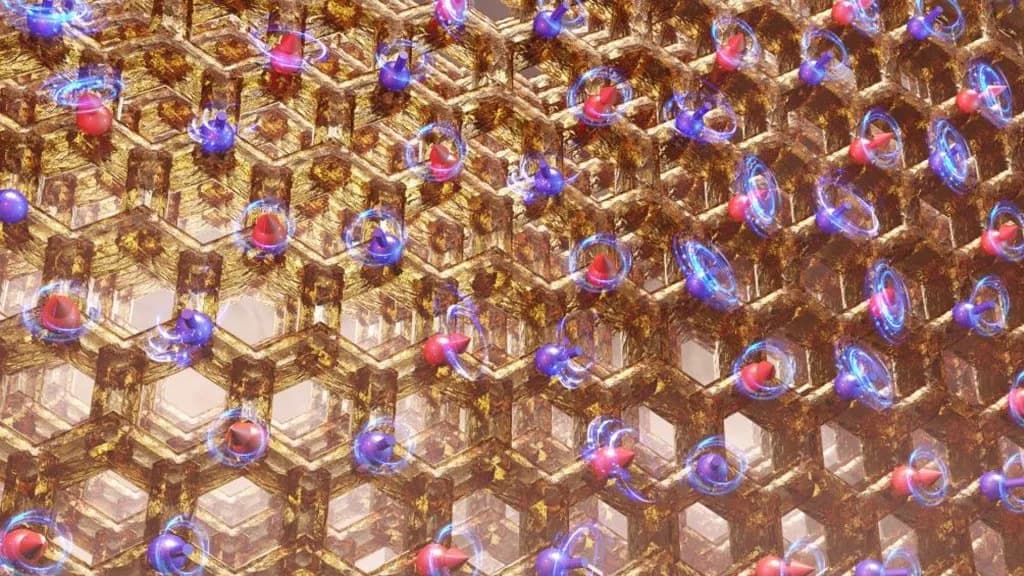
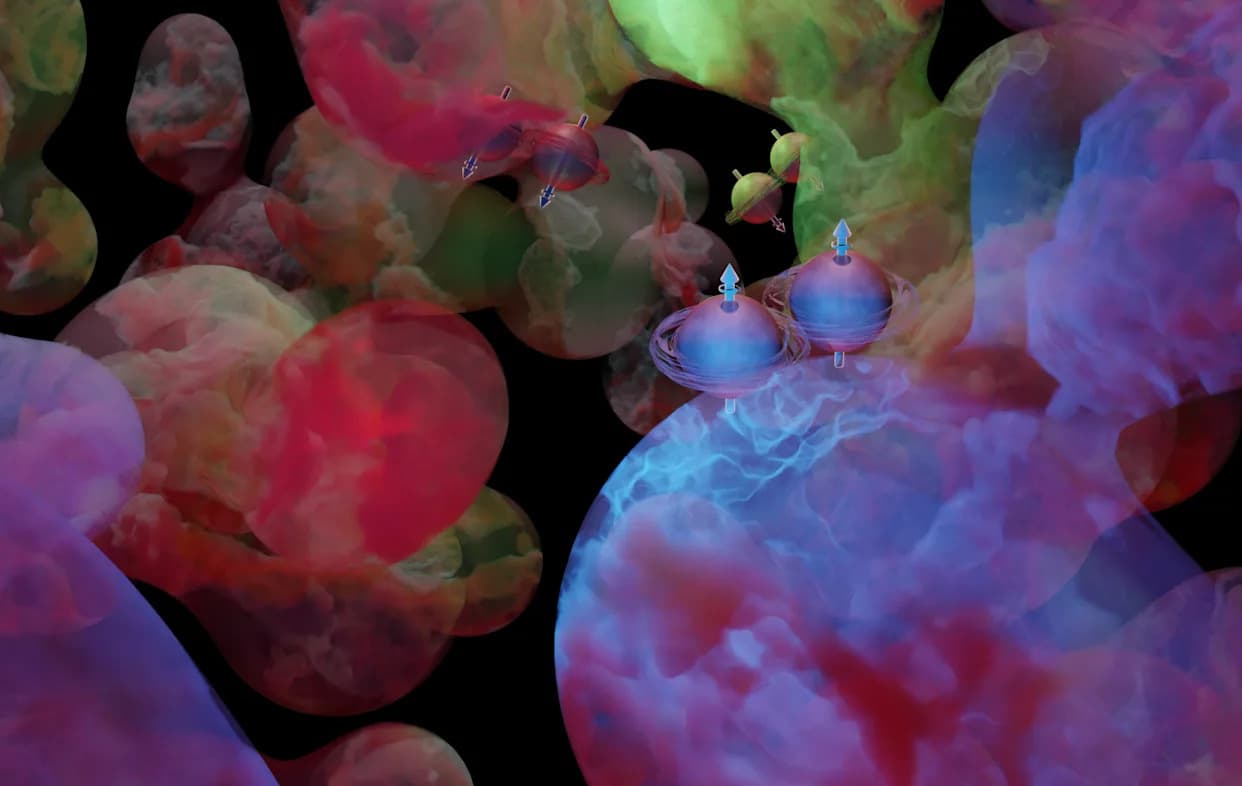
An illustration of excitons arranging into a solid pattern in bilayer graphene. For the first time, physicists have observed a superfluid tranform into a supersolid and back again. | Credit: Cory Dean, Columbia University
Researchers have for the first time observed a superfluid transform into a suspected supersolid and then revert back in a controlled, reversible experiment — a milestone reported Jan. 28 in the journal Nature. The work catches an exotic phase transition in action and opens new routes to study quantum matter.
What the Team Did
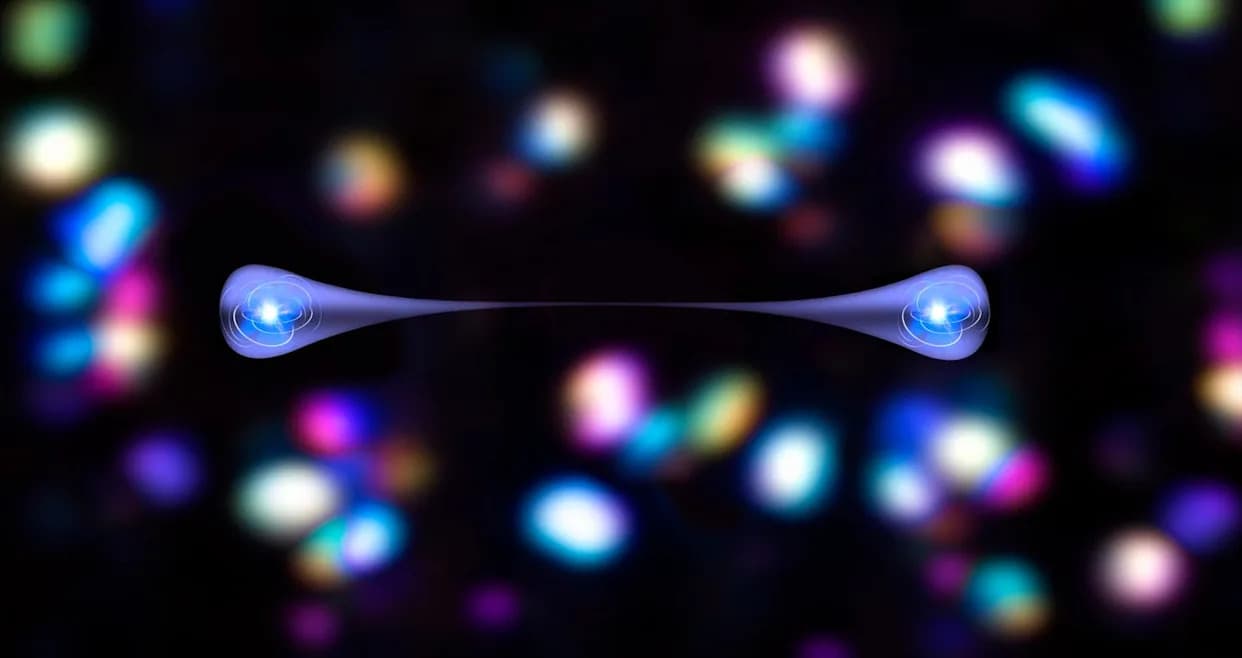
The experiment used two atom-thin sheets of graphene placed extremely close together, exposed to a strong magnetic field and cooled until quasiparticles called excitons formed an interacting ‘‘soup.’’ Excitons are bound pairs of an electron and an electron hole that can act like composite particles. As the researchers lowered the temperature, the excitons first behaved as a superfluid and, with further cooling, entered an electrically insulating phase the team interprets as a supersolid.
Temperatures and Conditions
The transition was observed when the system was cooled to within about 1.5–4 kelvin (K) above absolute zero — i.e., roughly between −271.7°C and −269.2°C. Under those cryogenic conditions and a strong magnetic field, the excitons condensed into collective states whose properties changed reversibly with temperature.
Why This Matters
Superfluids flow without viscosity and can host persistent quantum vortices. A supersolid is a counterintuitive state that combines superfluid flow with spatial order: the particles both move without friction and arrange into a crystal-like lattice. Previous laboratory realizations of supersolid-like behavior — for example, a two-dimensional dysprosium supersolid (2021) and later observations of vortices in a supersolid (2024) — typically required externally imposed structure or engineered traps. The new result is notable because the team captured a spontaneous, reversible phase transition from a superfluid into a phase that appears to be an ordered, insulating exciton solid.
Cory Dean, a physicist at Columbia University and co-author of the study, said, "For the first time, we've seen a superfluid undergo a phase transition to become what appears to be a supersolid."
Jia Li, a physicist at the University of Texas at Austin and co-author, added, "Superfluidity is generally regarded as the low-temperature ground state. Observing an insulating phase that melts into a superfluid is unprecedented. This strongly suggests that the low-temperature phase is a highly unusual exciton solid."
Next Steps
The research team is expanding the search to other material platforms and developing more direct probes to map the suspected supersolid's internal order and dynamics. Those follow-up studies will test whether the insulating phase truly combines crystalline order with superflow and whether similar behavior can be stabilized at higher, more practical temperatures.
This work deepens our understanding of quantum phases of matter and may guide future efforts to harness exotic collective states for quantum technologies.
Help us improve.