ORNL researchers synthesized potassium cobalt arsenate, a two‑dimensional cobalt honeycomb magnet, and performed chemical, microscopic, thermal and neutron scattering studies. The material exhibits weak Kitaev‑type interactions but orders magnetically below ~14 K because conventional magnetic couplings remain stronger. Calculations show the compound lies near a tipping point—small changes in chemistry, pressure, or applied fields could push it into a quantum spin liquid regime that might host Majorana excitations. The study provides a practical, tunable platform for pursuing engineered Kitaev quantum spin liquids.
Cobalt Honeycomb Magnet Reveals Practical Path Toward Engineered Quantum Spin Liquids
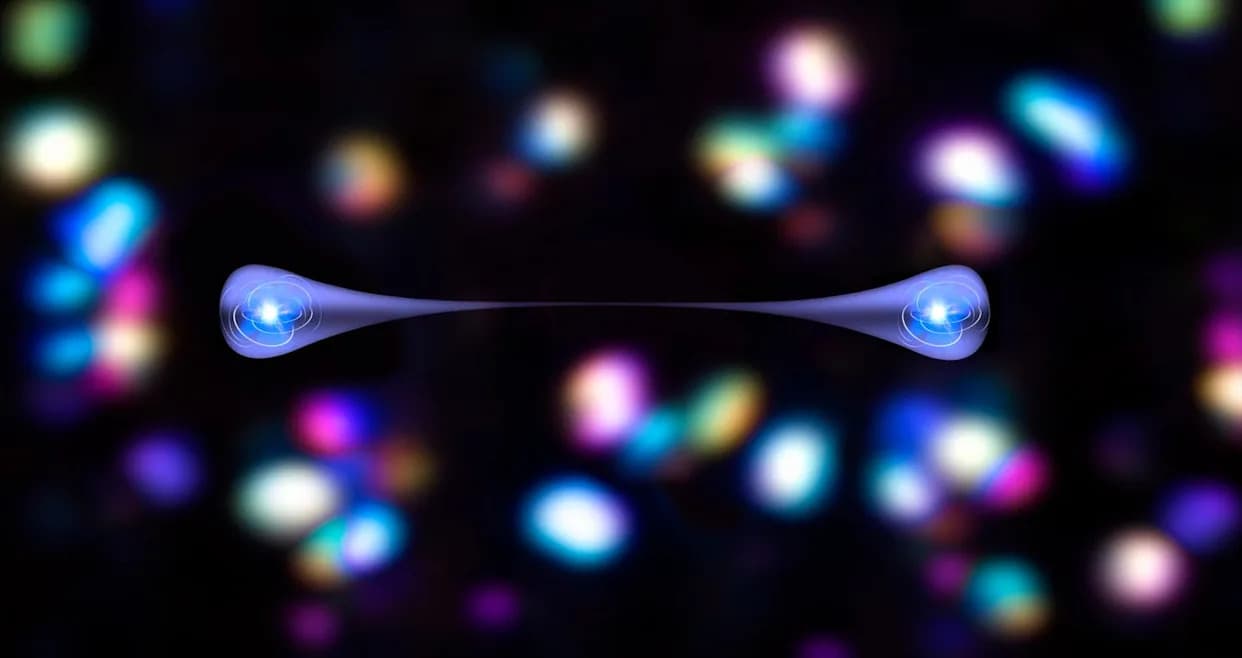
Most magnets behave predictably: cool them and their tiny magnetic moments lock into place. But physicists have long suspected that, under special conditions, magnetism can remain fluctuating even at extremely low temperatures—forming a phase known as a quantum spin liquid. Such a state could host exotic collective excitations and provide a noise‑resistant foundation for future quantum devices.
Researchers at Oak Ridge National Laboratory (ORNL) have synthesized and thoroughly characterized a new cobalt‑based material that brings this possibility closer to reality, even though the sample stops short of a true quantum spin liquid.
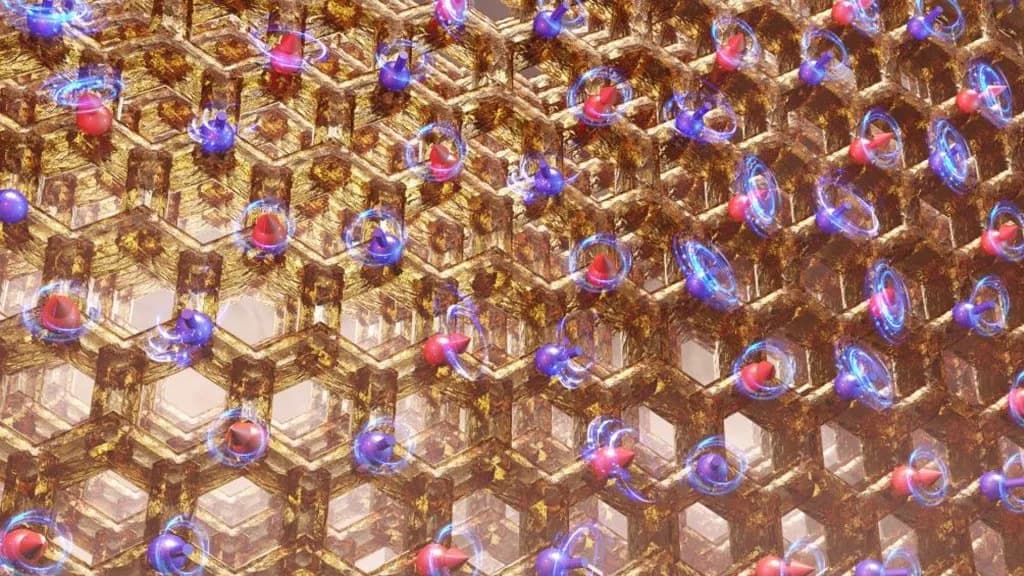
The compound is potassium cobalt arsenate, in which cobalt atoms form a two‑dimensional honeycomb network. Synthesizing the crystals required an unconventional low‑temperature approach: the team slowly heated a carefully prepared solution so crystals could grow without decomposing, avoiding the breakdown that occurs at higher temperatures.
Chemical analysis confirmed the expected stoichiometry of potassium, cobalt, arsenic and oxygen. Electron microscopy and diffraction established a honeycomb lattice that is slightly distorted rather than perfectly symmetric. That small structural asymmetry plays an important role in the material's magnetic behavior.
Thermodynamic and magnetic measurements revealed that the cobalt spins ultimately freeze into an ordered pattern below roughly 14 kelvin (about −259 °C), instead of remaining in the fluctuating quantum spin liquid state. Neutron scattering—sensitive to magnetic moments—confirmed that the honeycomb arrangement and the magnetic order are uniform across the sample.
Why the Spins Freeze
Computer simulations based on the measured crystal structure explain the outcome: the distinctive bond‑dependent interactions proposed by Alexei Kitaev are present in the material, but they are weaker than conventional magnetic couplings. In other words, Kitaev physics appears but does not dominate, so the system falls into an ordered magnetic phase rather than a quantum spin liquid.
'Computational studies suggest the presence of a weak nearest‑neighbor Kitaev term, K1, consistent with related honeycomb cobaltates,' the authors write. 'Together, the data suggest that this material should present a new platform for developing Kitaev quantum spin liquids.'
Paths Forward
Crucially, the compound sits near a critical boundary between ordered and spin‑liquid behavior. Calculations indicate that modest perturbations—such as slight chemical substitution, applied pressure, or strong magnetic fields—could change the balance of competing interactions and push the material into a Kitaev‑dominated quantum spin liquid phase.
If that tipping point can be reached, the payoff could be substantial: quantum spin liquids are expected to host Majorana‑like collective excitations, modes that are delocalized across the material and are naturally protected from certain types of noise. Such excitations are of intense interest for more robust quantum computing and sensing architectures.
While the ORNL cobalt honeycomb does not yet realize a quantum spin liquid, it offers a tangible and tunable platform for further development. The work, with combined synthesis, experimental characterization and theoretical modeling, is published in the journal Inorganic Chemistry.
Help us improve.