A sodium nanocluster about 8 nm across and heavier than 170,000 atomic mass units has been observed producing quantum interference, making it the largest object yet seen to behave as a quantum wave. Researchers used UV-laser-generated diffraction gratings in an interferometer to place cooled clusters into a superposition, recording de Broglie wavelengths of roughly 10–22 × 10-15 m. The result demonstrates quantum mechanics at a much larger scale than intuition suggests and provides a testing ground for decoherence and the quantum–classical boundary.
Sodium Nanocluster Breaks Record As Largest Object Observed Behaving Like A Quantum Wave

person's face blurred
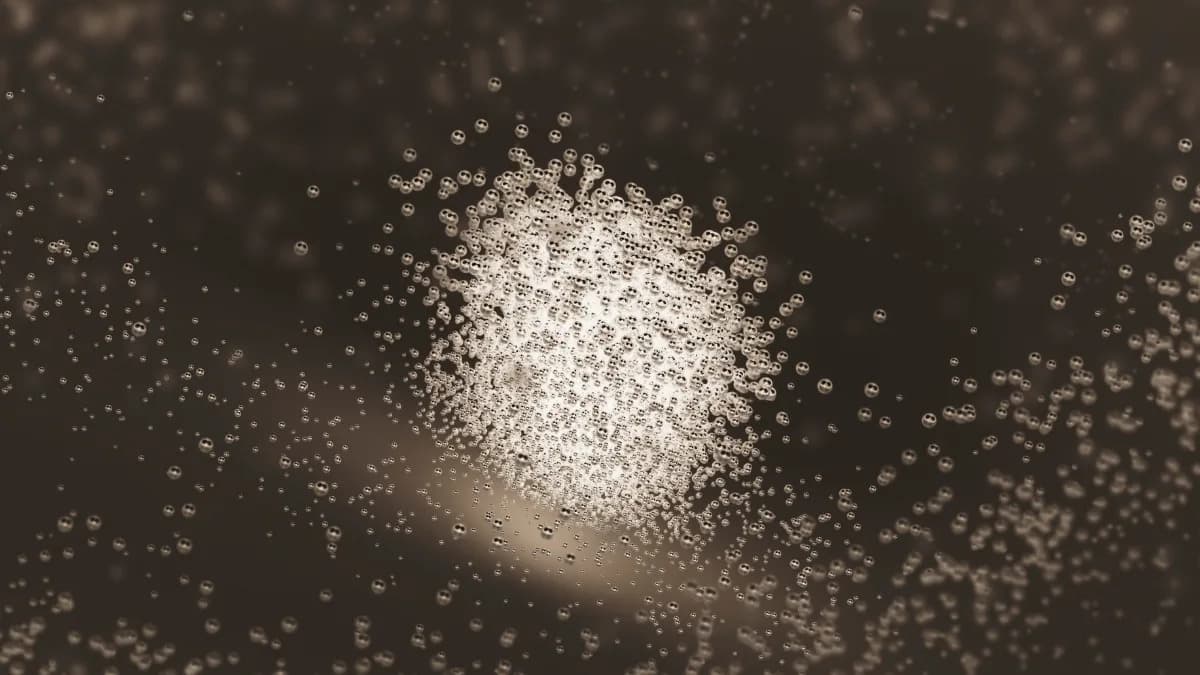
A microscopic cluster of sodium atoms has set a new record as the largest object yet observed to behave as a quantum wave. Measured at roughly 8 nanometres in diameter and weighing more than 170,000 atomic mass units—heavier than many proteins—the nanoparticle produced clear quantum interference in an experiment published in Nature.
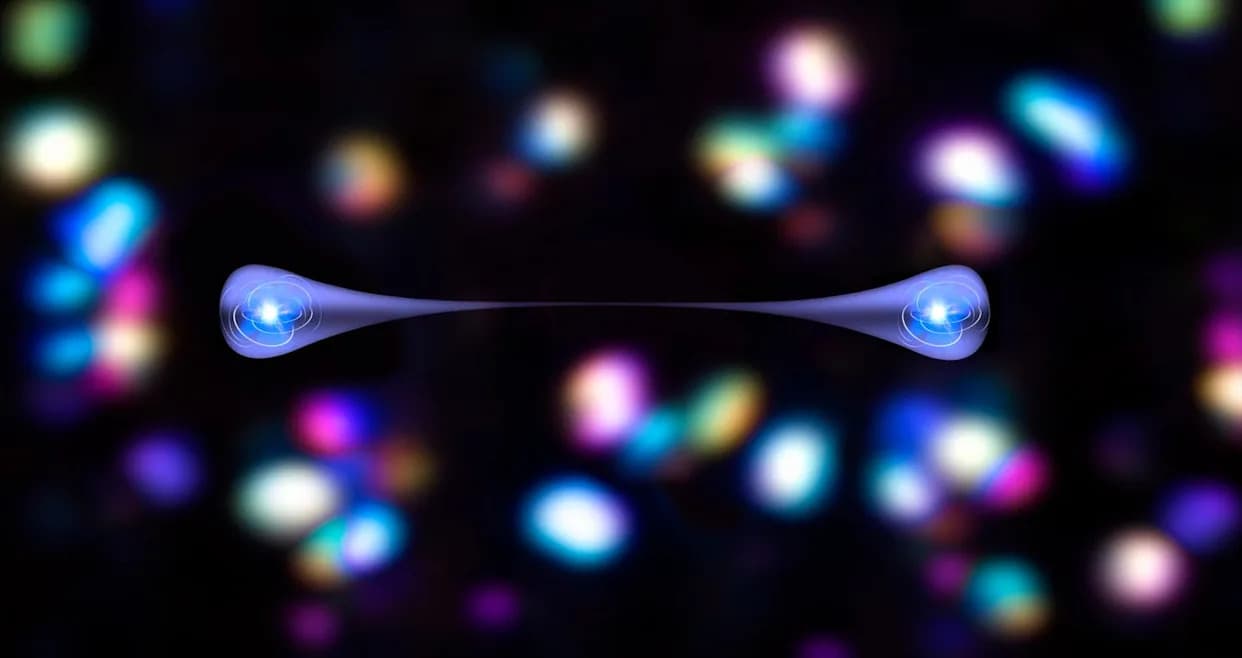
Researchers at the University of Vienna (Austria) and the University of Duisburg-Essen (Germany) cooled the sodium clusters and passed them through an interferometer constructed from a sequence of diffraction gratings generated by ultraviolet lasers. An initial grating guided the clusters through narrow openings; the particles then propagated as waves with apparent wavelengths between 10 and 22 quadrillionths of a metre (10–22 × 10-15 m), placing them into a superposition of different paths that was resolved by a final grating.

The sodium clusters behaved as quantum particles at about 200,000 atomic mass units, a size and mass comparable with those of large proteins and smallviruses. (Pedalino et al.,Nature, 2026)
These observations imply that the clusters’ positions were not fixed while they traversed the unobserved portion of the apparatus: the particles displayed a delocalization many times larger than their physical size. The result demonstrates that assemblies composed of thousands of atoms can still obey quantum mechanics and exhibit interference, challenging the intuition that larger chunks of matter must always behave classically.
At macroscopic scales, interactions with the environment typically destroy fragile superpositions in a process known as quantum decoherence, which helps explain why everyday objects appear to have definite positions. This experiment pushes the boundary of where quantum behavior remains observable and offers a valuable platform for studying decoherence and the quantum–classical transition. While some interpretations of quantum mechanics (for example, the many-worlds view) treat all branches of a superposition as equally real, the experiment itself does not resolve interpretational questions.

Subscribe to ScienceAlert's free fact-checked newsletter
Lead author Sebastian Pedalino, a graduate student at the University of Vienna, noted: “Intuitively, one would expect such a large lump of metal to behave like a classical particle. The fact that it still interferes shows that quantum mechanics is valid even on this scale and does not require alternative models.”
The study appears in the journal Nature, and its methods and findings will inform future work on macroscopic quantum phenomena and precision interferometry.
Help us improve.