The University of Vienna team has created the largest measured spatial quantum superposition so far, placing ~7,000-atom sodium clusters (≈8 nm) into distinct locations separated by 133 nm using a three-grating laser interferometer at 77 K. The interference confirmed quantum behaviour at masses comparable to proteins or small viruses and raises the tested scale for quantum mechanics. The result boosts constraints on collapse theories and informs the prospects for large-scale quantum technologies.
Vienna Team Creates Largest Spatial Quantum Superposition Yet — A Supersized Schrödinger’s Cat

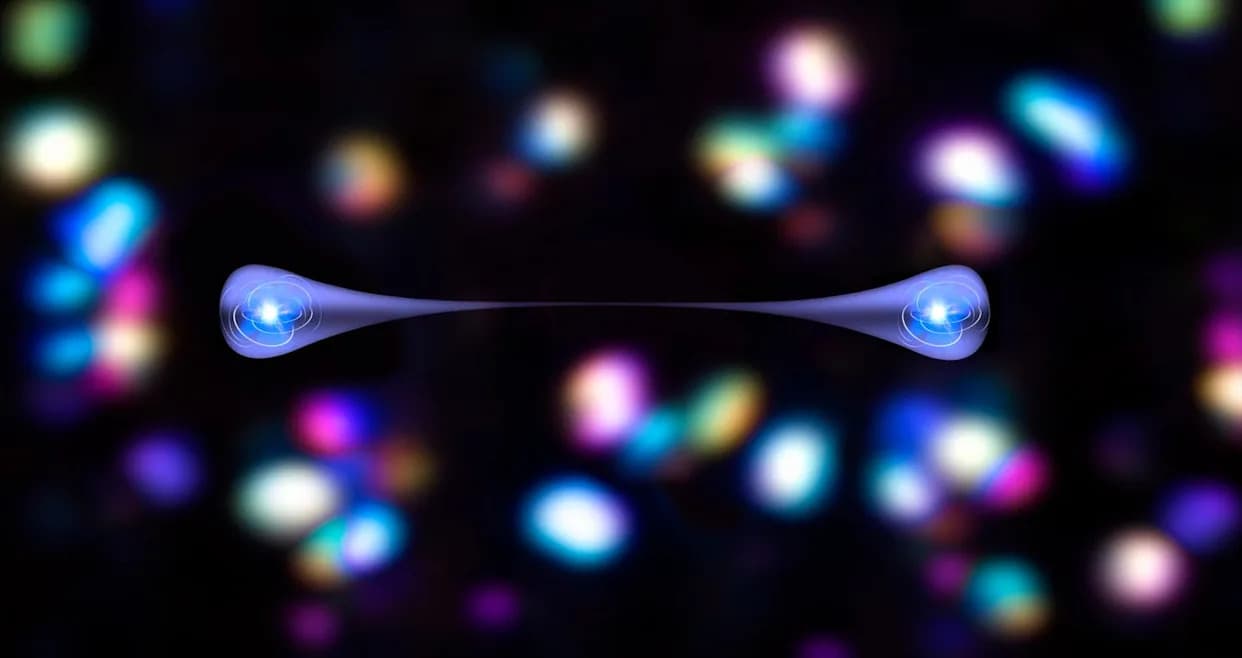
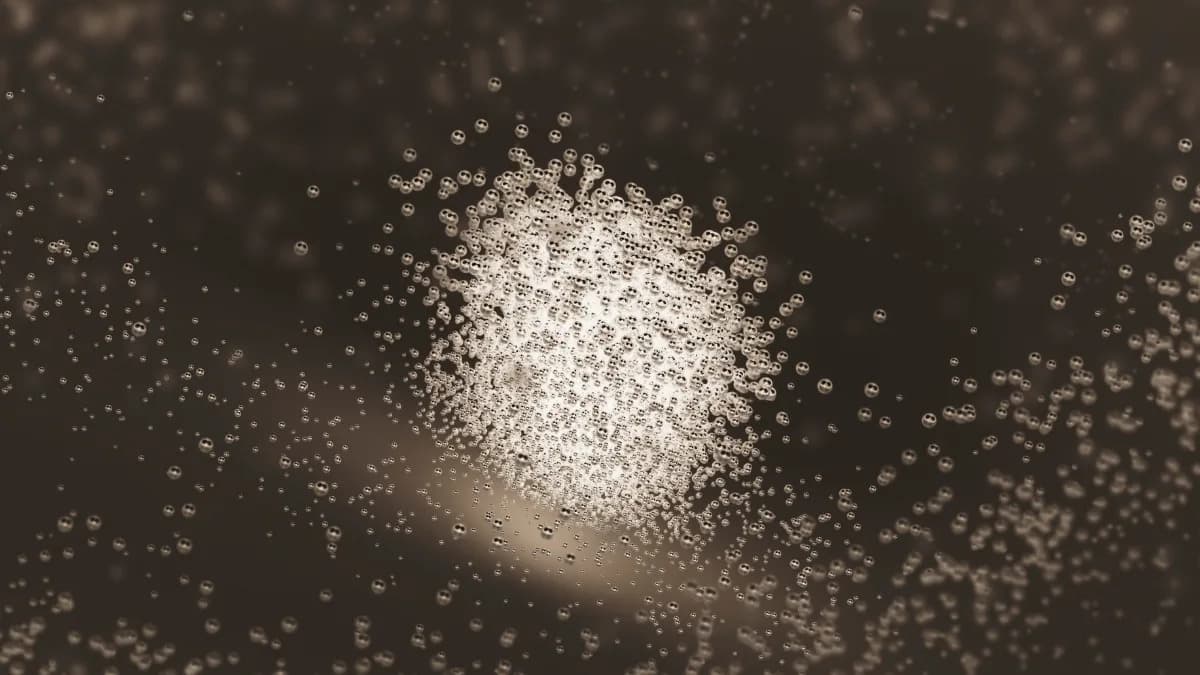
Physicists at the University of Vienna have created the largest measured spatial quantum superposition to date, effectively making Schrödinger’s cat a little "fatter." The team placed clusters of roughly 7,000 sodium atoms, each about 8 nanometres across, into a quantum state in which the same cluster existed simultaneously in distinct locations separated by 133 nanometres. The result was published in Nature on 21 January 2026.
How the Experiment Worked
To produce the effect the researchers cooled a beam of sodium clusters to 77 kelvin (−196 °C) and sent it through an ultra-high vacuum into a three-grating interferometer formed by laser standing waves. The first grating funneled the clusters into narrow channels so they could diffract and travel in phase as matter waves; the second grating induced interference between those wave paths; and the third allowed the team to detect the resulting interference fringes.
Why This Matters
Rather than behaving like billiard balls, each chunky cluster spread out as a wave, occupying multiple spatially separated paths and producing a detectable interference pattern. The experiment demonstrates clear quantum behaviour for objects with masses comparable to large proteins or small virus particles, and pushes upward the scale at which quantum mechanics has been directly tested.
“It’s a fantastic result,” says Sandra Eibenberger-Arias of the Fritz Haber Institute in Berlin. Co-author Sebastian Pedalino adds that the experiment supports the idea that quantum theory does not suddenly fail at larger masses: “Quantum theory never states it stops working above a certain mass or size.”
Technical and Practical Challenges
Observing interference at this scale was difficult: stray gas molecules, ambient light, electric fields or tiny misalignments can destroy the fragile coherence and wash out the interference pattern. Pedalino says the team spent two years to obtain a clear signal, and recalls “thousands of hours” of measurements that initially produced only noise.
The Vienna team’s result scores about ten times higher than the previous record on a metric called macroscopicity, which combines mass, coherence time and the spatial separation of the superposed states. That said, it is not necessarily the largest mass ever placed into a quantum state: in 2023 a 16-microgram vibrating crystal was prepared in a quantum superposition, but its components were separated by only two-billionths of a nanometre (≈2×10⁻⁹ nm, or ≈2×10⁻¹⁸ m).
Implications For Foundations And Technology
The experiment informs debates about how the classical world emerges from quantum mechanics. Some alternative proposals — collapse theories — predict that sufficiently large or massive systems will spontaneously reduce to classical states; only 4% of respondents in a 2025 Nature survey favored such models. Experiments that scale up quantum superpositions test these ideas directly.
There are also practical implications. Scalable quantum computers will ultimately require many physical systems to remain coherent together; if nature enforced a collapse at a scale smaller than that needed for computation, that would be problematic. The Vienna result indicates no such collapse occurs at the tested scale.
Looking Ahead
Co-author Stefan Gerlich notes that heavier particles have shorter de Broglie wavelengths, making it harder to distinguish quantum from classical predictions. The team is exploring whether biological particles — including some viruses that are comparable in size to the sodium clusters — can be made to interfere. Fragility and fragmentation in flight add technical hurdles, but the researchers consider such tests increasingly plausible.
This experiment strengthens the empirical reach of quantum mechanics and opens paths to more ambitious tests of the quantum–classical boundary and technologies that rely on large-scale coherence.
This article reproduces material first published on January 21, 2026, with permission.
Help us improve.