Researchers have experimentally detected a topological semimetal phase in CeRu4Sn6 at temperatures near absolute zero, overturning expectations that topology could not survive quantum criticality. The team observed a Hall-like transverse response with no applied magnetic field, indicating intrinsic topology. Quantum critical fluctuations were found to stabilize the new phase, and researchers aim to search for this behavior in other materials to assess its generality.
Scientists Find Unexpected Topological Quantum Phase in CeRu4Sn6 Near Absolute Zero
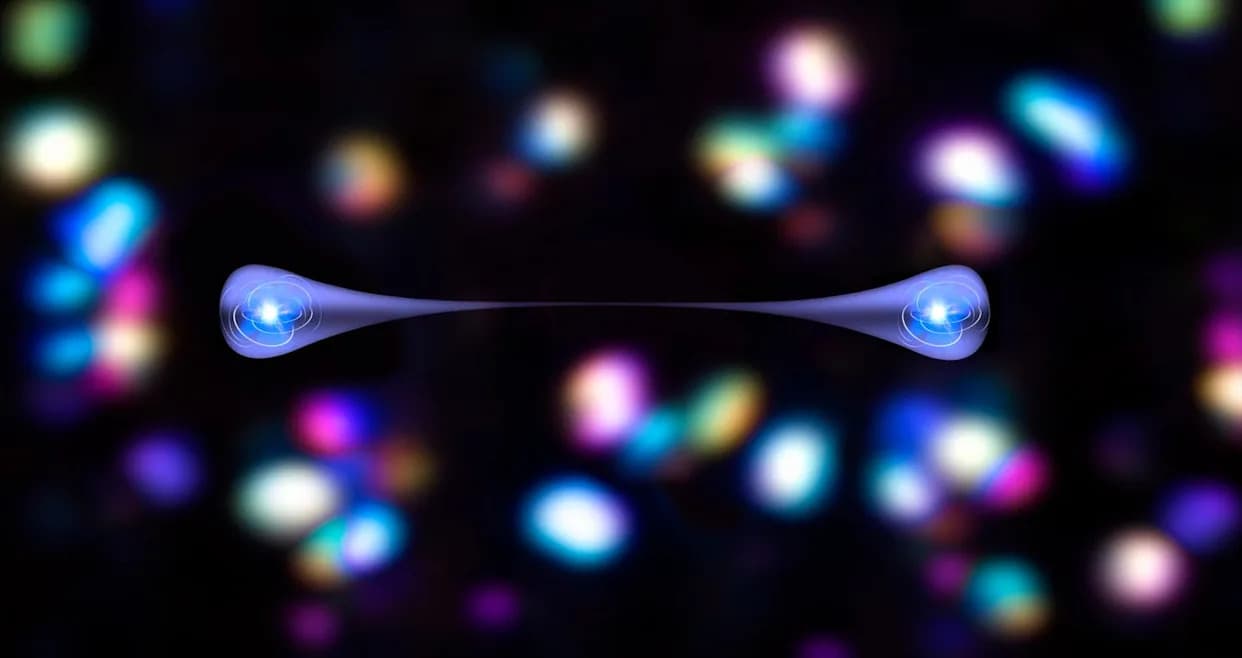
Particle line explosion
A quantum state once thought impossible in certain unstable materials has been observed in the cerium–ruthenium–tin compound CeRu4Sn6, forcing researchers to rethink how strong electron interactions and topology can coexist.
The international research team cooled CeRu4Sn6 to temperatures approaching absolute zero and drove an electric current through the sample. They measured a transverse voltage consistent with a Hall-like response even though no external magnetic field was applied. This zero-field transverse signal points to intrinsic topological features in the material's electronic structure.
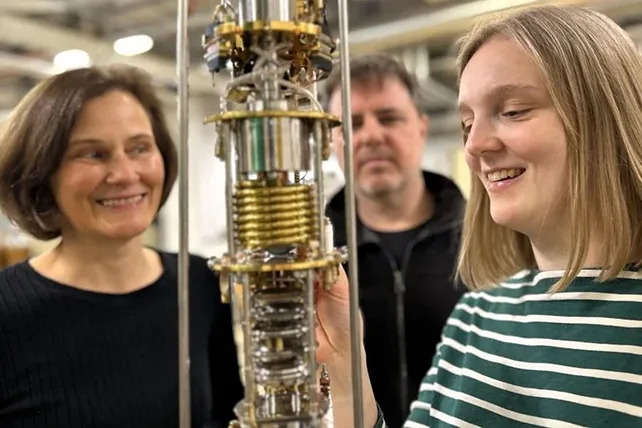
From left to right, Silke Bühler-Paschen, Diego Zocco, and Diana Kirschbaum – some of the researchers involved in the study. (TU Wien)
Quantum Criticality Meets Topology
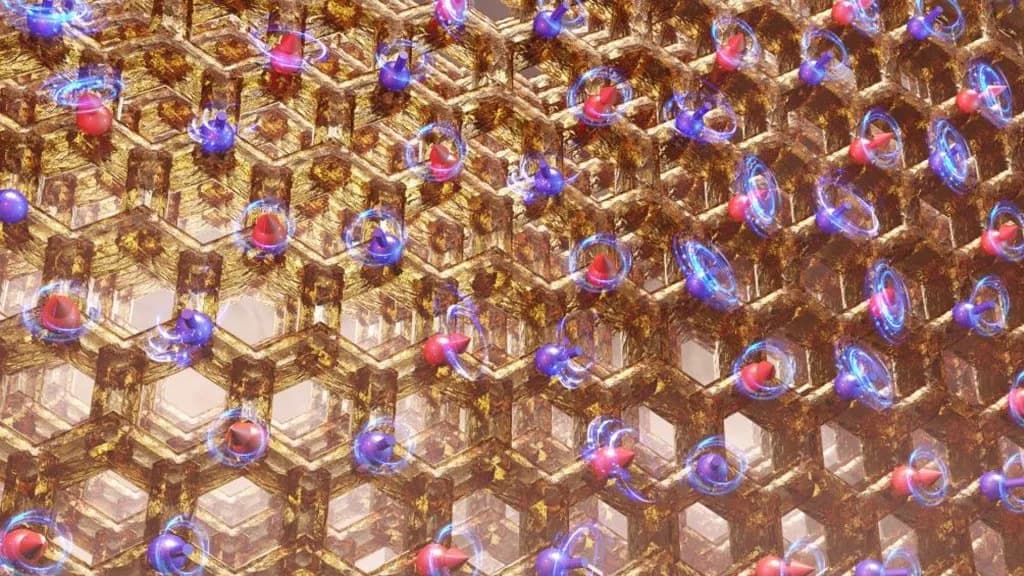
CeRu4Sn6 reaches a regime called quantum criticality at ultralow temperatures: a delicate tipping point between competing phases where quantum fluctuations dominate and thermal motion is negligible. Traditionally, topology in solids is understood using particle-like descriptions of electrons, an approach thought to break down under quantum critical conditions. The surprising result of this study is that quantum critical fluctuations do not destroy topological order here but instead help stabilize a topological semimetal phase.
Why This Matters
Topological phases protect certain electronic properties from local disturbances, while quantum criticality produces extreme sensitivity to tiny changes in conditions. Their coexistence could yield materials that combine robust, protected responses with heightened tunability and sensitivity—properties of interest for quantum computing, more efficient electronics, and advanced sensing and imaging technologies.

Audition now for ScienceAlert's Casting Call
“This is a fundamental step forward,” says physicist Qimiao Si of Rice University. “Our work shows that powerful quantum effects can combine to create something entirely new, which may help shape the future of quantum science.”
Physicist Silke Bühler-Paschen of the Vienna University of Technology adds that the zero-field Hall-like response was the key observation that required a revision of prevailing views about when topology can exist in interacting systems.
Next Steps
The team plans to search for similar behavior in other compounds to determine how widespread this phenomenon is, and to map the precise topological features and conditions required to realize and control this phase reliably. The discovery, reported in the journal Nature Physics, opens new experimental and theoretical directions in condensed-matter physics.
Publication: Nature Physics. Potential Applications: Quantum computing, energy-efficient electronics, precision sensing and imaging.
Help us improve.