Brookhaven physicists used RHICs STAR detector to track strange-quark pairs that appear to have been promoted from virtual fluctuations in the quantum vacuum to real particles by high-energy collisions. The resulting lambda hyperons showed unusually aligned spins, matching a theoretical prediction made about 30 years ago. This direct evidence of vacuum-originated quark pairs opens a new experimental path to study how interactions with the vacuum contribute to proton mass.
Physicists Trace Particles Back to the Quantum Vacuum — Direct Evidence From RHIC
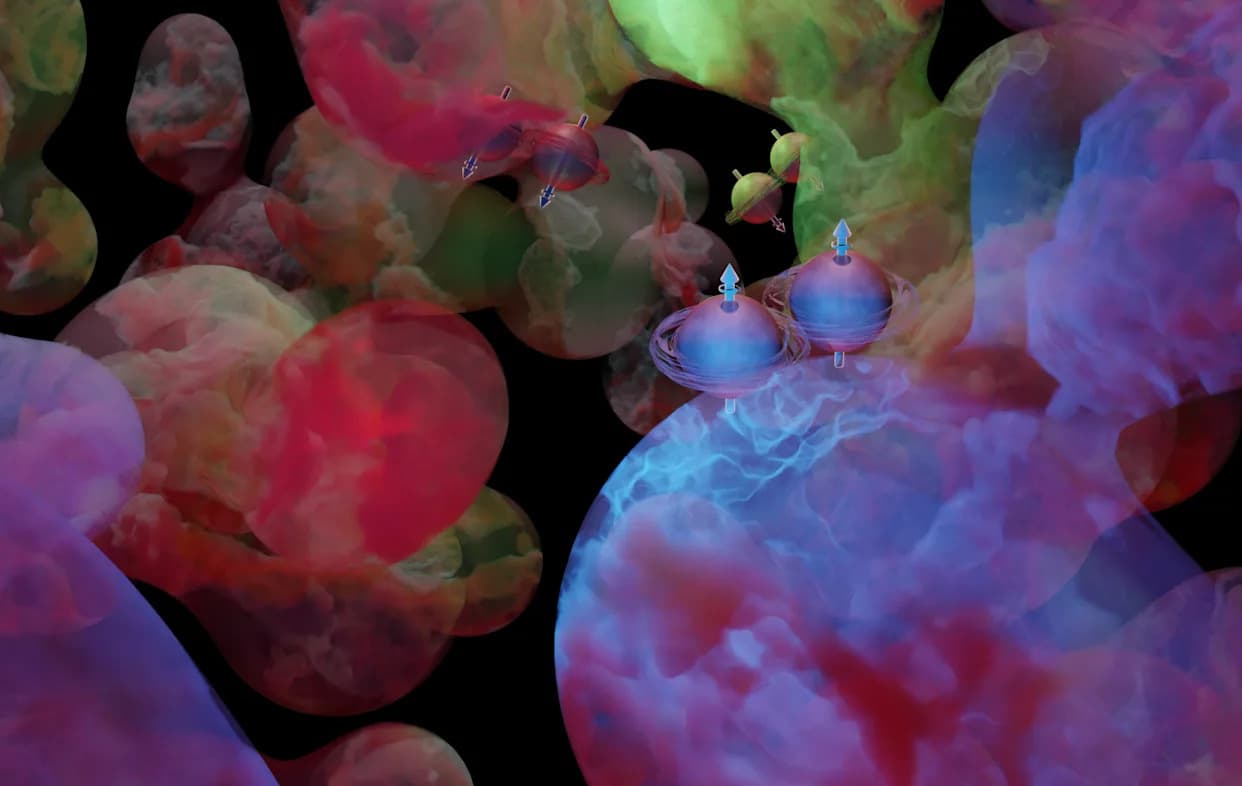
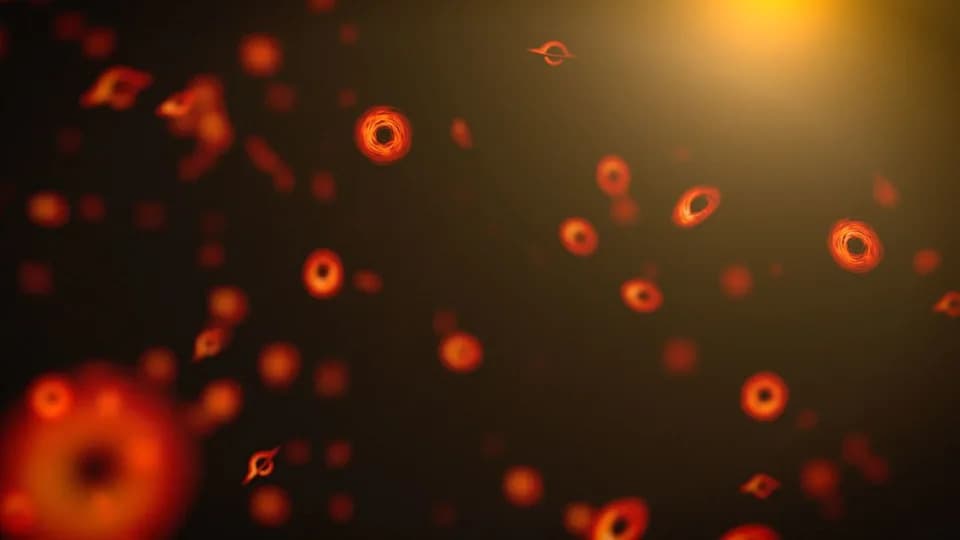
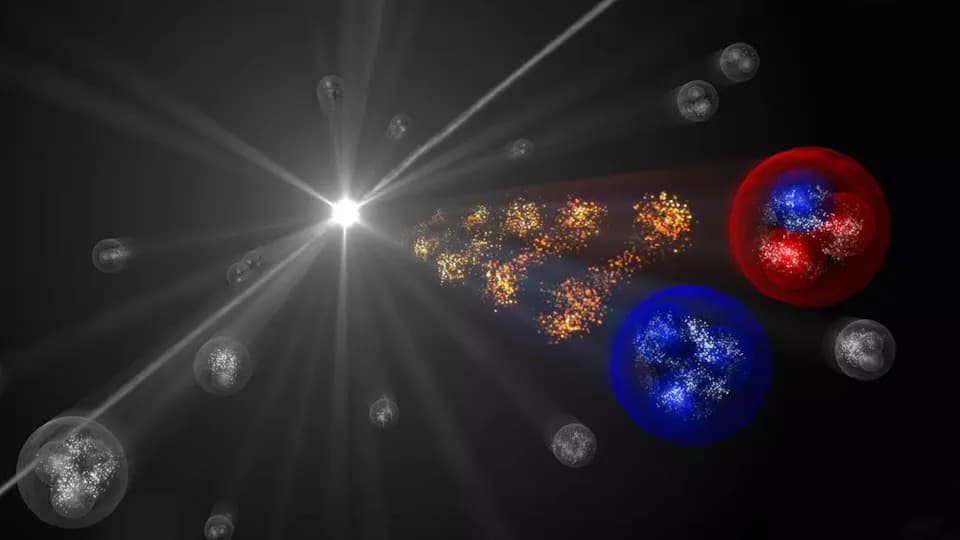
An illustration depicts pairs of strange quarks arising out of nothing in the quantum vacuum.(Valerie A. Lentz/Brookhaven National Laboratory)
Researchers at Brookhaven National Laboratory have for the first time followed particles that appear to originate from virtual pairs in the quantum vacuum, providing a direct experimental window into one of quantum field theory's strangest predictions.
Using the Solenoidal Tracker at RHIC (STAR) detector, the team at the Relativistic Heavy Ion Collider (RHIC) reconstructed events in which pairs of strange quarks produced in high-energy proton collisions emerged with a striking alignment in their spins. The quarks combined quickly with other quarks to form lambda hyperons, whose decays reveal the original quark spins.
How Virtual Particles Become Real
In quantum theory the vacuum is not empty but teems with fleeting fluctuations known as virtual particles. These ephemeral particle-antiparticle pairs normally annihilate almost instantly, but Heisenberg's uncertainty principle allows brief violations of energy conservation that permit such pairs to appear.
Inside RHIC, extremely energetic proton collisions give the vacuum an energy boost. If a virtual pair appears within that energized region, it can absorb collision energy and be promoted to a real, detectable particle pair. According to Zhoudunming (Kong) Tu, a co-author of the study, 'The collision gives the vacuum an energy kick so virtual particles can survive instead of immediately annihilating.'
Spin Correlations and Entanglement
Because the quark pairs originate together, they are born entangled and can retain correlated properties such as spin even after separating. The STAR detector recorded lambda hyperons — composite particles made of up, down and strange quarks — that carried the imprint of their strange-quark spins. By measuring the directions of the lambda decay products, the researchers inferred the hyperons' spins and thus the spins of the strange quarks inside them.
'Their spins seem to be parallel,' says Jan Vanek of the University of New Hampshire. That parallel alignment matches a theoretical prediction made roughly 30 years ago by Dmitri Kharzeev and collaborators for strange-quark pairs emerging from the vacuum.
Implications for Nuclear Physics
The result confirms the older prediction and opens a new experimental route to probe the vacuum's role in generating hadron properties. Only a small fraction of a proton's mass comes from its three valence quarks; the bulk is widely believed to arise from strong interactions with a sea of virtual quarks and gluons. Tracing a quark pair from a virtual fluctuation to a real, measurable particle may help illuminate how those interactions contribute to mass generation.
The measurement is also a milestone for RHIC as it concludes a 25-year program of collisions. RHIC will cease collisions this month, and components of the accelerator will be repurposed for Brookhaven's planned Electron-Ion Collider, slated to begin operations in the mid-2030s.
What This Means: The experiment provides strong, direct evidence that virtual quark pairs in the quantum vacuum can be converted into real particles with correlated spins under extreme experimental conditions — a striking confirmation of quantum-field predictions and a new tool for studying how the vacuum shapes observable matter.
Help us improve.