New simulations show a vast, flattened sheet of mass — mostly dark matter — just beyond the Local Group that pulls nearby galaxies outward, canceling much of the Milky Way and Andromeda’s inward gravity. This explains why nearly every major neighboring galaxy is receding while only Andromeda is approaching at ~110 km/s. The models reproduce the positions and velocities of the Milky Way, Andromeda and 31 nearby galaxies out to ~32 million light-years and remain consistent with ΛCDM. Future observations of infalling structures from void directions could further confirm the picture.
Why All Nearby Giant Galaxies Are Receding — Except Andromeda: A Vast Dark-Matter Sheet Explains the Oddball
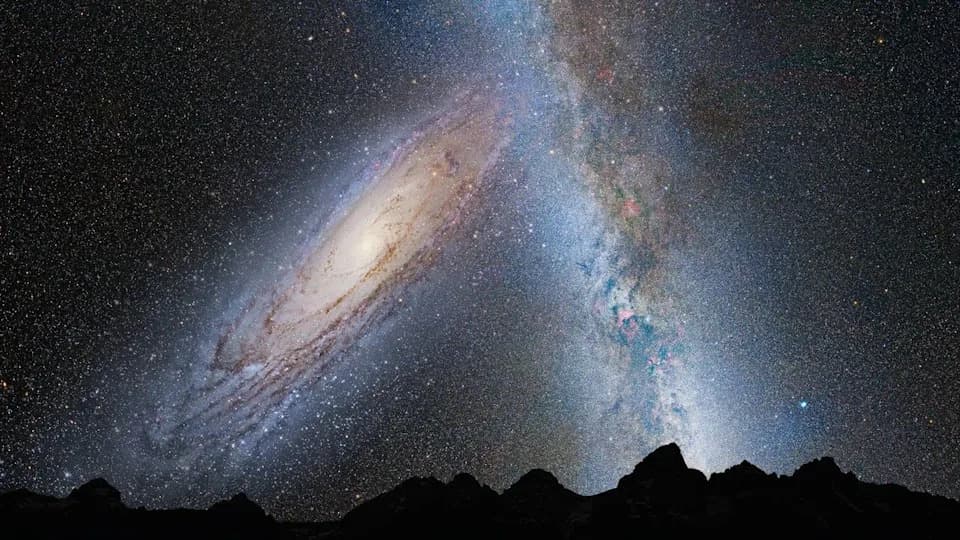
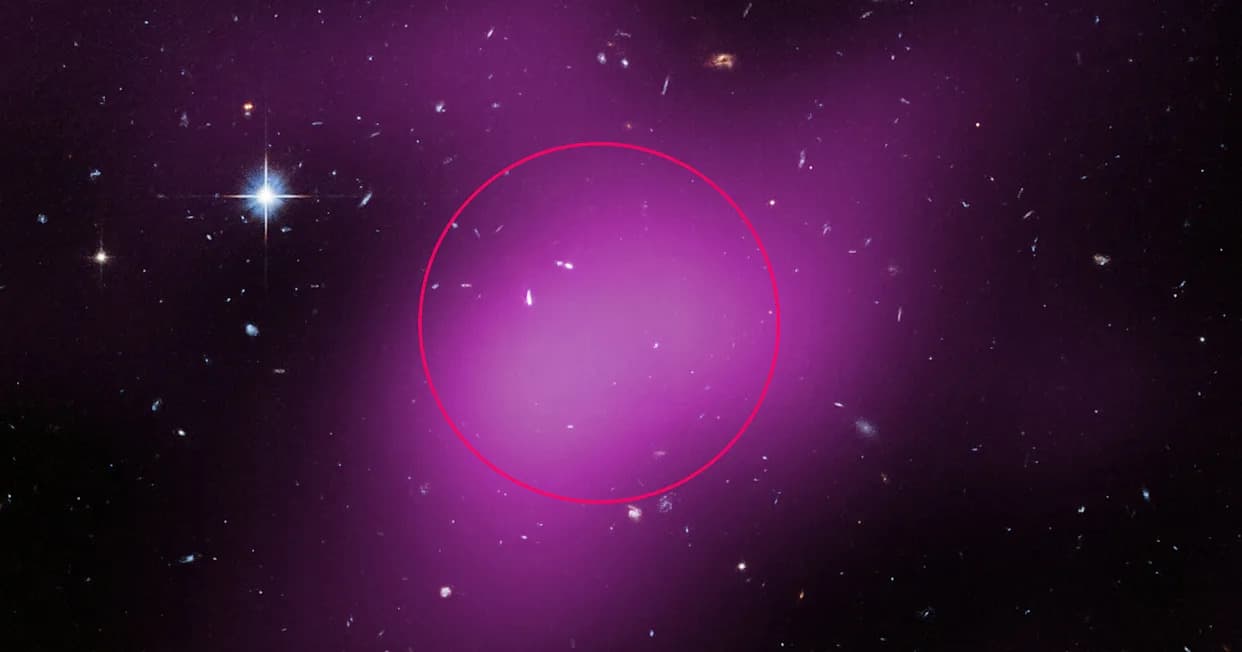
A view of the potential merger between the Milky Way and Andromeda as it may appear in Earth's night sky in 3.75 billion years. . | Credit: NASA; ESA; Z. Levay and R. van der Marel, STScI; T. Hallas; and A. Mellinger
New cosmological simulations suggest the local universe is sculpted by a vast, flattened sheet of mass — largely dark matter — that pulls most nearby galaxies away from the Milky Way, while only the Andromeda Galaxy is on an inward collision course. The result reconciles decades of puzzling observations with the standard Lambda Cold Dark Matter (ΛCDM) cosmological model.
A Cosmic Sheet That Shapes Local Motions
For many years astronomers have noticed a striking pattern: our nearest large neighbor, the Andromeda Galaxy (about 2.5 million light-years away), is rushing toward the Milky Way at roughly 110 kilometers per second (≈68 miles per second), while nearly every other major galaxy in the neighborhood is receding. A study published Jan. 27 in Nature Astronomy argues this difference arises because most nearby galaxies sit inside a broad, flattened distribution of mass that pulls them outward, counteracting the inward gravity of the Local Group (the Milky Way, Andromeda and their bound satellites).
What the Simulations Did
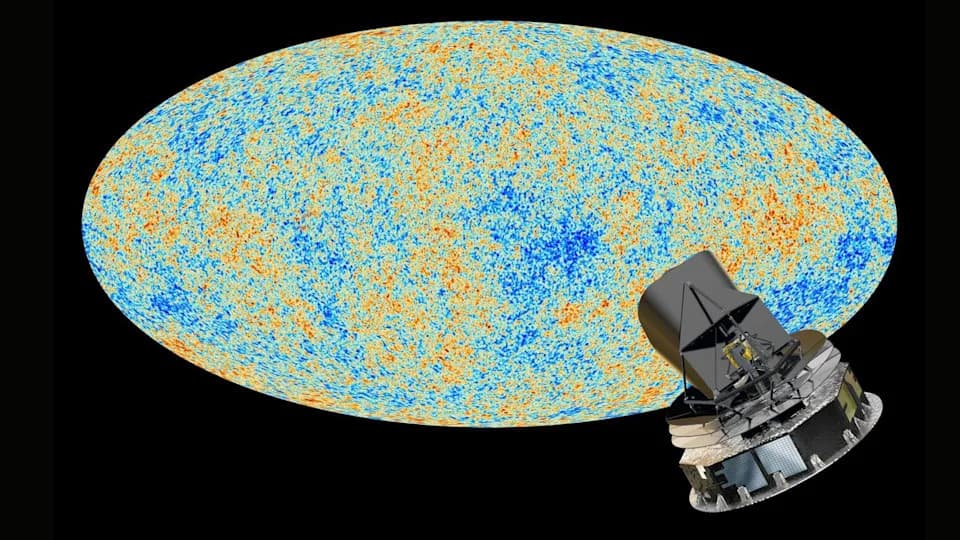
The research team ran many detailed cosmological simulations that started from the mass fluctuations preserved in the cosmic microwave background — the snapshot of the universe when it was about 380,000 years old — and evolved those conditions forward to the present. They constrained their runs to reproduce key observed properties: the masses, positions and velocities of the Milky Way and Andromeda, plus those of 31 galaxies just outside the Local Group, out to about 32 million light-years.
The simulations consistently produced a large, flat sheet of matter (including both dark and visible matter) stretching for tens of millions of light-years around and slightly beyond the Local Group. Galaxies embedded in this sheet feel a net gravitational tug away from the Local Group that nearly cancels the inward pull of the Milky Way and Andromeda — so they recede at or even slightly faster than the Hubble flow.
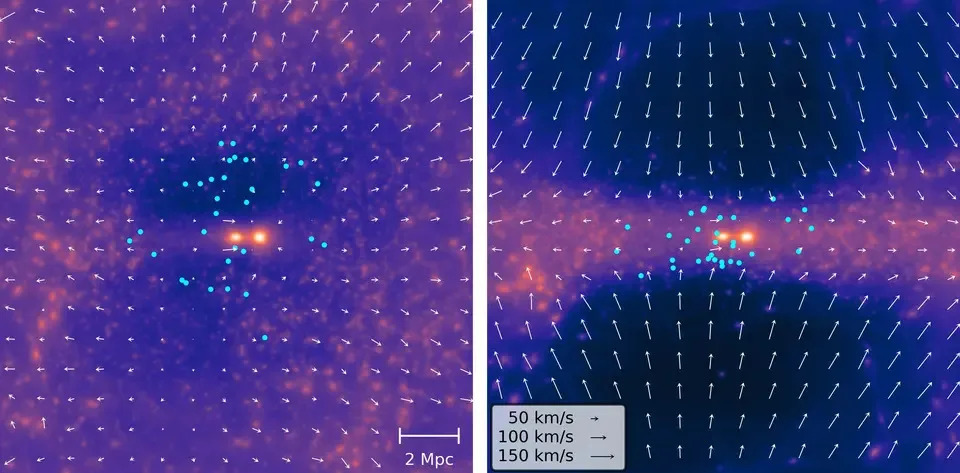
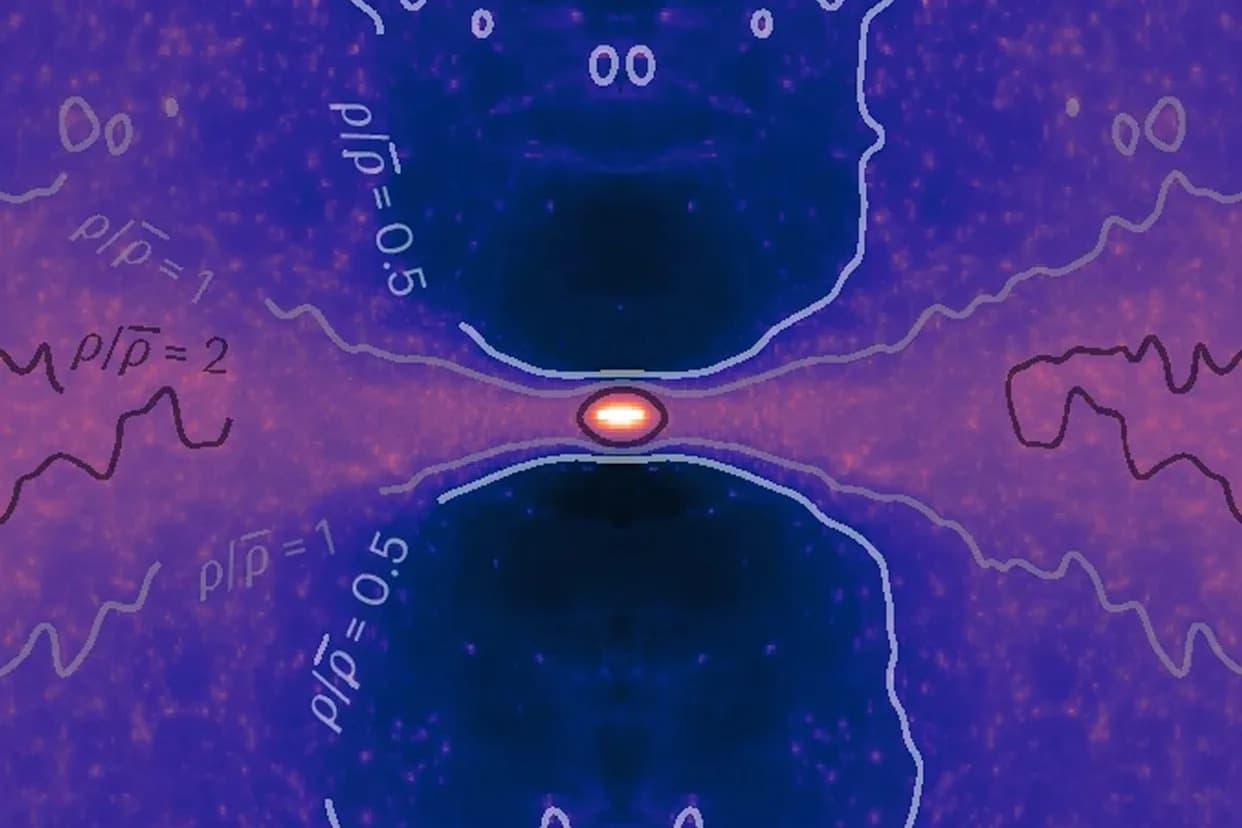
The average distribution of dark matter in the local universe, showing Andromeda and the Milky Way as the two bright-orange blobs at center and the 31 nearby galaxies outside the Local Group as cyan dots. The left image looks down on the flat sheet of dark matter and galaxies, while the right image views it from the side. | Credit: Max Planck Institute for Astrophysics
“The observed motions of nearby galaxies and the joint masses of the Milky Way and the Andromeda Galaxy can only be properly explained with this ‘flat’ mass distribution,” said the study team.
Voids, Walls, and the Cosmic Web
Another crucial element is the arrangement of low-density regions, or voids, above and below the sheet. These voids began slightly underdense in the early universe and expanded faster than average, evacuating matter into surrounding walls and filaments. Because the voids lie where objects would otherwise fall toward the Local Group, their emptiness explains why there are no other massive galaxies careening toward us like Andromeda: there simply aren’t galaxies in those directions to do so.
Simon White, director emeritus of the Max Planck Institute for Astrophysics, explained that if the mass around the Local Group were roughly spherical, external galaxies would be slowed inward by the Milky Way and Andromeda and would recede more slowly than Hubble’s law predicts. Instead, the flattened mass distribution pulls them outward in a way that nearly compensates for the Local Group’s pull.
Consistency With ΛCDM And Future Tests
When the sheet and surrounding voids are included, the simulations reproduce the observed positions and motions of local galaxies and remain consistent with ΛCDM. The team — led by Ewoud Wempe of the University of Groningen — also notes independent observational hints: some higher-latitude galaxies farther out appear to be falling toward the sheet at speeds of several hundred kilometers per hour, and finding more such infalls from void directions would strengthen the case.
Future observations and higher-resolution simulations should test the robustness of the sheet hypothesis and further clarify how large-scale dark-matter structures influence the dynamics of our cosmic neighborhood.
Why This Matters
This result helps resolve a long-standing local cosmological puzzle (first highlighted in 1959 by Franz Kahn and Lodewijk Woltjer): the Milky Way–Andromeda system requires far more mass than visible stars can provide, and that missing mass — now understood as dark matter — not only resides in galaxy halos but also in larger-scale flattened structures that shape nearby galaxy motions.
Help us improve.