The Dark Energy Survey has released its largest cosmic map, showing the distribution of matter is "less clumpy" than standard cosmological models predict. From 2013–2019 DES imaged about 150 million galaxies and followed more than 1,500 Type Ia supernovae from Cerro Tololo, Chile. By combining four probes — supernovae, galaxy clustering, BAO and weak lensing — the collaboration confirmed a persistent tension between late-time structure growth and early-Universe observations. Upcoming surveys will help determine whether the discrepancy signals new physics or observational issues.
Dark Energy Survey's Massive Map Shows the Universe Is Less "Clumpy" Than Models Predict
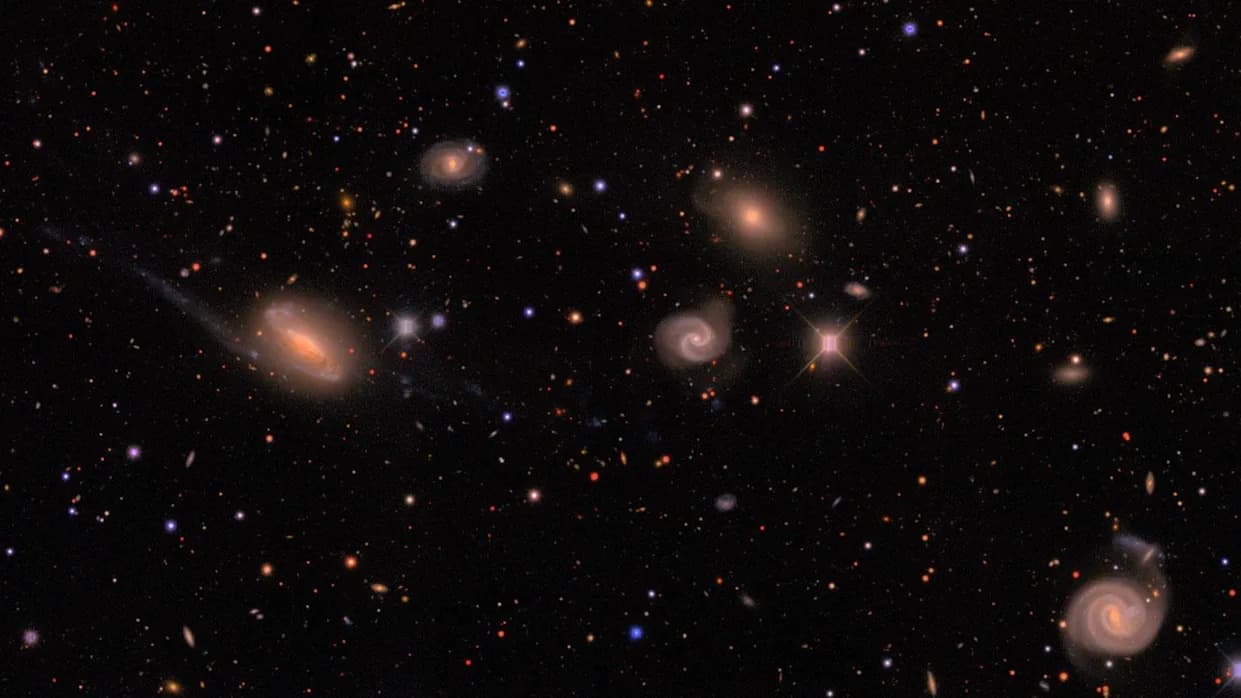
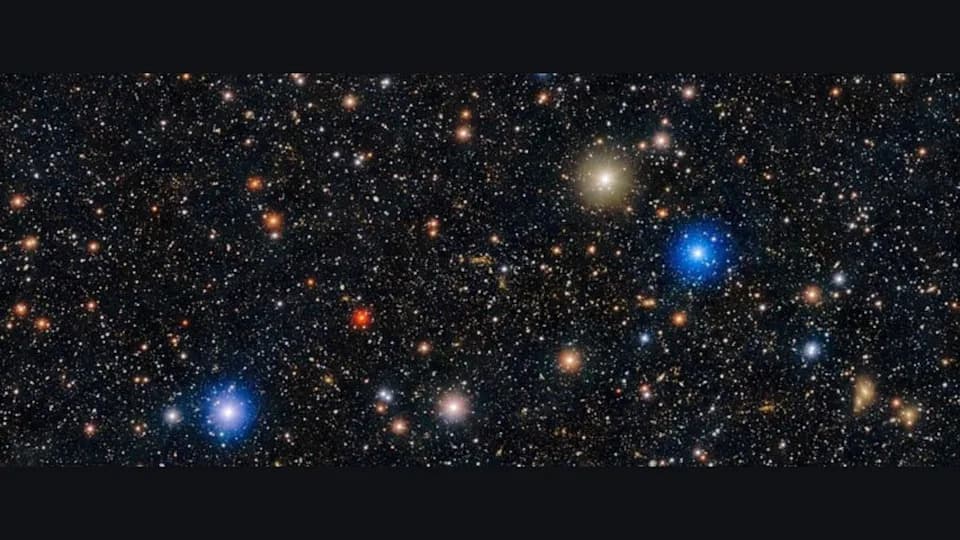
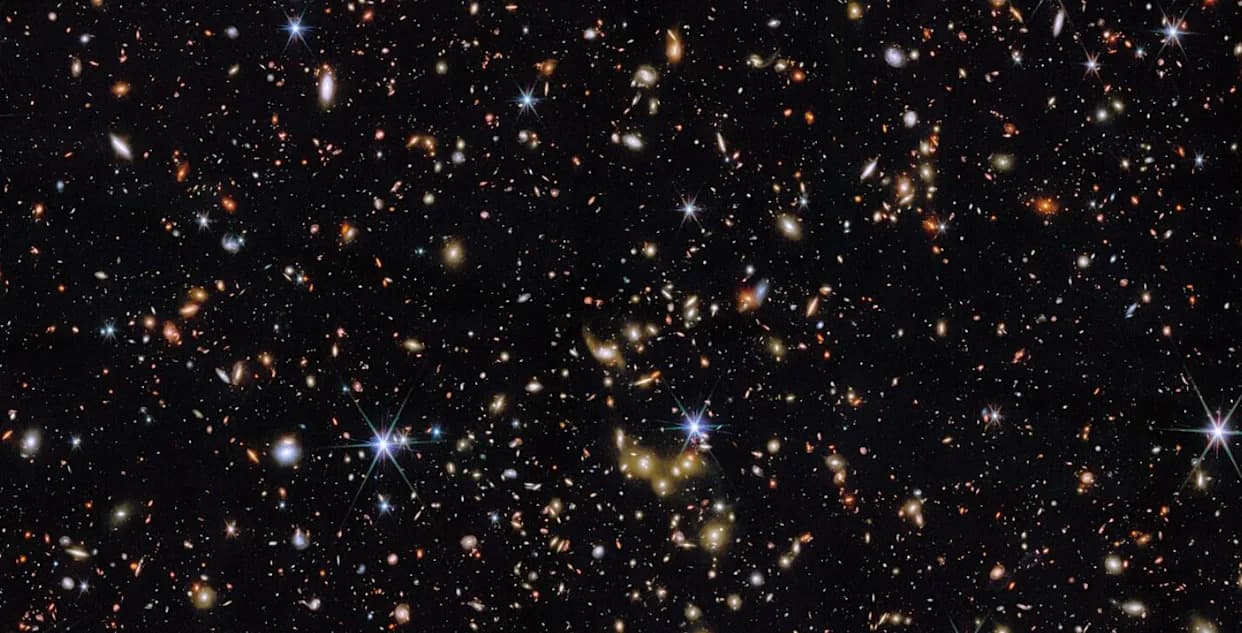
The Dark Energy Survey observed around 150 million galaxies visible in Earth’s southern sky.(Erin Sheldon and the Dark Energy Survey Collaboration)
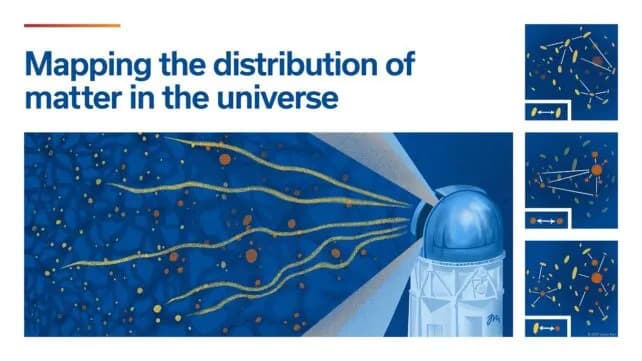
The Dark Energy Survey (DES) has released its largest cosmic map to date, finding that the distribution of matter in the Universe is "less clumpy" than standard cosmological models would predict.
Survey Overview
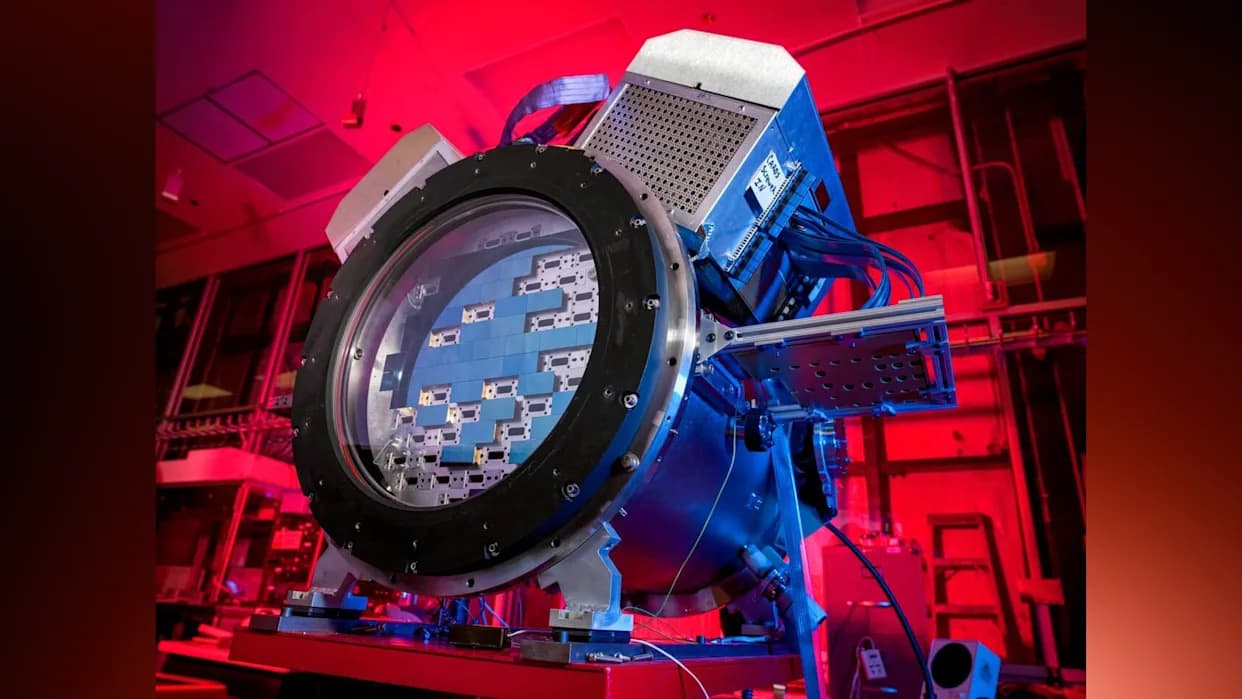
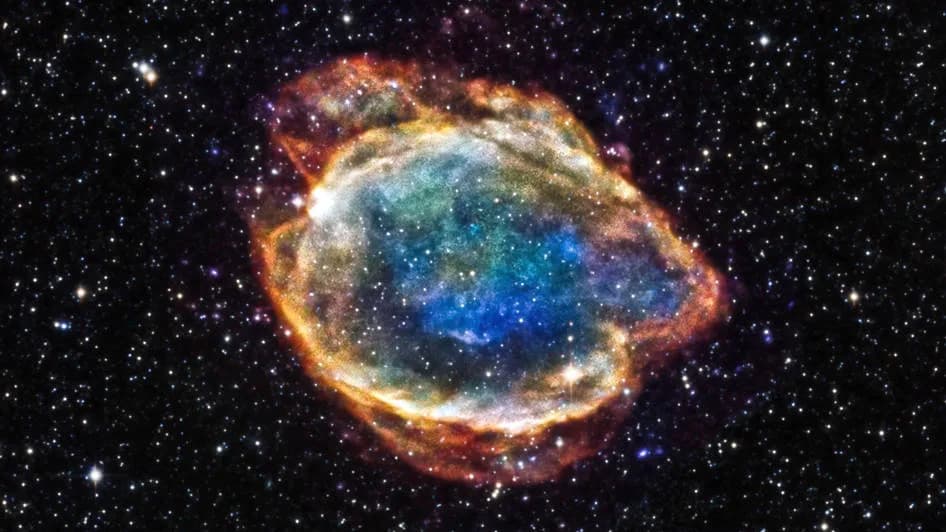
Between 2013 and 2019, the DES collaboration repeatedly imaged a broad swath of the southern sky from the Cerro Tololo Inter-American Observatory in Chile. The survey measured the positions, colours and shapes of roughly 150 million galaxies and discovered and followed more than 1,500 Type Ia supernovae — explosions that astronomers use as precise distance markers to trace the Universe's expansion.
Four Complementary Probes
The DES team combined four independent probes from the dataset: the brightness and properties of Type Ia supernovae; the spatial clustering of galaxies over space and time; the changing scale of relic pressure-wave signatures known as baryon acoustic oscillations (BAO); and weak gravitational lensing, the subtle distortion of background-galaxy images caused by intervening dark matter. By analysing these probes together the collaboration obtained a comprehensive picture of cosmic structure growth at relatively late times.
Main Findings
The combined results refine and sharpen earlier DES measurements and confirm that gravity has not produced as much large-scale clumping of matter as would be expected from observations of the early Universe if the standard model of cosmology were complete. In other words, measurements of structure growth at late times are consistently lower than predicted by the simplest extrapolation of early-Universe data — a persistent tension that challenges cosmologists.
What This Means
This tension does not yet point to a single explanation. Possibilities include unrecognized systematic errors in observations or analysis, new physics such as modifications to the properties of dark energy or gravity, or a statistical fluctuation. Resolving the discrepancy will require independent confirmation and more precise data from current and upcoming surveys.
Future projects — including the Vera C. Rubin Observatory's Legacy Survey of Space and Time (LSST) and space missions such as Euclid and the Nancy Grace Roman Space Telescope — will provide deeper and wider measurements that can test these findings and help determine whether the tension signals new physics or can be traced to measurement issues.
This article is reproduced with permission and was first published on January 30, 2026.
Help us improve.