Hubble observations have confirmed Cloud-9 as the first confirmed RELHIC — a starless, neutral-hydrogen cloud about 14 million light-years away near M94. The cloud contains roughly 1 million solar masses of neutral hydrogen and implies a dark matter halo near 5 billion solar masses, placing it just below the threshold to form a galaxy. This discovery supports the Lambda Cold Dark Matter model and highlights the rarity and fragility of such "failed" galaxies.
Hubble Confirms Cloud-9: A Starless, Gas-Rich 'Failed Galaxy' That Strengthens Dark Matter Theory
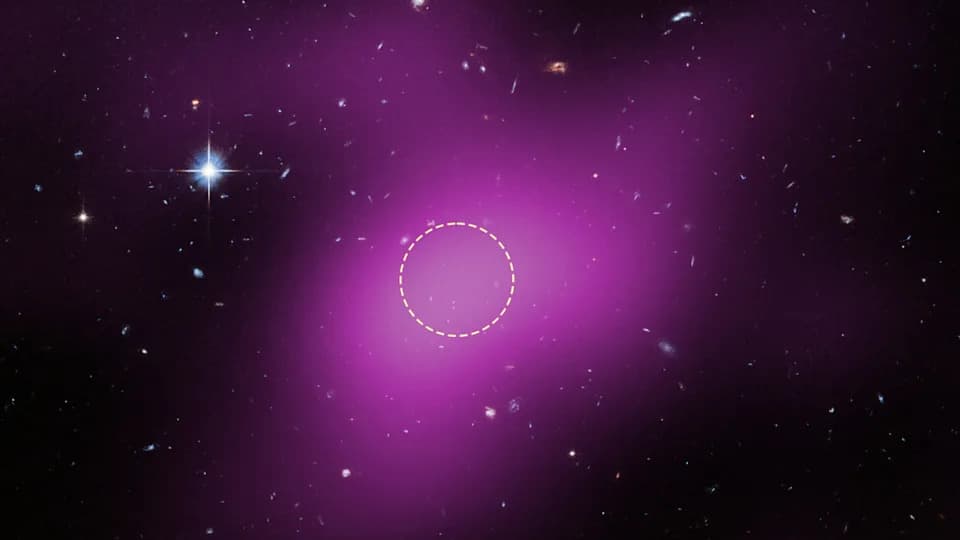
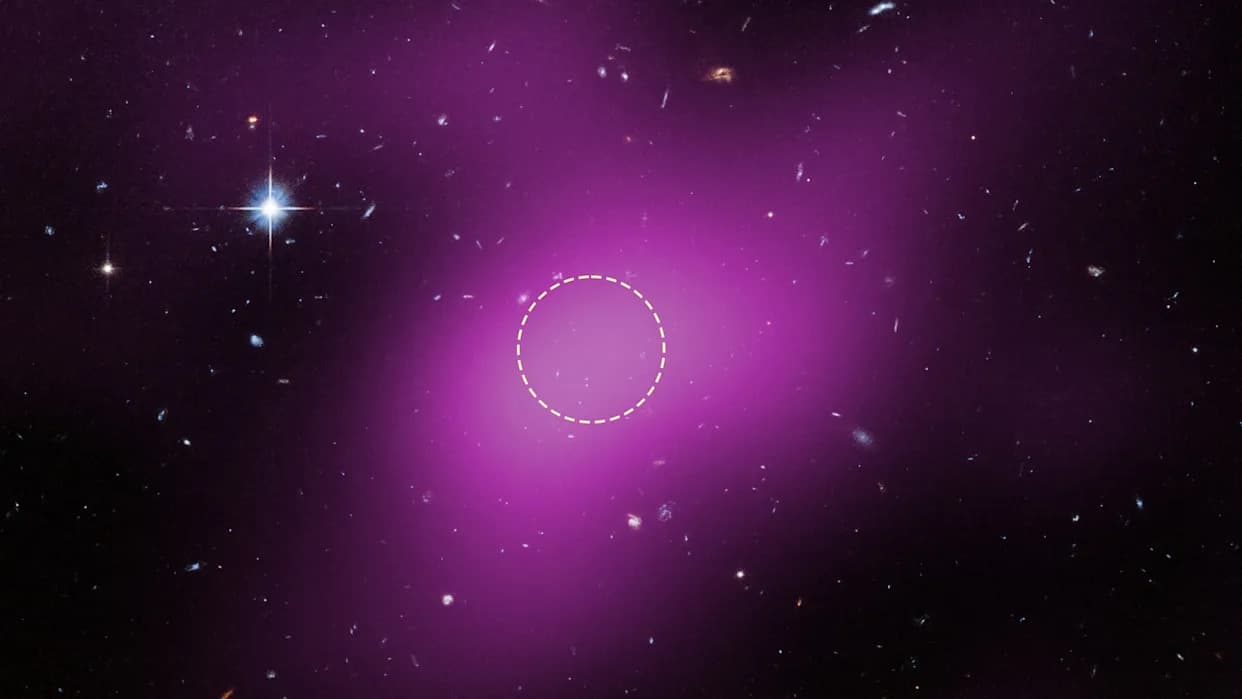
At the center of the dashed circle hides Cloud-9 — a rare type of ‘failed galaxy’ loaded with hydrogen and dark matter, but no discernible stars. | Credit: NASA, ESA. G. Anand (STScI), and A. Benitez-Llambay (Univ. of Milan-Bicocca); Image processing: J. DePasquale (STScI)
Astronomers using the Hubble Space Telescope have confirmed a new and unusual object: Cloud-9, a starless, gas-rich concentration of dark matter that appears to have fallen just short of becoming a conventional galaxy.
Discovery and Observations
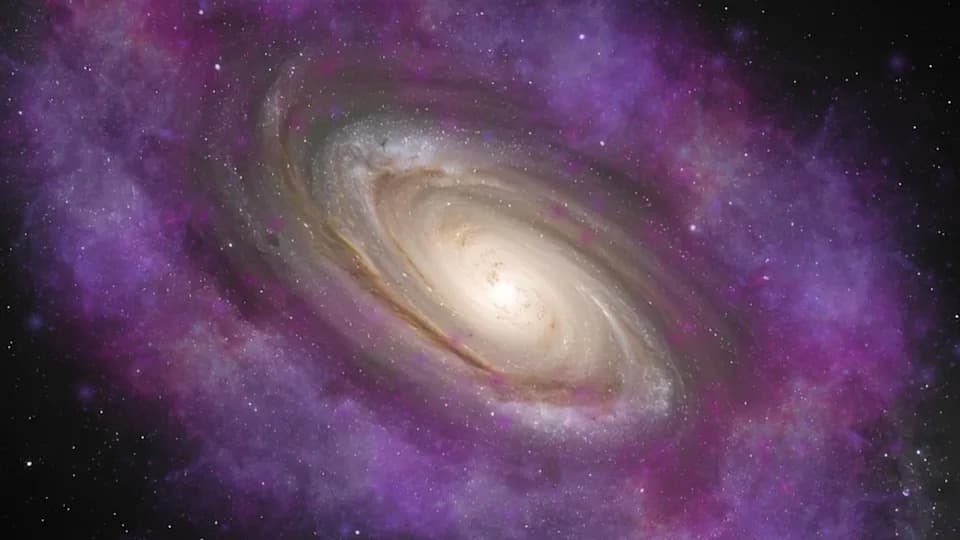
Cloud-9 lies more than 14 million light-years from Earth near the spiral galaxy Messier 94 (M94). It was first detected three years ago by the Five-hundred-meter Aperture Spherical Telescope (FAST) in China. Follow-up radio observations with the Very Large Array (VLA) focused on a bright core roughly 5,000 light-years across but could not definitively classify the object. A decisive follow-up with Hubble’s Advanced Camera for Surveys (ACS) detected neutral hydrogen, revealing Cloud-9 as the first confirmed RELHIC (Reionization-Limited H I Cloud).
What Makes Cloud-9 Special?
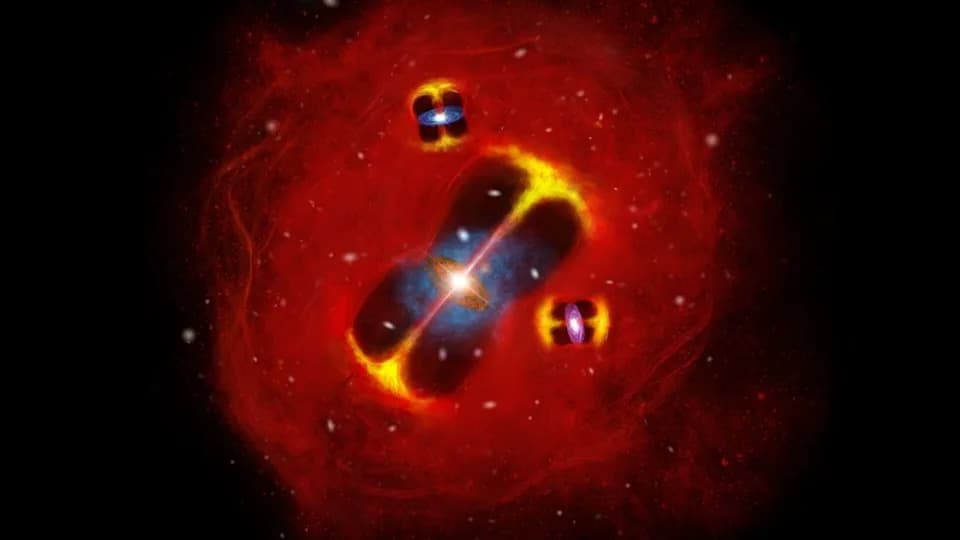
RELHICs are rare neutral-hydrogen clouds thought to be relics of the early universe: dark-matter halos that retained gas but never formed stars. The team’s analysis estimates Cloud-9 contains about 1 million solar masses of neutral hydrogen. That gas mass alone is insufficient to bind the cloud gravitationally, so the researchers infer a dark matter halo of roughly 5 billion solar masses, placing Cloud-9 just below the critical mass threshold needed for collapse into a star-forming galaxy.
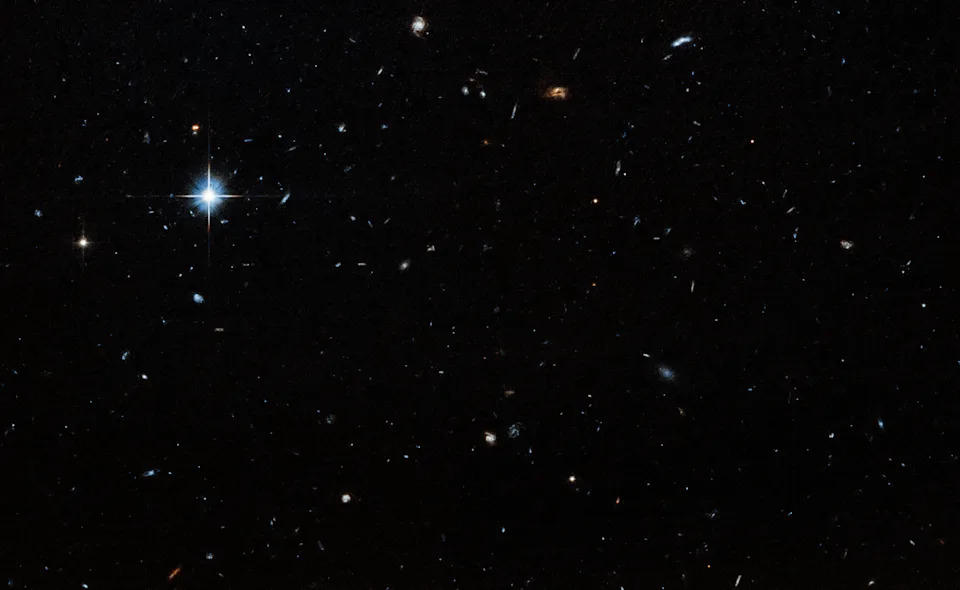
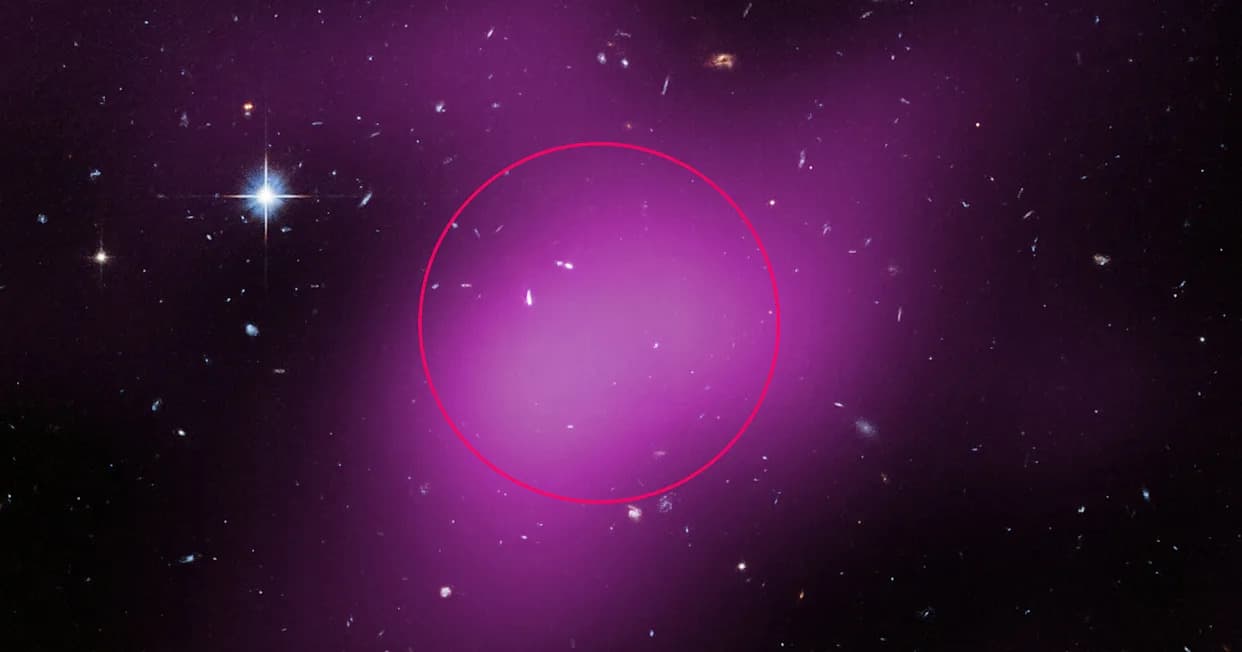
Cloud-9 was spotted in this region of space, about 2,000 light-years from Earth. | Credit: NASA, ESA. G. Anand (STScI), and A. Benitez-Llambay (Univ. of Milan-Bicocca); Image processing: J. DePasquale (STScI)
“Cloud-9 lies at the very upper end of the dark halo mass range, thus allowing it to retain its gas, and therefore being visible through radio observations. This is indeed a strong confirmation of a cornerstone prediction of LCDM,” said Deep Anand of the Space Telescope Science Institute, lead author of the study.
Cosmological Significance
This finding is a strong observational confirmation of a key prediction from the Lambda Cold Dark Matter (LCDM) model: many low-mass dark matter halos exist, but only some grow massive enough to form galaxies. Cloud-9 sits in thermal equilibrium with the cosmic ultraviolet (UV) background, whose heating keeps gas ionized and too warm to form stars—one reason the object is starless today.
Rarity and Future Prospects
RELHICs are expected to be rare and fragile. Environmental effects such as ram-pressure stripping can remove their gas as they travel through intergalactic space. The Cloud-9 team reports signs that the hotter circumgalactic medium around nearby M94 may already be perturbing the cloud. Alejandro Benítez-Llambay, principal investigator of the program, notes that two conditions are required for a system to survive as a present-day, starless gas cloud: an unusually slow halo assembly history and sufficient isolation. Fewer than 10% of similar halos may remain as pristine as Cloud-9.
Why This Matters
Published Nov. 10 in The Astrophysical Journal Letters and presented at the 247th meeting of the American Astronomical Society, the Cloud-9 discovery provides a tangible benchmark for dark matter and galaxy-formation theory. Although speculative scenarios could allow Cloud-9 to accrete more mass and eventually form stars, for now it stands as a rare, direct glimpse of the dark side of cosmic structure.
Looking ahead: FAST, the VLA and space telescopes like Hubble will continue searching for similar objects. Finding more RELHICs will help astronomers map the low-mass end of the halo population and test predictions of cosmological models.
Help us improve.