The Dark Energy Survey has released a unified analysis of its six‑year dataset, combining BAO, Type Ia supernovae, galaxy clusters and weak lensing. The results broadly support the standard Lambda‑CDM model but are also compatible with an evolving dark‑energy model (wCDM). A mild tension appears in late‑time galaxy clustering, though it is far below the five‑sigma level required to claim new physics. DES will test alternative models, including modified gravity, and future data will determine whether this hint strengthens or fades.
Six-Year Dark Energy Survey Release Hints at Physics Beyond Lambda‑CDM
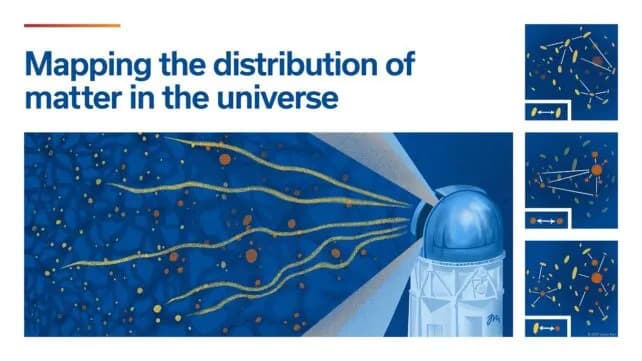
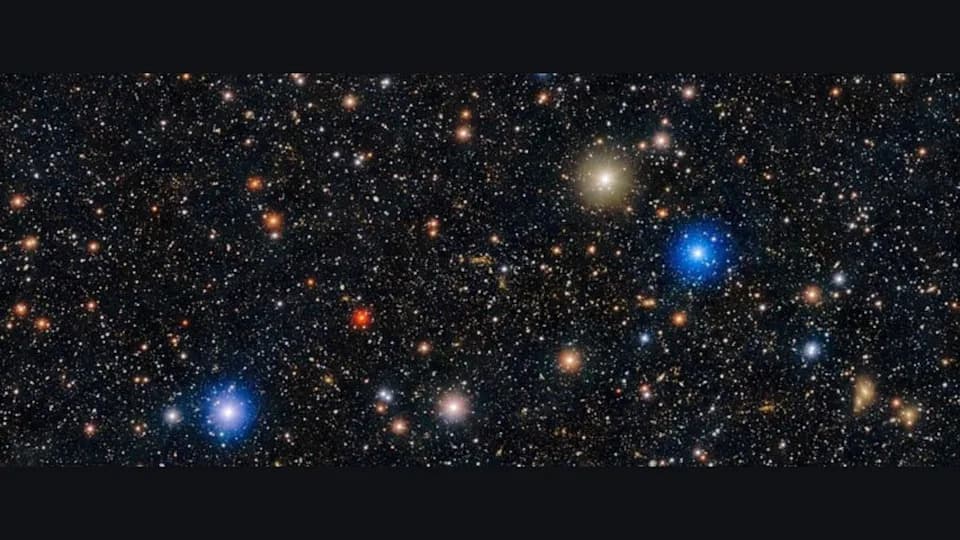
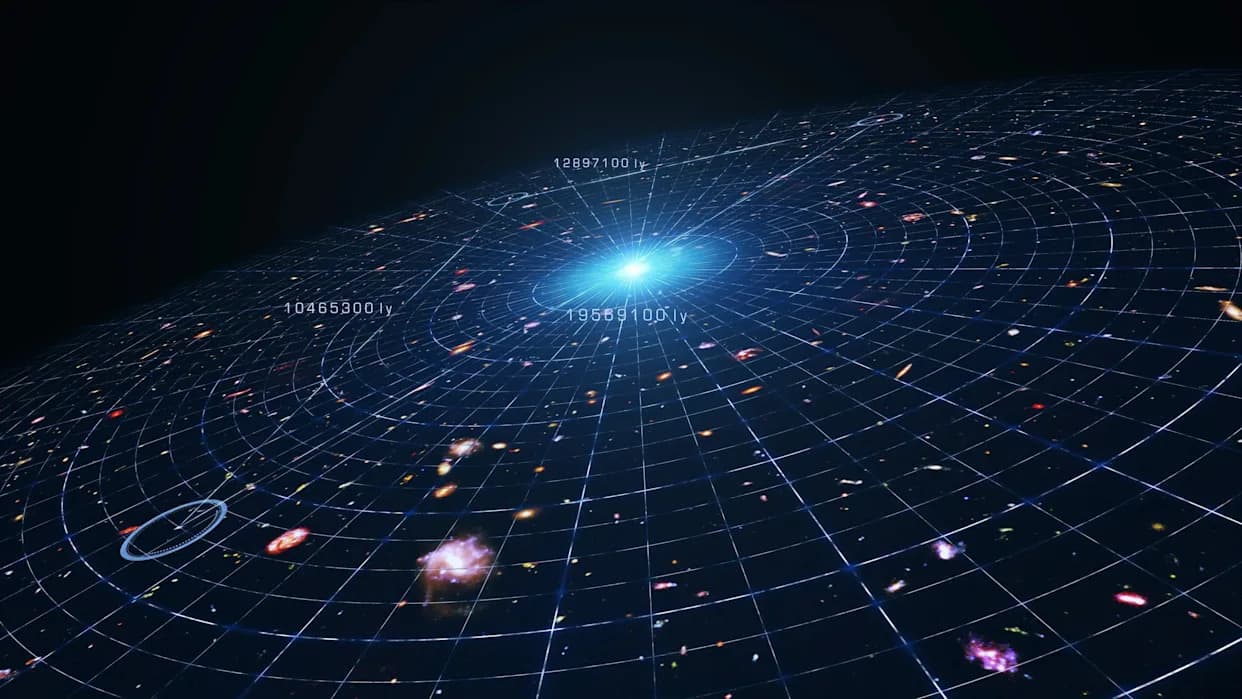
An illustration of how DES maps the distribution of matter in the Universe, by calculating the distances between galaxies (yellow) and lensing objects (orange). (Jessie Muir/DES Collaboration)
Astrophysicists are closer than ever to pinning down the mysterious force that drives the Universe's accelerating expansion. The Dark Energy Survey (DES) collaboration has published a comprehensive analysis of its full six-year dataset, combining four independent cosmological probes to produce the most complete empirical portrait yet of dark energy.
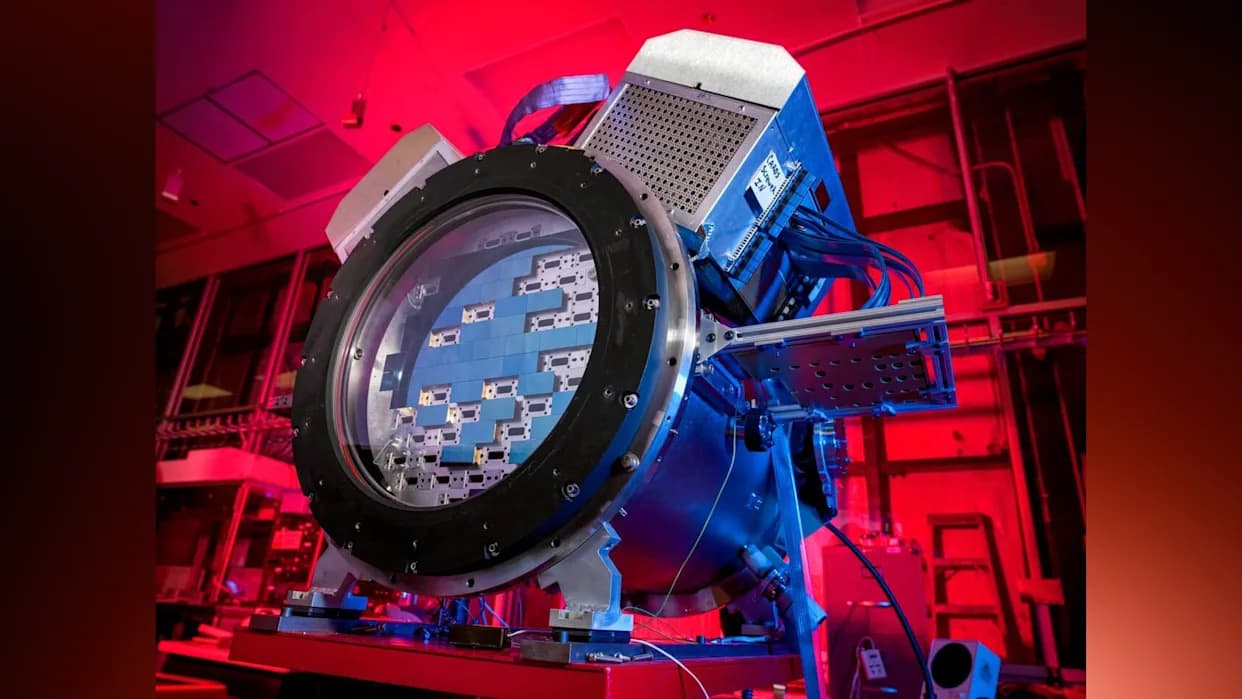
What DES measured: From 2013 to 2019 DES mapped a large portion of the southern sky and used four complementary techniques — baryon acoustic oscillations (BAO), Type Ia supernovae, galaxy cluster counts, and weak gravitational lensing — to trace how the expansion rate and structure growth evolved across cosmic time.
Key findings: Overall, the DES results remain consistent with the standard Lambda Cold Dark Matter (Lambda‑CDM) model, in which dark energy (Lambda) is a constant energy density that makes up roughly 68% of the Universe's energy budget, cold dark matter accounts for about 27%, and ordinary baryonic matter about 5%.

Audition now for ScienceAlert's Casting Call
At the same time, the DES data are also statistically compatible with an alternative parametrization called wCDM, in which the dark‑energy equation-of-state parameter w can differ from the Lambda value of −1. This means the observations do not yet decisively distinguish a constant dark energy from a slowly evolving one.
A notable, though not decisive, tension appears in the pattern of galaxy clustering at relatively recent times: the amplitude of matter clustering inferred from late‑time DES data is mildly lower than the value extrapolated from earlier epochs under both Lambda‑CDM and wCDM.
Importantly, this discrepancy is far short of the five‑sigma threshold normally required to claim a discovery. It could therefore be a statistical fluctuation, an unrecognized systematic error, or the first hint of new physics. The DES collaboration plans follow-up analyses to test alternative models — including variants of dark energy and possible modifications of gravity — to see whether such extensions improve the fit.
Publication and next steps
The full DES analysis is described across 19 papers, with an accompanying summary submitted to Physical Review D. Future surveys and additional cross-checks will be essential to determine whether the mild tension grows stronger or disappears as more data arrive.
Bottom line: The six‑year DES release tightens constraints on cosmic acceleration and opens intriguing, but not yet definitive, avenues for new theoretical work.
Help us improve.