Tobacco hornworm caterpillars (Manduca sexta) can detect airborne sound and jump in response, using fine body hairs as sensory structures. In controlled tests inside an anechoic chamber, caterpillars reacted 10–100 times more strongly to airborne tones (150 Hz and 2,000 Hz) than to substrate vibrations. Removing the hairs reduced the response, suggesting the hairs act as auditory-like sensors. Researchers propose this ability may help caterpillars evade predatory or parasitic wasps that beat their wings at ~100–200 Hz and could influence pest-management ideas.
How Tobacco Hornworms 'Hear' Danger: Body Hairs Let Caterpillars Detect Approaching Predators
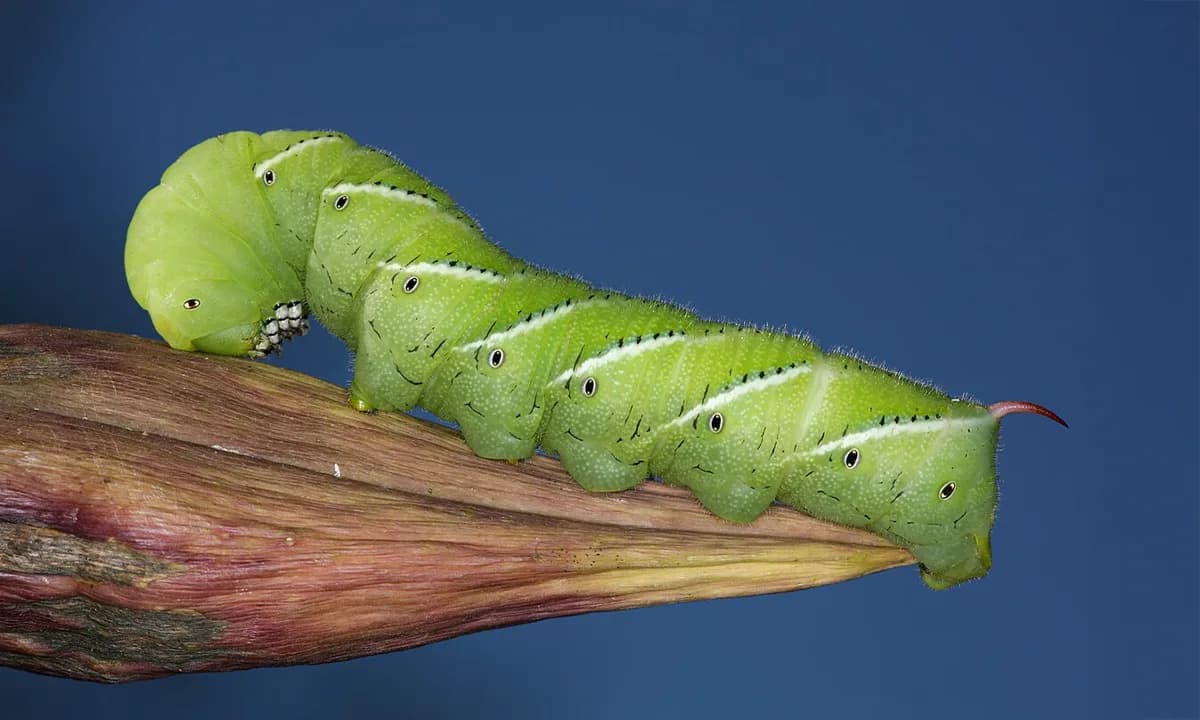
Lead image: Daniel Schwen / Wikimedia Commons(Tobacco Hornworm, found in Urbana, Illinois, USA. Credit: Daniel Schwen / Wikimedia Commons.)
Farmers across North America recognize tobacco hornworms — smooth, lime-green caterpillars that look as if they were molded from Play‑Doh — as common pests of tobacco, tomatoes, peppers and eggplants (plants in the Solanaceae family). New research presented at a meeting on animal bioacoustics reveals that these larvae can detect airborne sound and use fine body hairs as sensory organs to trigger escape behaviors.
A biologist at Binghamton University long noticed a curious habit in the lab: the hornworms would jump whenever a researcher spoke to them. "Every time I went 'boo' at them, they would jump," she said, and the observation sat in the back of her mind until it prompted formal investigation.
Carefully Controlled Acoustic Tests
To determine whether the caterpillars responded to airborne sound or to vibrations transmitted through plants, researchers (including mechanical engineer Ronald Miles and colleagues at Binghamton University) placed hornworms inside an anechoic chamber — one of the quietest types of rooms, designed to eliminate echoes — and exposed them to pure tones at low frequency (150 Hz) and high frequency (2,000 Hz).
Using setups that delivered sound without substrate vibration, and vibration without airborne sound, the team found that caterpillars were 10 to 100 times more responsive to airborne sound than to vibrations in the plant stem. That result was surprising because caterpillars are generally assumed to lack dedicated ears.
Body Hairs Act As Sound Sensors
To probe how the hornworms detected sound, researchers gently removed the fine body hairs from some individuals (a process called denuding). Denuded caterpillars showed a markedly reduced jump response to airborne tones, implicating the hairs as sensory structures that mediate the reaction.
Key result: With intact hairs, caterpillars responded strongly to airborne tones, especially in the low-frequency range; removing hairs dampened that sensitivity.
Why This Might Have Evolved
The team hypothesizes that this sensitivity evolved to help hornworms evade predatory or parasitic wasps. Many wasps beat their wings at roughly 100–200 Hz; if a caterpillar can detect those wingbeats, a sudden jump or twitch could shift its position and reduce the chance of being parasitized or captured. Alternatively, the movement could simply be a general startle response when an approaching threat is detected.
Implications
These findings expand our understanding of insect sensory biology by showing that body hairs can function as auditory-like sensors for airborne sound. The discovery may also inform future pest-management strategies by highlighting a previously unrecognized sensory channel that influences caterpillar behavior in crop systems.
Originally reported by Nautilus and presented at a meeting on animal bioacoustics.
Help us improve.