Researchers found that some rove beetles survive inside velvety tree ant colonies by acquiring the ants’ cuticular hydrocarbons (CHCs) and, in one striking case, by stopping their own CHC production. Sceptobius lativentris grooms onto ants to harvest and smear the ants’ scent, fooling workers into feeding and tolerating the beetles. The stolen scent fades in roughly 20 hours and must be continuously renewed; separated beetles desiccate and die in under a day, effectively trapping them in the symbiosis. Scientists are now probing how this relationship evolved and how host and parasite remain balanced.
How Beetles Steal Ants' Scent to Live Undetected — and Why They Can't Survive Alone
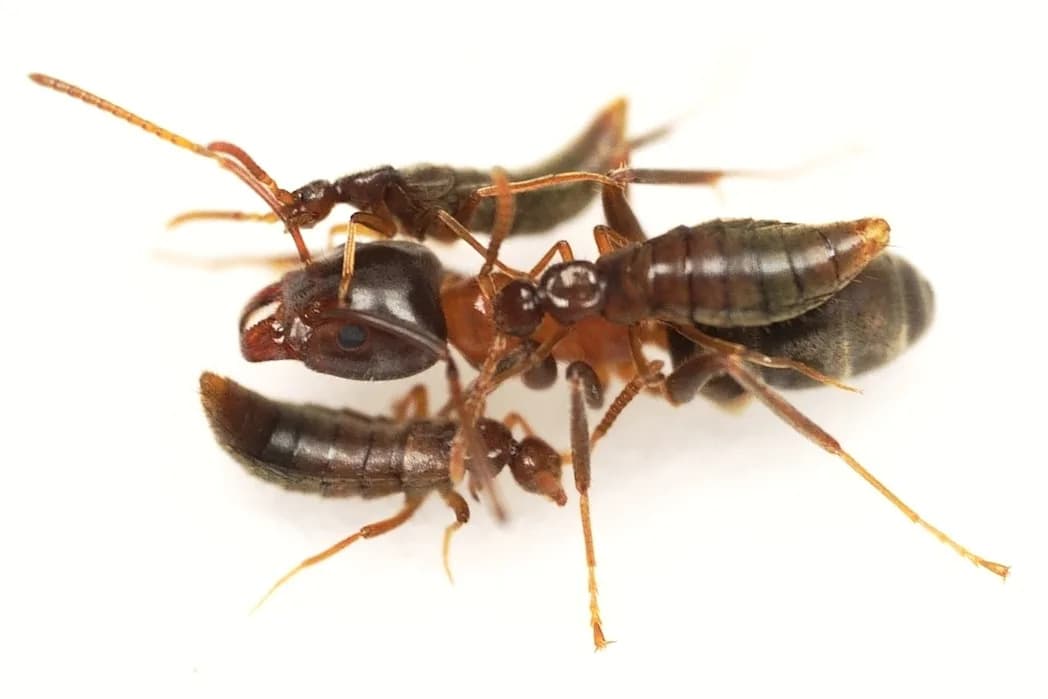
Sceptobius beetles are seen grooming an ant as part of their evolved symbiotic relationship.D. Miller, Parker Lab/Caltech
Life inside an ant colony is a double-edged sword for some rove beetles: abundant food and the ants’ protection, but only for those that can pass the ants’ chemical security check. A new study in Cell reveals how one species, Sceptobius lativentris, effectively steals ant odor to slip into velvety tree ant nests — and why that trick traps the beetles in lifelong dependence.
How Ants Recognize Nestmates
Velvety tree ants identify nestmates through antennation: when two ants meet they tap antennae and read a unique chemical signature made of cuticular hydrocarbons (CHCs). CHCs are waxy molecules every insect produces to prevent drying, but ants also use them as an identity badge. Any intruder must bypass this CHC-based recognition system to live among ants.
Different Beetles, Different Strategies
The researchers compared CHC profiles of three rove beetle species that associate with velvety tree ants to varying degrees. Each lineage evolved ant association independently and uses a distinct tactic:
- Platyusa sonomae: Produces some ant-like CHCs but not enough for full acceptance; it lives at the colony margin and may represent an intermediate evolutionary stage.
- Liometoxenus newtonarum: An imperfect chemical mimic that supplements its disguise with appeasing compounds; it feeds on ants outside the nest.
- Sceptobius lativentris: Takes chemical stealth further by largely turning off its own CHC production and physically acquiring the ants’ scent.
Scent Theft: Grooming as Chemical Burglary
Adult Sceptobius beetles perform a dramatic grooming maneuver to harvest host odor: they grip an ant’s antenna with their mandibles, scrape their legs across the ant’s body, then rub the legs over themselves. The result is a CHC profile that mirrors the ants’ so closely the beetles are accepted as nestmates. Once perfumed, ants not only refrain from attacking but will regurgitate food for the beetles and allow them to feed on larvae and eggs.
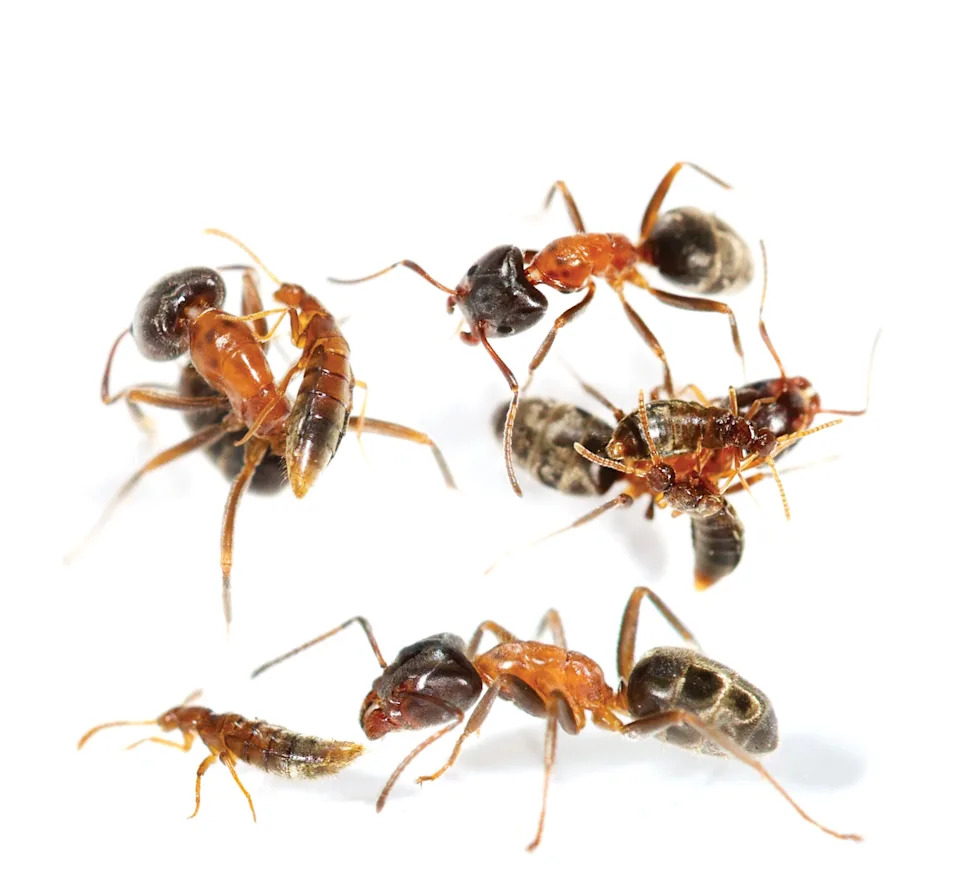
Researchers recently reported on a species of Sceptobius beetles that have evolved to chemically mimic pheromones secreted by Liometopum ants, allowing the beetles to parasitically infiltrate ant colonies.D. Miller, Parker Lab/Caltech
“It’s scooping up the ant’s CHC profile and essentially basting itself with the ant’s chemical cues, so it then gets accepted as a nest mate,” says Joseph Parker, the study’s senior author.
The Evolutionary Trap: Why the Trick Is Also a Prison
There’s a cost. Parker’s experiments show the ant-derived CHCs on Sceptobius fade within ~20 hours and require constant replenishment. Because adult Sceptobius have largely shut down CHC synthesis, they cannot re-establish their own waterproof coating and quickly desiccate when separated from the ants’ environment — often dying in less than a day. Resuming independent CHC production would expose them to host aggression, so the beetles are effectively trapped in the symbiosis.
Could They Switch Hosts?
In lab trials described in a related Current Biology paper (2025), Sceptobius attempted to approach and groom other ant species, though those ants typically attacked. These attempts suggest behavioral flexibility that, given the right ecological conditions, might allow shifts to different hosts over evolutionary time.
Next Questions for Researchers
Parker’s lab plans to investigate how myrmecophilous beetles evolved from resisting ants to seeking them out, and how parasitic beetles and ant hosts maintain a long-term balance without one overrunning the other — a central problem for symbioses that persist across deep timescales.
Reporting: The study is led by Joseph Parker (Caltech). Jason Bittel, a National Geographic contributor, reported the original article; his book Grizzled is forthcoming.
Help us improve.