Scientists observed small Cyclosa spiders building oversized, spider-shaped decorations on their webs across Peru, the Philippines and Madagascar. Made from prey remains and plant debris, these decoys form a central body with radiating legs and are hypothesized to deter predators such as hummingbirds and damselflies. Some spiders actively 'puppeteer' the figure to mimic a larger spider, while others hide inside it. Researchers say controlled experiments are needed to confirm how predators respond.
Tiny Spiders Build Giant Spider-Shaped Decoys to Scare Off Predators
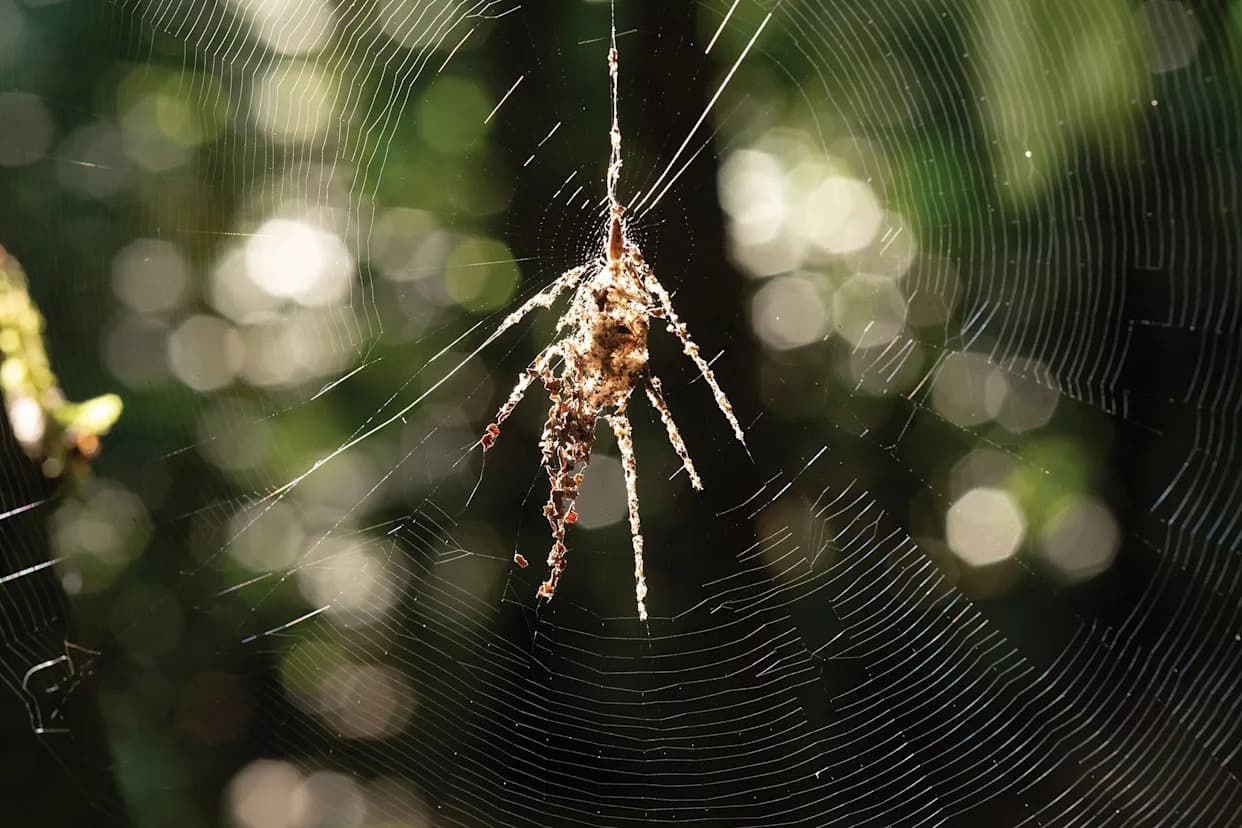
This spiderweb structure presents the illusion of an intimidating bigger spider.(Richard Kirby)
Researchers have documented a striking defensive behavior: tiny orb-weaving spiders constructing oversized, spider-shaped silhouettes on their webs to deter would-be predators.
What the Study Found
Between 2012 and 2022, scientists collected observations of these unusual web decorations in Peru, the Philippines and Madagascar. The team studied roughly 300 individuals from the genus Cyclosa, spiders that are typically only a few millimetres long. The findings were published in the journal Ecology and Evolution.
How The Decoys Are Built
The faux spiders are assembled from prey carcasses, plant fragments and other organic materials. Each construction has a central mass from which radiating "legs" extend, producing a clear spiderlike outline. The materials and arrangement create a conspicuous silhouette that can be much larger than the real spider.
Possible Functions And Behavior
The researchers propose these assemblages primarily serve as a defense against predators such as hummingbirds and helicopter damselflies, though function may vary among species and populations. In some Peruvian populations, spiders appear to use the decoys as movable displays: study co-author Phillip Torres, an entomologist and television host, reports that the spider sits atop the figure and shakes the web, effectively puppeteering the silhouette to mimic a larger spider and potentially frightening off smaller predators or specialists that avoid larger prey.
By contrast, observations from the Philippines show some spiders hiding inside the structure and remaining still until a threat passes, suggesting an alternative defensive strategy of concealment rather than intimidation.
Next Steps
External experts urge caution before assigning a single function to these decorations. As ecologist Dinesh Rao of Veracruzana University notes, careful observational studies or controlled experiments are needed to measure how predators actually respond to these structures and to test alternative hypotheses.
'You need either careful observations or experimental conditions where you actually look at how [predators] respond to these structures.' — Dinesh Rao
The discovery adds a vivid example to the diversity of web decorations and behavioral defenses in spiders, and highlights how small animals can use clever tactics to manipulate predator perception.
Help us improve.