The JWST VENUS program has discovered two gravitationally lensed supernovas, SN Ares and SN Athena, whose light is split into multiple images that arrive at different times. SN Ares exploded nearly 10 billion years ago and will produce additional images arriving in about 60 years; SN Athena should reappear within 1–2 years. Measuring these time delays provides an independent, geometrical way to constrain the Hubble constant and help address the longstanding Hubble tension.
JWST’s VENUS Program Finds Two ‘Time‑Warped’ Supernovas — A New Way to Measure Cosmic Expansion
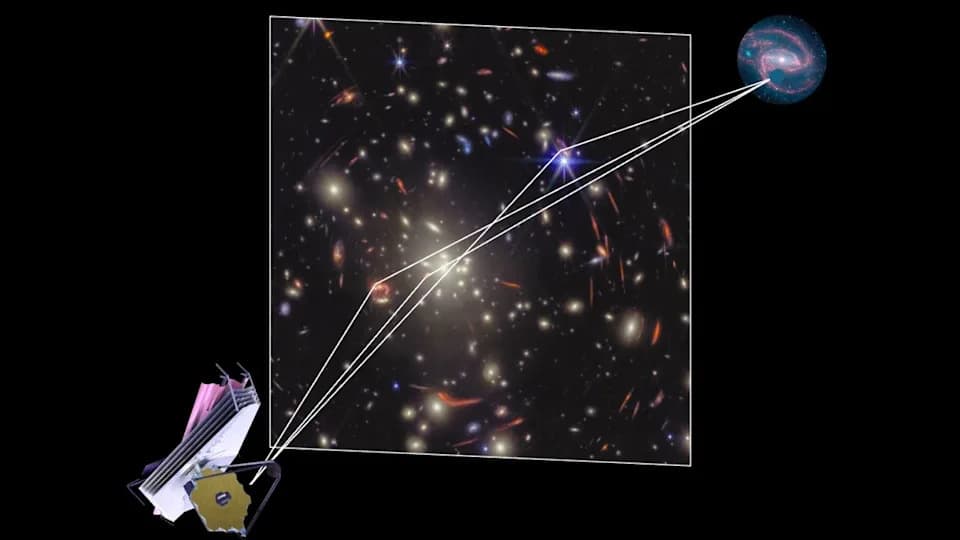
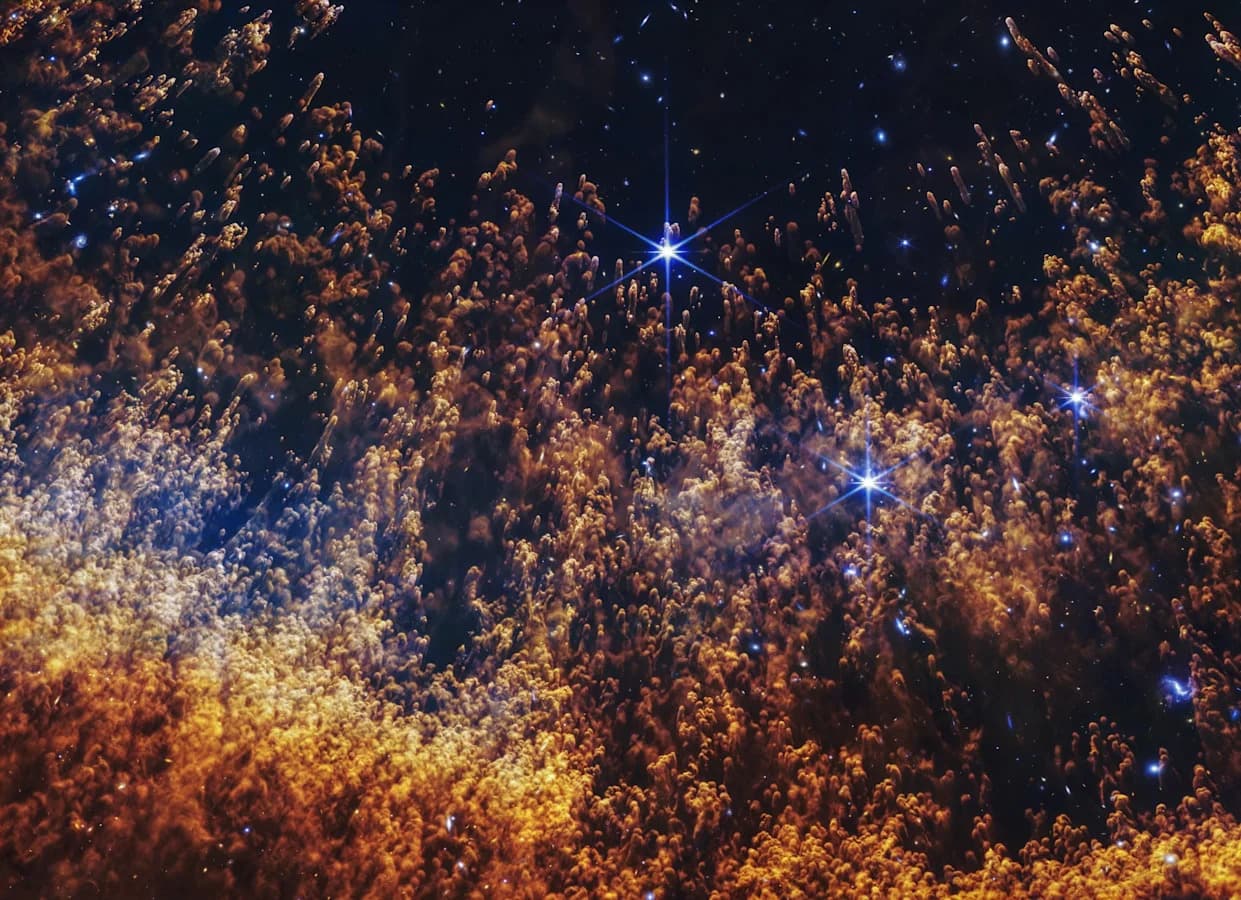
The massive MJ0308 galaxy cluster in the foreground produces a gravitational lensing effect, which causes multiple images of SN Ares to appear. . | Credit: NASA/ESA/CSA/image processing: Gavin Farley
Two exceptionally rare, gravitationally lensed supernovas discovered by the James Webb Space Telescope’s VENUS program give astronomers a new, independent way to measure how fast the universe is expanding.
Gravitational lensing — the bending and splitting of light by massive foreground galaxy clusters — has produced multiple images of each explosion. Because each image follows a different route through curved space-time, some arrive at Earth earlier than others. Measuring those arrival-time differences yields a geometrical distance measurement that can constrain the Hubble constant independently of other methods.
What Was Discovered
Conor Larison, a postdoctoral researcher at the Space Telescope Science Institute, announced at the 247th meeting of the American Astronomical Society that VENUS (Vast Exploration for Nascent, Unexplored Sources) has identified two lensed supernovas: SN Ares and SN Athena. VENUS uses JWST to survey 60 massive galaxy clusters that act as natural telescopes, magnifying extremely distant and faint sources.
SN Ares exploded nearly 10 billion years ago, when the universe was about one-third of its current age. The foreground cluster MJ0308 has split Ares’ light into three images. One image has already reached our telescopes; two other images travel paths that pass much closer to MJ0308’s dense core and are predicted to arrive roughly 60 years from now — an unprecedentedly long delay for a single lensed supernova.
SN Athena, which exploded when the universe was about half its present age, has a shorter predicted delay: a reappearing image is expected within the next one to two years. Athena will provide an immediate test of the models and predictions that produced the Ares timing.
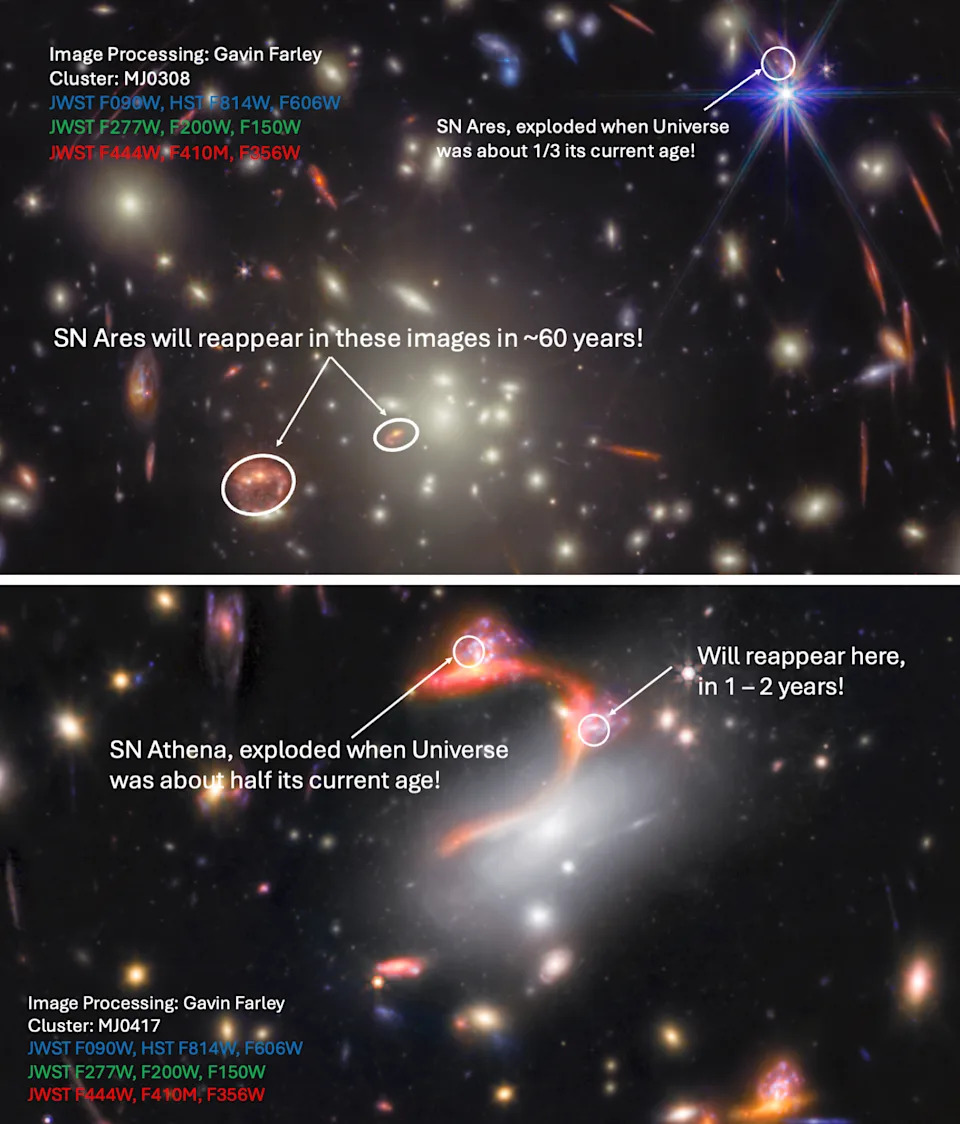
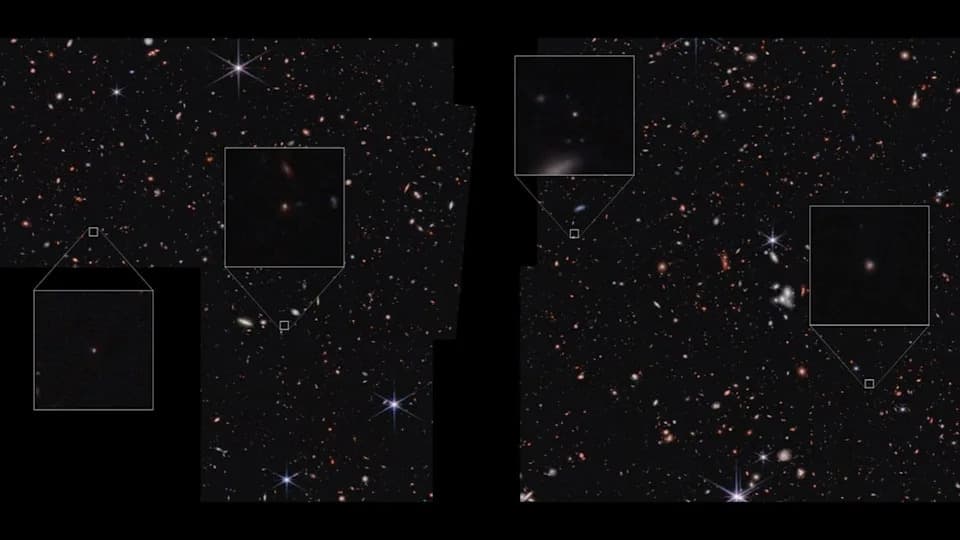
Combined data from the Hubble Space Telescope and the James Webb Space Telescope capture the gravitationally lensed supernovas SN Ares and SN Athena. The researchers can predict when and where their images will reappear in the future. | Credit: NASA/ESA/CSA/image processing: Gavin Farley
Seiji Fujimoto, principal investigator of VENUS: “Strong gravitational lensing transforms galaxy clusters into nature’s most powerful telescopes. VENUS was designed to find the rarest events in the distant Universe, and these lensed supernovas are exactly the kind of phenomena this approach can reveal.”
Why This Matters For Cosmology
Comparing predicted reappearance times with the actual arrival of the delayed images gives a direct, geometrical estimate of distances across cosmological scales. That measurement directly constrains the Hubble constant (H0), the parameter that quantifies the current expansion rate of the universe.
The Hubble constant values currently reported by different methods disagree — a discrepancy known as the Hubble tension. Early-Universe probes like the cosmic microwave background give H0 ≈ 67 km/s/Mpc, while local measurements using Cepheid-calibrated Type Ia supernovae give H0 ≈ 73 km/s/Mpc. Time delays from lensed supernovas offer an independent route to H0 that does not rely on either the cosmic microwave background or the traditional distance ladder.
Conor Larison: “If we can measure the difference in when these images arrive, we recover a measurement of the physical scale of the lensing system that spans the Universe between the supernova and us. Any distance measurement like this tells us how the Universe has been evolving over cosmic time.”
VENUS, JWST, and the Growing Sample
Before VENUS, fewer than ten lensed supernovas had been identified. Since July, VENUS has found eight new lensed supernovas in 43 observations, nearly doubling the known sample in a short time. The jump in discoveries highlights JWST’s depth and wavelength coverage, which make it uniquely capable of finding these rare events in larger numbers.
Because lensed supernovas provide a single-step, self-consistent geometrical distance measure, they are poised to become a powerful complementary probe in long-baseline cosmology — the study of how the Universe has evolved across its 13.8-billion-year history.
Broader Implications
Beyond refining H0, better measurements of cosmic expansion inform our understanding of dark energy and the Universe’s ultimate fate. While current data suggest accelerated expansion, improved constraints could reveal whether that acceleration changes over time — with important consequences for scenarios such as continued expansion (a Big Freeze) or eventual contraction (a Big Crunch). Observations of SN Ares and SN Athena will help test those possibilities.
What to watch next: SN Athena’s delayed image is expected within one to two years; SN Ares’ additional images are predicted in about 60 years. Each reappearance will be a valuable, time-resolved experiment in cosmology.
Help us improve.