The supermassive black hole M87*—the first black hole ever imaged—powers a jet roughly 3,000 light-years long. New research in Astronomy & Astrophysics analyzes Event Horizon Telescope data and reports the "probable position" of the jet’s launch zone near the black hole’s bright ring. Although tentative, the result helps link jet-launching theories with direct observations and will guide future studies.
3,000-Light-Year Jet from M87*: New Evidence Pinpoints Probable Launch Zone
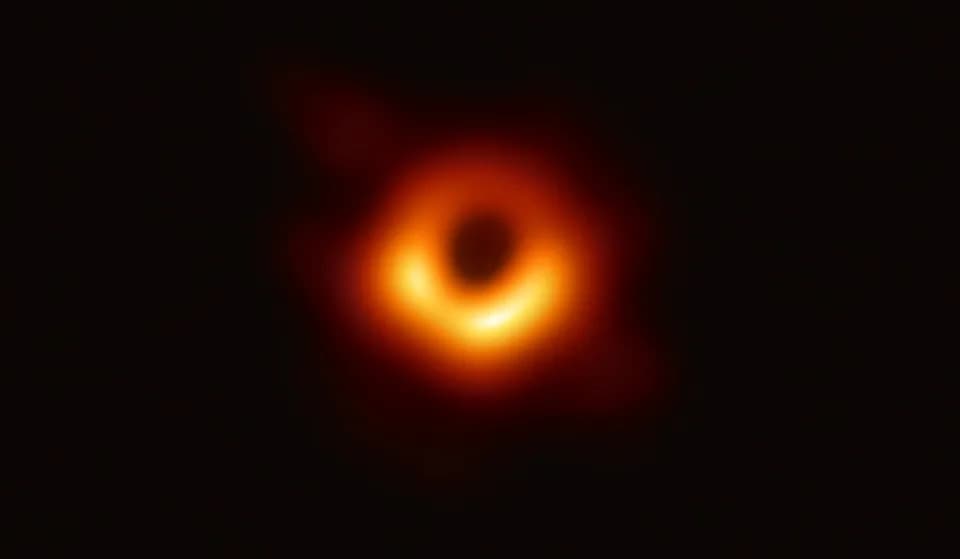
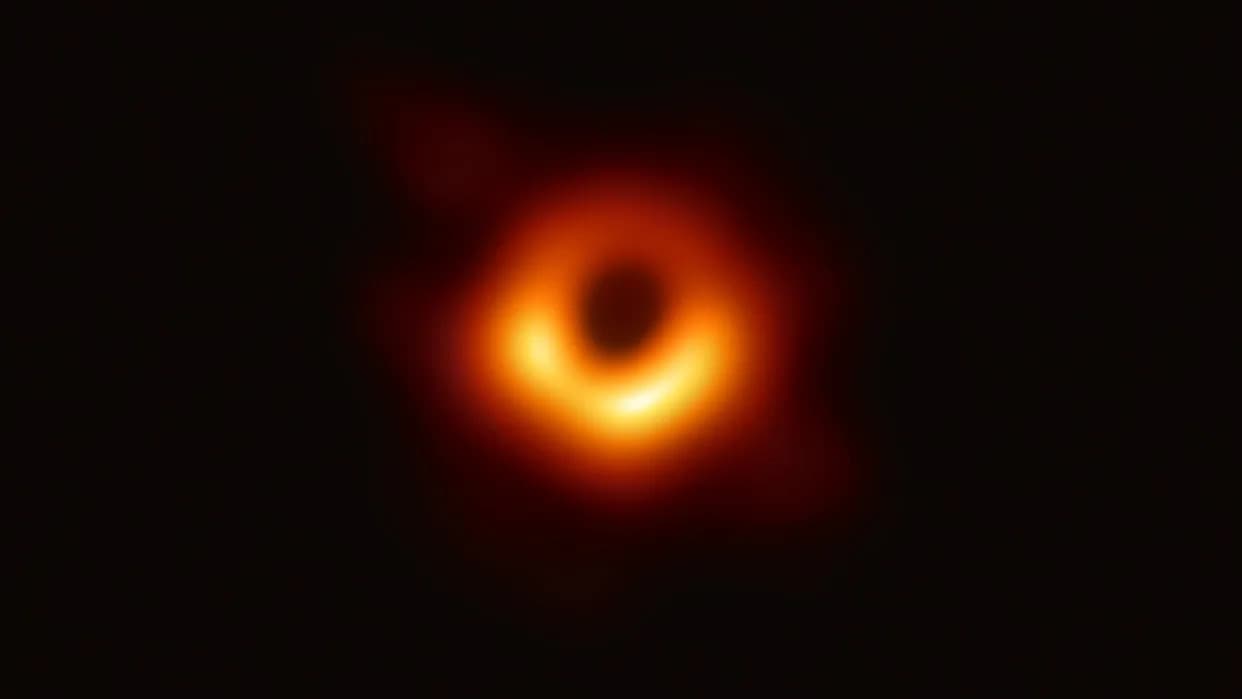
The first image of the black hole at the center of the galaxy M87. The image was released April 2019.Event Horizon Telescope Collaboration
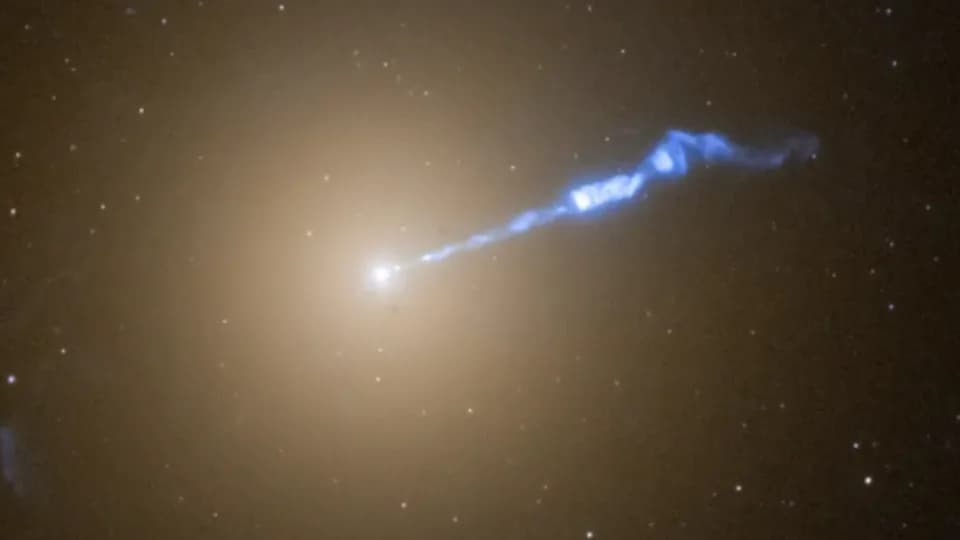
At the heart of the galaxy Messier 87 (M87) lies the supermassive black hole M87*, famous as the first black hole ever imaged. That black hole drives one of the most spectacular phenomena in astronomy: a narrow, high-energy jet of material that stretches roughly 3,000 light-years into intergalactic space.
New research published in Astronomy & Astrophysics reports the first observational evidence identifying the likely base of that jet. Using high-resolution data from the Event Horizon Telescope (EHT), the team studied the bright, superheated ring of plasma that surrounds M87* and identified a feature they interpret as the "probable position" where the jet is launched.
What the Observations Show
The EHT’s extremely fine angular resolution lets astronomers resolve structures on scales comparable to the black hole’s shadow. By carefully modeling the ring of emission and comparing multiple observations, the researchers isolated a region close to the black hole that aligns with the direction of the large-scale jet. While the detection is described as an early or tentative hint rather than a definitive measurement, it provides a concrete target for follow-up observations and theoretical work.
Why This Matters
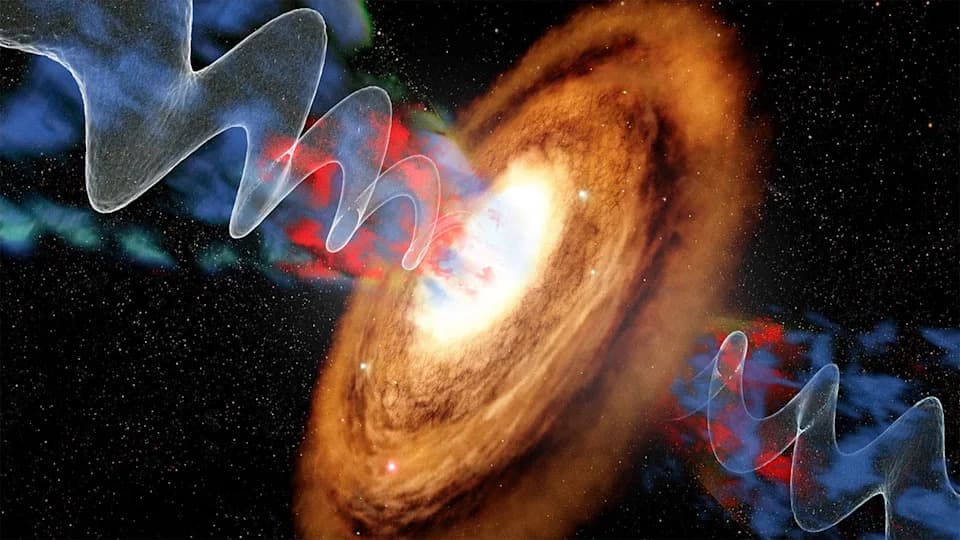
Understanding where and how relativistic jets originate is central to explaining how black holes interact with their environments and regulate galaxy evolution. Pinpointing a probable launch zone links theoretical models of magnetized plasma and accretion flows to direct imaging data, helping astrophysicists test competing ideas about jet formation and collimation.
"This study represents an early step toward connecting theoretical ideas about jet launching with direct observations," said Saurabh, a researcher at the Max Planck Institute for Radio Astronomy in Bonn, Germany.
"Identifying where the jet may originate and how it connects to the black hole’s shadow adds a key piece to the puzzle and points toward a better understanding of how the central engine operates," he added.
The first direct image of M87*’s shadow, released in April 2019 by the Event Horizon Telescope Collaboration, was a milestone for observational astronomy. These new results build on that achievement by probing the immediate environment where jets may be born.
Future EHT observations, multiwavelength campaigns, and refined theoretical models will be needed to confirm the jet-base identification and to determine the physical mechanisms (for example, magnetic fields and accretion dynamics) that launch and shape such powerful outflows.
Bottom line: The study provides promising observational clues about the origin of M87*’s enormous jet, offering a bridge between theory and direct imaging that could deepen our understanding of how supermassive black holes power cosmic jets.
Help us improve.