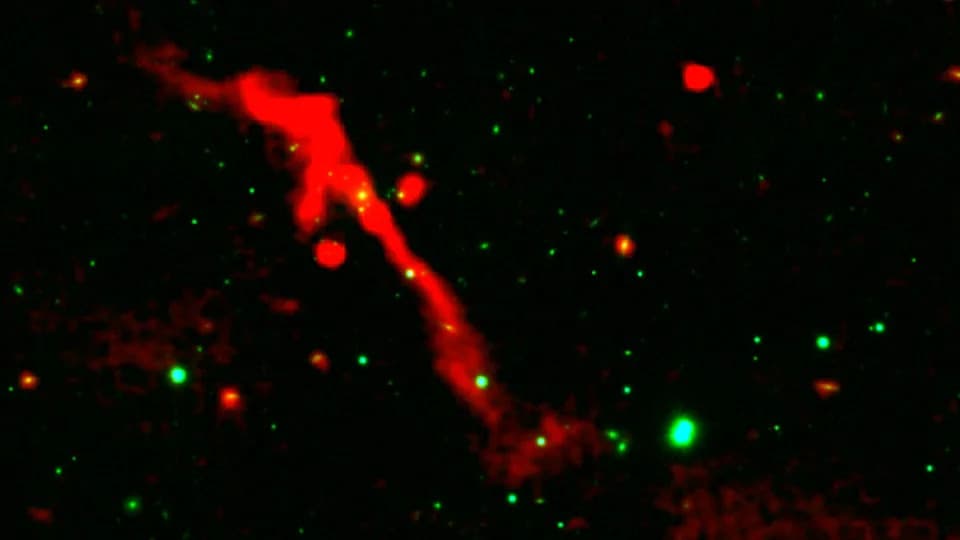
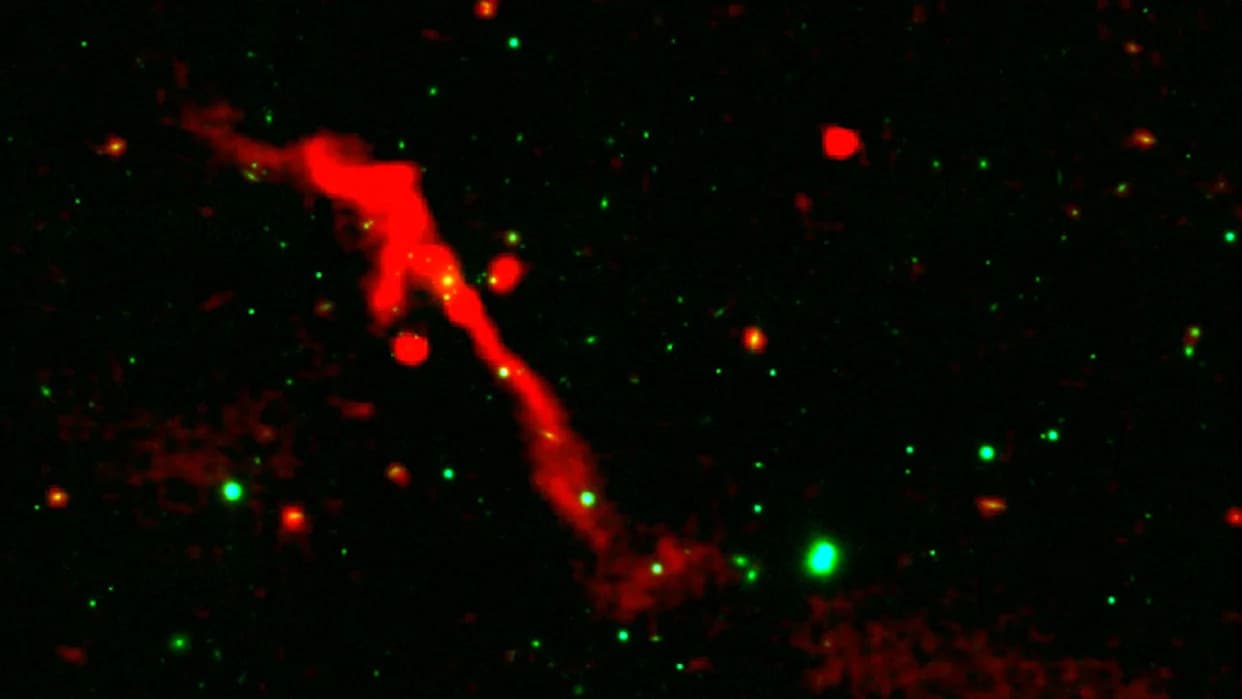
A global team using the Event Horizon Telescope linked a 3,000‑light‑year relativistic jet to its origin at the supermassive black hole M87*. By comparing 2021 VLBI data with earlier EHT observations, researchers connected the bright ring that defines the black hole's shadow to a compact emission region less than a tenth of a light‑year away. The result provides direct observational evidence pinpointing a probable jet launch site and motivates deeper follow‑up imaging to resolve the jet's fine structure.
EHT Traces 3,000‑Light‑Year Jet Back to M87*’s Glowing Shadow — Pinpointing the Jet’s Launch Site
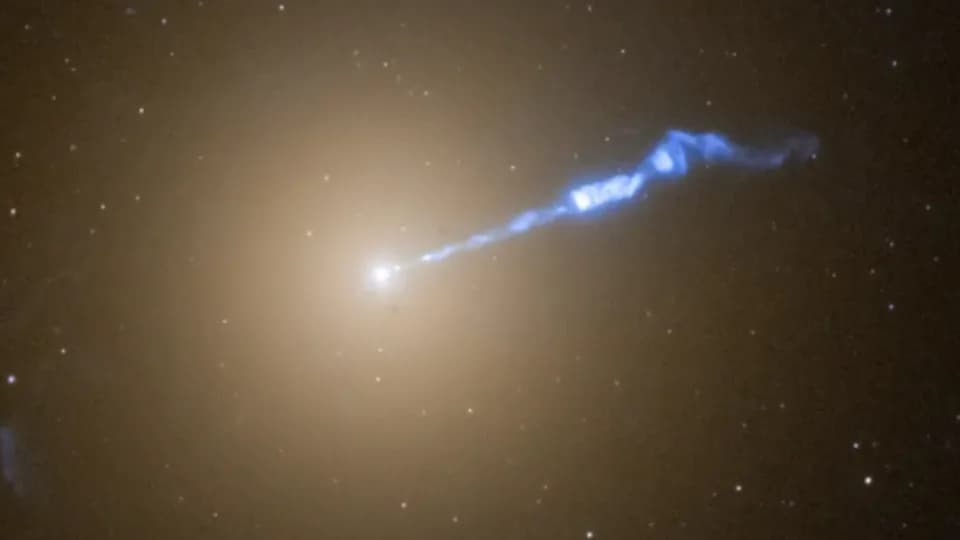
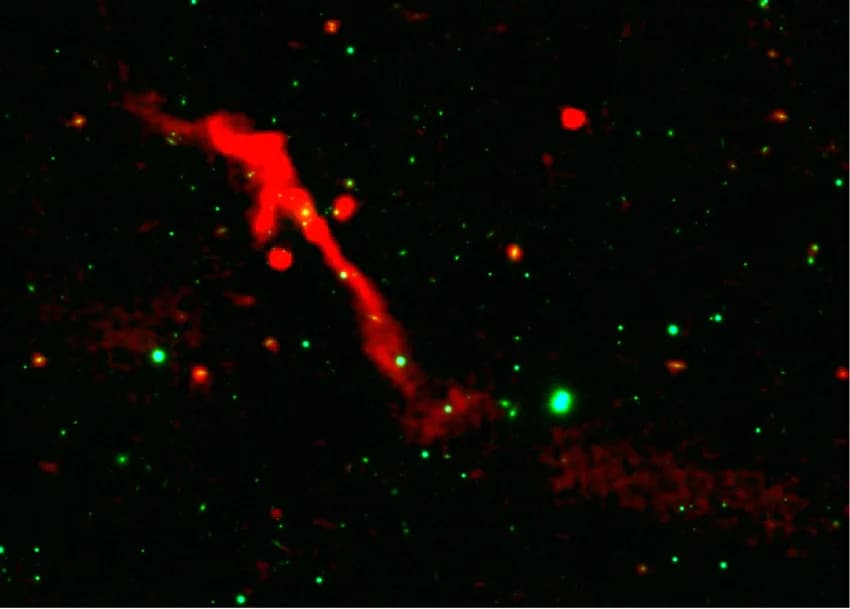
M87* and its cosmic blowtorch-like jet as seen by the Hubble Space Telescope. | Credit: NASA, ESA, A. Lessing (Stanford University), E. Baltz (Stanford University), M. Shara (AMNH), J. DePasquale (STScI)
Using the global Event Horizon Telescope (EHT), astronomers have traced a 3,000‑light‑year relativistic jet back to its source: the supermassive black hole M87*. This work links the bright ring that defines the black hole's shadow to a compact region near the base of the jet, providing the clearest observational evidence yet for where these powerful outflows originate.
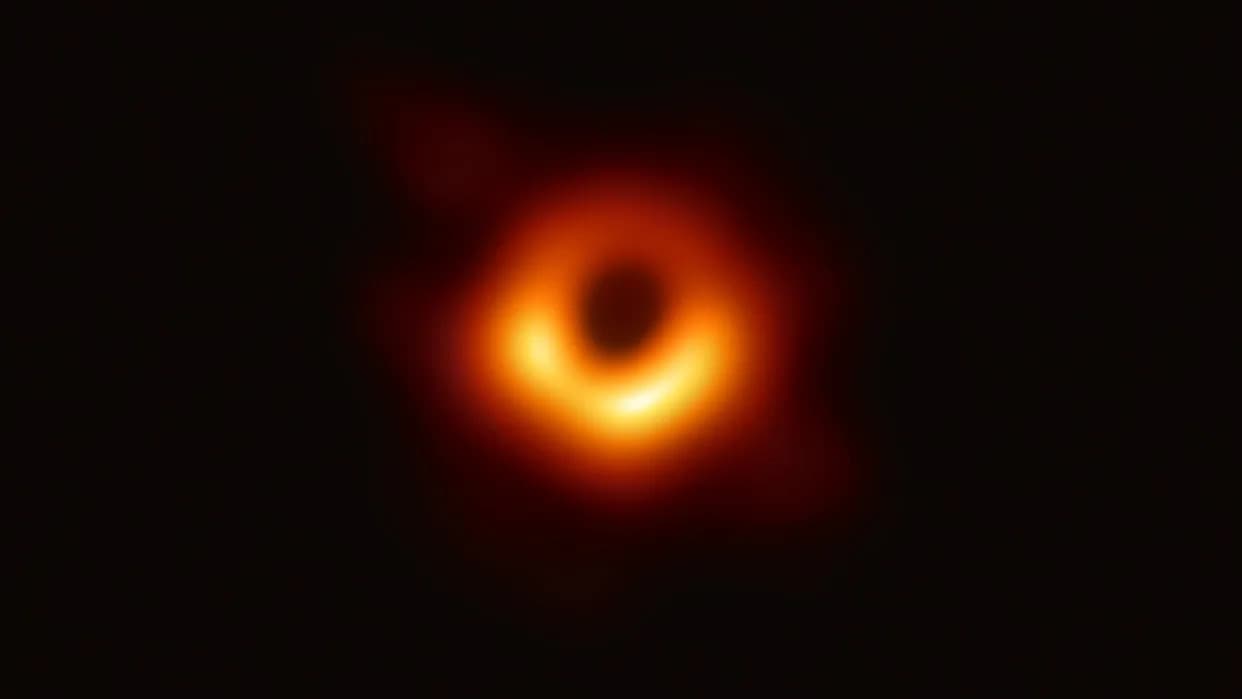
M87* lies at the center of the galaxy Messier 87 (M87), about 55 million light‑years from Earth. The EHT produced the first direct image of a black hole's shadow in 2017, released to the public in April 2019, showing a glowing, golden ring of superheated matter encircling a dark silhouette. M87* is enormous — roughly 6.5 billion times the mass of the Sun — and is much more massive and active than Sagittarius A* (Sgr A*), the Milky Way's central black hole, which is about 4 million solar masses.
Unlike Sgr A*, M87* is actively accreting gas and launching powerful, near‑light‑speed jets from its poles. Despite decades of theoretical and observational work, the precise region and mechanism that launch these relativistic jets close to the black hole have remained uncertain.
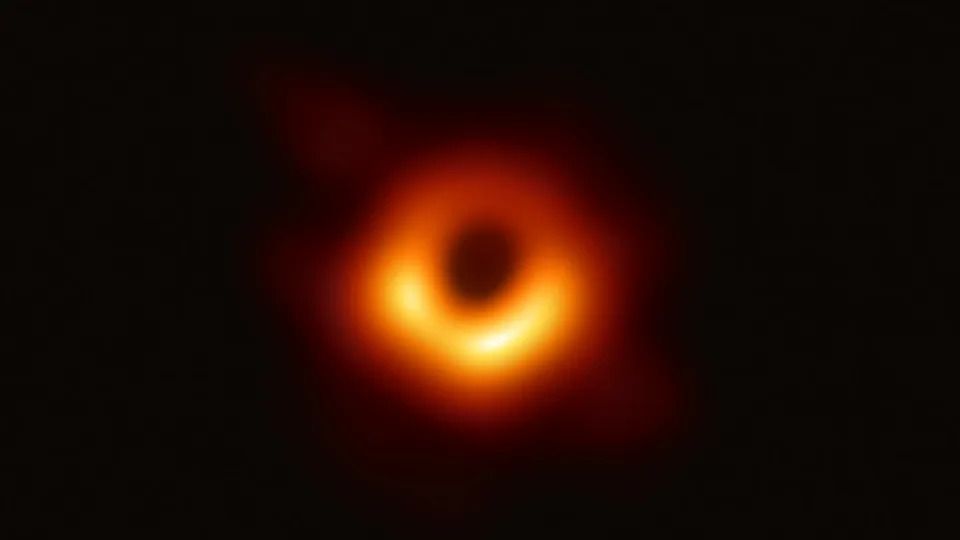
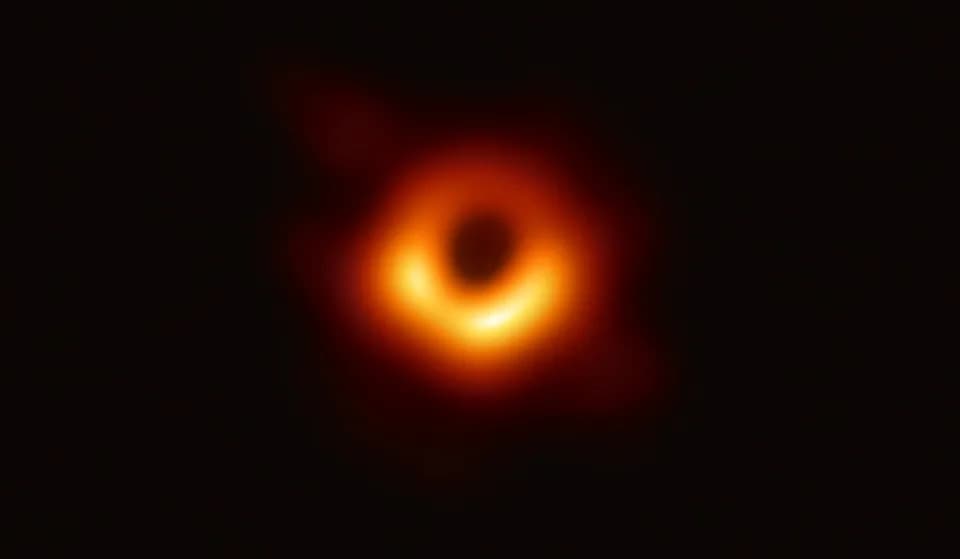
This photo is the historic first image of a supermassive black hole ever recorded. It shows the shadow of the monster black hole inside the distant galaxy M87. | Credit: EHT Collaboration
To home in on the jet's origin, the team analyzed EHT observations of M87* from 2021 obtained with Very Long Baseline Interferometry (VLBI). VLBI combines radio telescopes around the world to achieve the extreme angular resolution needed to resolve structures at scales comparable to the black hole's shadow. By comparing the 2021 data with earlier EHT observations, researchers identified radio emission that was absent in the 2017–2019 data but appeared in 2021, pinpointing a compact emission region very close to the black hole.
"This study represents an early step toward connecting theoretical ideas about jet launching with direct observations," said team leader Saurabh of the Max Planck Institute for Radio Astronomy (MPIfR). "Identifying where the jet may originate and how it connects to the black hole's shadow adds a key piece to the puzzle."
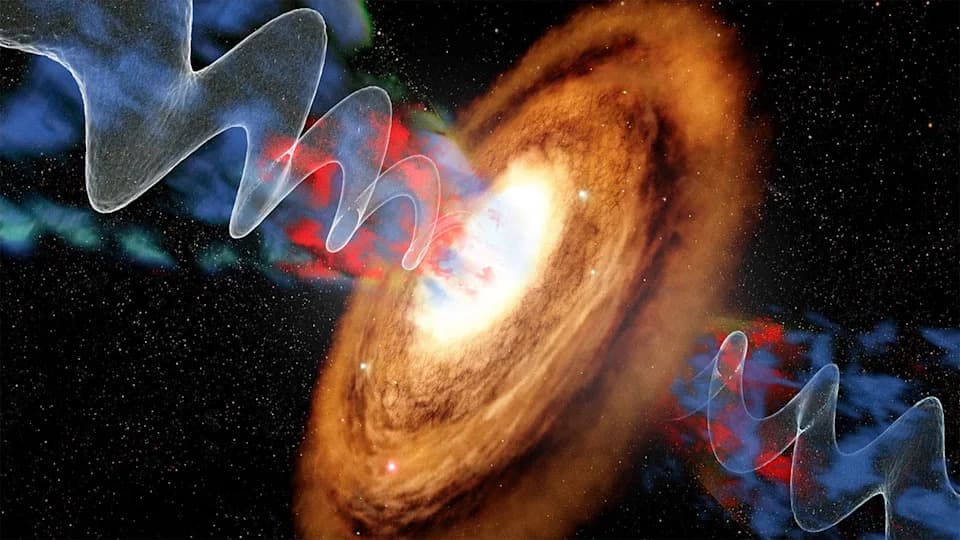
Through detailed modeling, the team inferred that the newly detected radio emission is produced in a compact zone located less than a tenth of a light‑year from M87*. That region corresponds to the base of the jet and aligns with the southern arm of a jet previously observed at longer radio wavelengths, strengthening the connection between the shadow-scale structure and the large‑scale jet.
"We have observed the inner part of the jet of M87 with global VLBI experiments for many years, with ever‑increasing resolution, and finally managed to resolve the black hole shadow in 2019," said team member Hendrik Müller of the National Radio Astronomy Observatory (NRAO). "It is exciting to combine these breakthrough observations across multiple frequencies and complete the picture of the jet‑launching region."
The findings were published on Jan. 28 in the journal Astronomy & Astrophysics. The team plans follow‑up observations to image the jet's fine structure and to map how energy is transferred from the black hole environment into the large‑scale jet. Those next steps could reveal how supermassive black holes influence their host galaxies and the surrounding intergalactic medium.
Why this matters: By connecting shadow‑scale structure to the jet base, astronomers can better test models of how magnetic fields, accretion flows, and black hole spin combine to launch and accelerate jets to relativistic speeds — a crucial piece in understanding galaxy evolution and high‑energy astrophysical processes.
Help us improve.