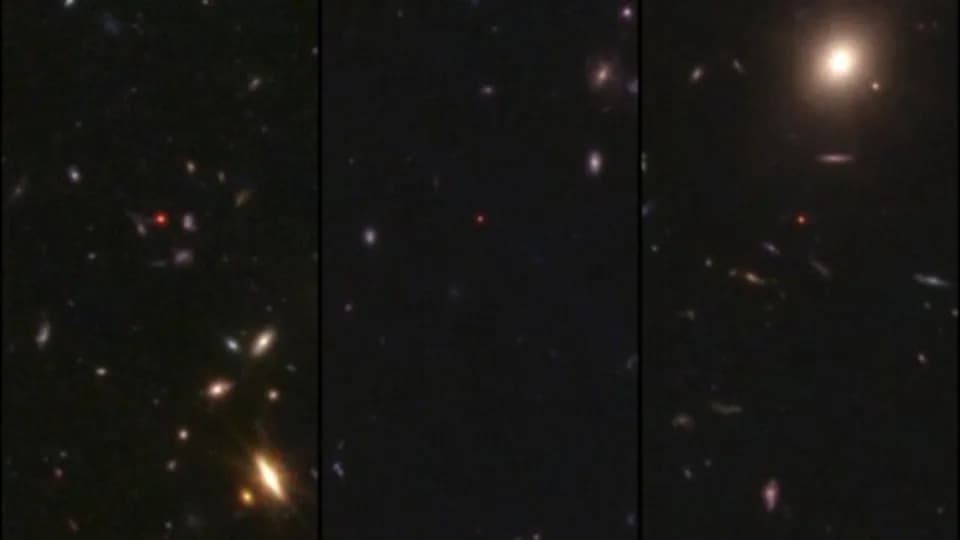
Researchers from Waseda and Tohoku Universities have found a distant quasar that is accreting at roughly 13 times the Eddington limit while emitting strong X-rays and a powerful radio jet. Observations with Subaru's MOIRCS and the Mg II emission line place this object among the fastest-growing black holes known at its mass. The simultaneous presence of a bright corona and a strong jet challenges theoretical expectations and may represent a brief transitional phase of rapid growth in the early Universe. The study appears in The Astrophysical Journal.
Ancient Quasar Defies Theory — Black Hole Growing About 13× Faster Than Expected
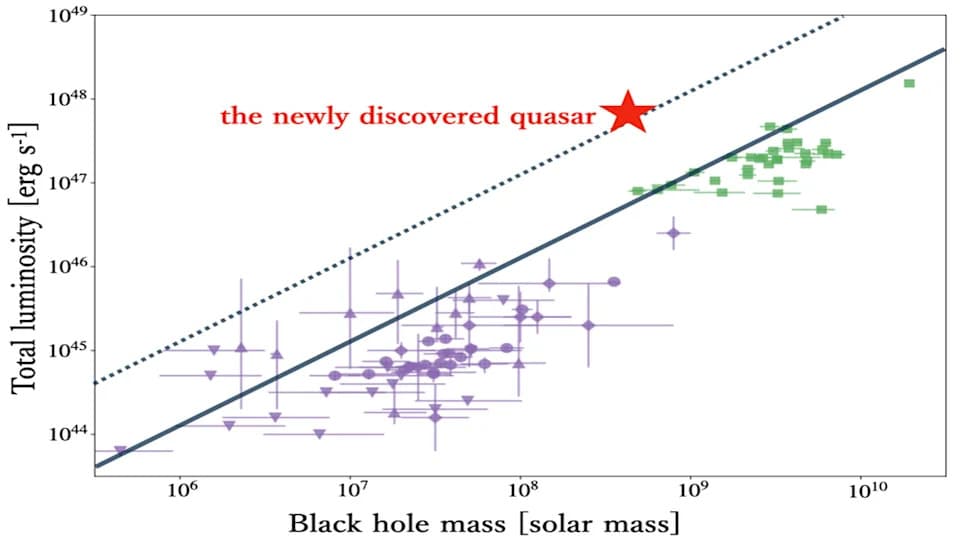
Quasar luminosity versus black hole mass for the newly discovered object (red star) and known quasars.Credit:National Astronomical Observatory of Japan (NAOJ)
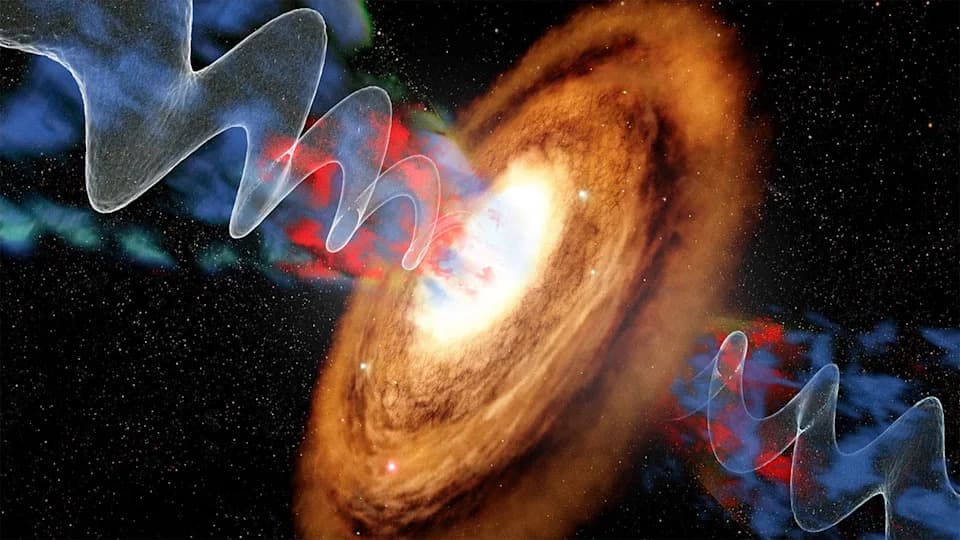
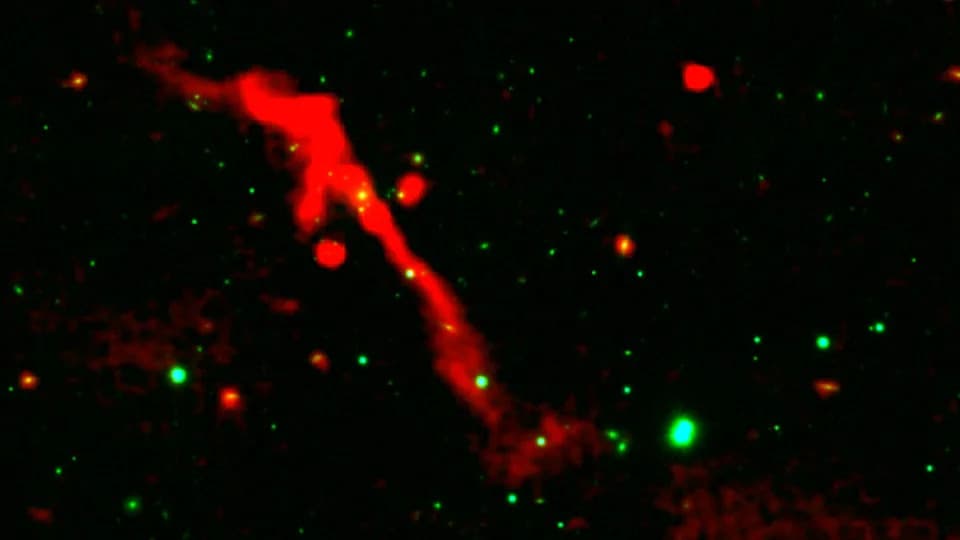
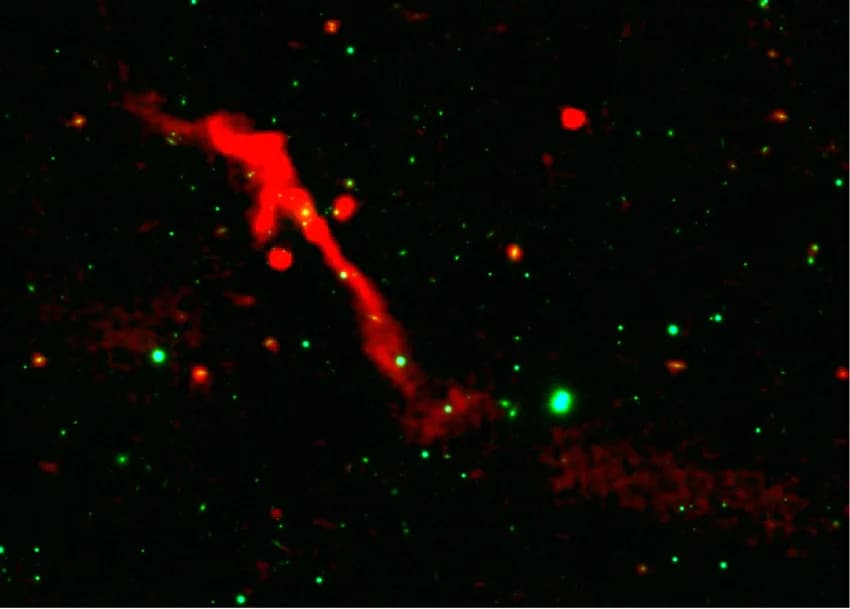
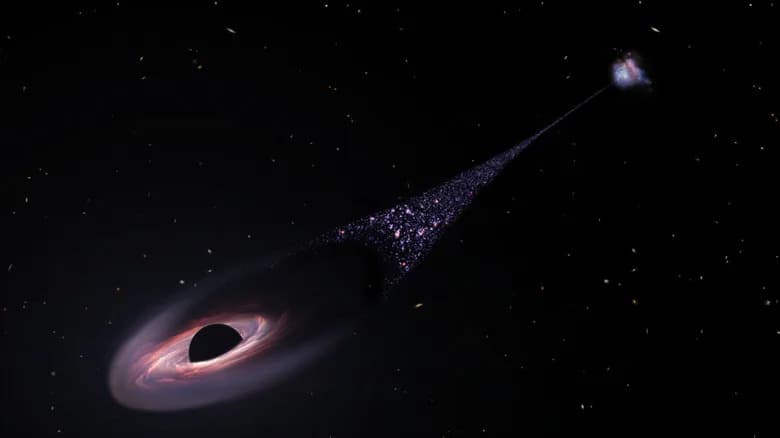
Japanese astronomers have discovered an extraordinary supermassive black hole in the early Universe that is accreting mass at an almost inconceivable rate while simultaneously emitting strong X-ray and radio signals.
The international team from Waseda University and Tohoku University identified the object as a distant quasar using observations from the Subaru Telescope. The quasar existed when the Universe was younger than roughly 1.5 billion years.
Measurements of gas motion near the black hole, obtained with Subaru's near-infrared spectrograph MOIRCS and using the Mg II emission line, indicate the black hole is accreting at about 13 times the Eddington limit — placing it among the fastest-growing black holes known at this mass scale.
Why This Is Surprising
Under standard theory, extremely rapid (super-Eddington) accretion should generate intense radiation pressure that chokes off further inflow and typically weakens the high-energy emission and jet activity. Yet this quasar shows both a bright X-ray-emitting corona and a powerful radio jet at the same time — a combination many theoretical models do not predict.
"This discovery may bring us closer to understanding how supermassive black holes formed so quickly in the early Universe," said Sakiko Obuchi, PhD, lead author and researcher at Waseda University.
The team suggests the quasar may be caught in a short-lived transition: a sudden surge of inflowing gas pushed the system beyond the Eddington limit while the X-ray corona and radio jet remained active briefly before fading. If correct, this snapshot would provide rare, time-sensitive evidence of variable black hole growth in the early cosmos.
Broader Implications
If confirmed by follow-up observations, the finding could help explain how supermassive black holes grew to large masses so quickly after the Big Bang. It may also illuminate how energetic jets influence star formation and the early evolution of galaxies during intense black hole growth episodes.
The study has been published in The Astrophysical Journal and highlights the need to revise or expand existing models of super-Eddington accretion to account for persistent high-energy emission and jets in some rapidly growing quasars.
"We want to investigate what powers the unusually strong X-ray and radio emissions, and whether similar objects have been hiding in survey data," the Waseda team said in a press release.
Help us improve.