Researchers discovered a compact cluster of neurons in the medial amygdala that functions like a neural "switch": active in females, off in sexually mature males, and reactivated in males after mating. Gonad removal showed sex hormones alone do not account for the effect; prolactin can activate the cluster but is not the sole trigger. Activation depends on cohabitation with a female and may help reconfigure male behavior after mating, potentially promoting paternal care and reducing infanticide.
Neural 'Switch' in Male Mice Turns On After Mating — A Brain Change Linked to Fatherhood
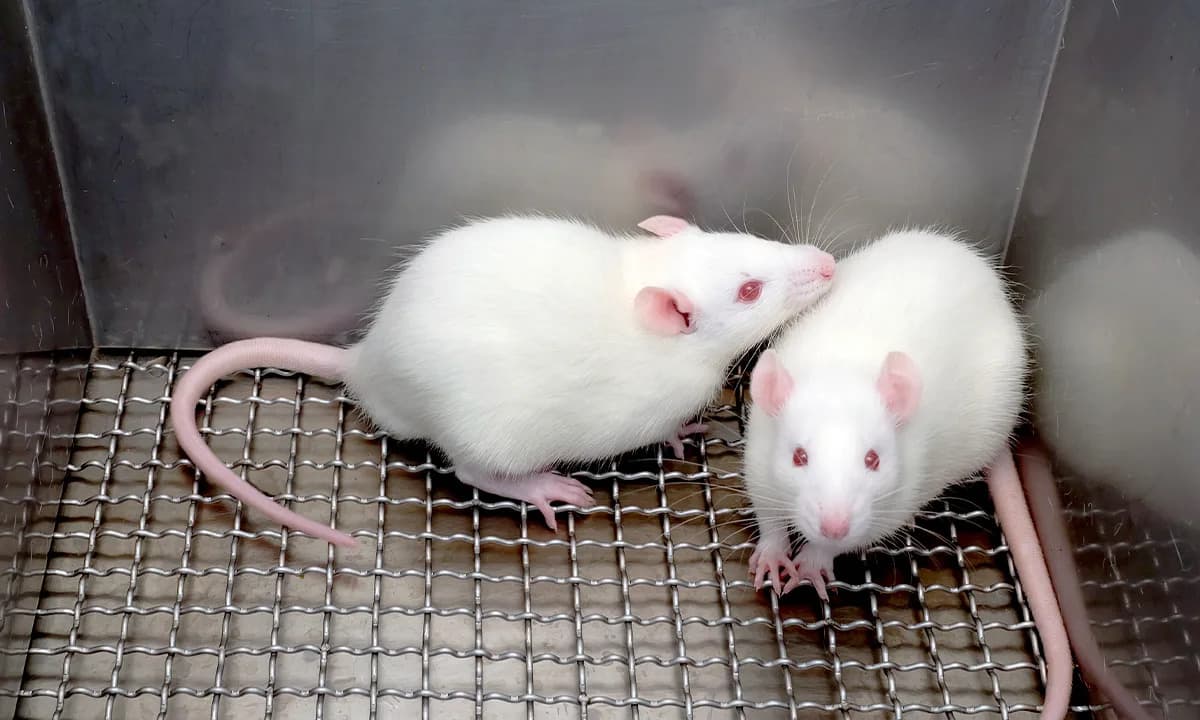
Lead image: Kampol Taepanich / Shutterstock(Laboratory white mice with red eye in stainless steel cages. Credit: Kampol Taepanich / Shutterstock)
Neuroscientists have identified a small, discrete cluster of neurons in the medial amygdala that behaves like a neural "switch": it is persistently active in female mice, but switches off in males at sexual maturity and reactivates after mating. The work, led by Tamar Licht and Dan Rokni at the Hebrew University of Jerusalem, was published in the Proceedings of the National Academy of Sciences.
What the researchers found
The group discovered a compact neuronal population in the medial amygdala — a region involved in social and reproductive behaviors — whose activity pattern reliably encodes both sex and recent social experience. In females the cluster remains active, whereas in males it turns off when they reach sexual maturity and then turns back on after mating.
How they probed the mechanism
To determine what drives the on/off state, the researchers removed testes and ovaries (gonadectomy) and found the switching behavior persisted, indicating circulating sex steroids alone do not explain the effect. They then administered prolactin, a hormone that rises after mating, to virgin males and observed that prolactin could activate the cluster. However, blocking prolactin signaling in males after mating did not prevent the cluster from turning on, implying additional signals or circuit-level changes are involved.
Context and likely function
The activated state of this neural cluster was observed only when males cohabited with their female partners; separation caused activity to revert to the off state. The authors propose the circuit helps reconfigure male behavior after mating — for example, by suppressing infanticidal tendencies and promoting paternal care — although causal links to specific behaviors will require further experiments.
Why it matters
Most reported sex differences in brain structure and function are modest and widely distributed. This study stands out because it identifies a small, well-defined neuronal population with a clear, reproducible activity pattern tied to both sex and social state. That clarity makes it a promising target for future work on how mating and parenthood reshape neural circuits and behavior.
Open questions
Key questions remain: what additional hormones, neuromodulators, or synaptic changes cooperate with prolactin to flip the switch? How long does the activated state persist? And what are the precise behavioral consequences of manipulating this cluster? The answers will clarify how mating experience produces lasting changes in male social behavior.
Research credit: Tamar Licht and Dan Rokni, Hebrew University of Jerusalem. Published in Proceedings of the National Academy of Sciences.
Help us improve.