New mouse data from Karolinska Institutet challenge the long-standing idea that brain function maps neatly onto anatomical regions. Recording over 24,000 neurons with Neuropixels probes, researchers found that prefrontal neurons fire slowly and steadily while decision-related neurons fire in fast, irregular bursts. Mapping by firing dynamics produced overlapping functional zones that often cross classical anatomical borders, suggesting cognition may arise from distributed network dynamics rather than isolated modules.
Mouse Study Suggests Brain Function Follows Firing Patterns More Than Fixed Anatomy
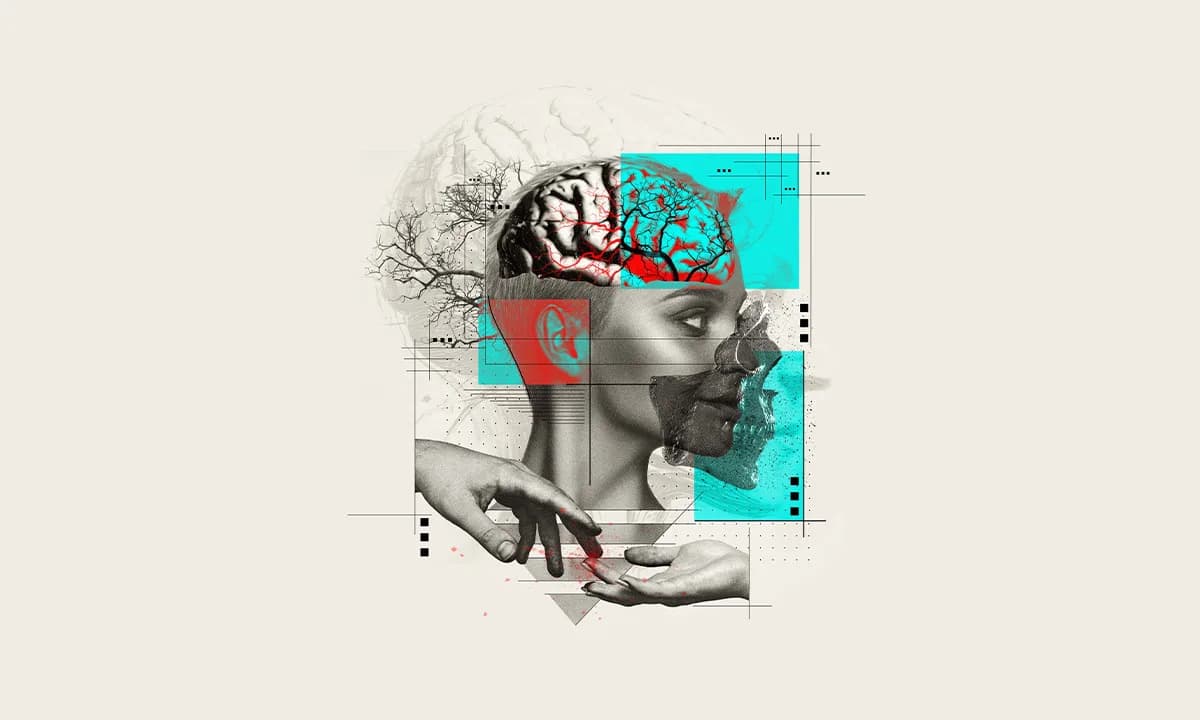
Lead image: Master1305 / Shutterstock(A collage of a woman's profile combined with brain imagery, abstract shapes, and overlapping textures. Credit: Master1305 / Shutterstock.)
For more than a century neuroscientists have linked brain function to anatomical landmarks. In the early 1900s, German neuropsychiatrist Korbinian Brodmann mapped the cerebral cortex into 52 areas by staining thin slices of brain tissue and noting abrupt changes in cellular layering; many researchers since have used Brodmann areas as a reference for relating structure to function.
A New Perspective From Neural Dynamics
But a new study from the Karolinska Institutet, published in Nature Neuroscience, argues that this structural map is incomplete. The authors show that, at least in mice, cognitive roles may be better predicted by patterns of neuronal firing than by cytoarchitectonic borders. Instead of functions arising from sharply localized spots, they appear to emerge from distributed networks defined by characteristic activity motifs.
Methods
The team recorded activity from more than 24,000 single neurons using high-density Neuropixels probes—thin silicon shanks with many tiny recording sites. Roughly half of the recorded neurons were in the prefrontal cortex and the rest across other cortical and subcortical regions. Researchers analyzed spontaneous (resting) firing as well as responses to simple auditory stimuli, quantifying rate, regularity, consistency and bursting patterns.
To relate firing motifs to cognitive roles, the group used an independent dataset from the International Brain Laboratory that links neural activity with behavior in a task involving a visual cue, wheel turning, water reward and white-noise error feedback. Statistical classification identified neurons tuned primarily to sensory input, decision variables or reward signals.
Key Findings
Neurons in the mouse prefrontal cortex displayed a distinctive motif: slow, steady, and regular firing with few erratic bursts. This profile was stable over time and was also characteristic of other regions associated with high-level cognition. By contrast, neurons tied to decision-making tended to fire in fast, irregular bursts.
"Our findings challenge the traditional way of defining brain regions and have major implications for understanding brain organization overall," said Marie Carlén, co-author and professor in the department of neuroscience at Karolinska Institutet.
When the researchers remapped the prefrontal cortex by firing dynamics rather than cellular architecture, some boundaries matched classical anatomical divisions, but many did not. Instead of strict borders, the cortex resembled a patchwork of overlapping functional zones defined by shared rhythms and connectivity. The authors propose that slow, regular firing creates a stable scaffold that supports bursty neurons which encode transient events and rapid decisions.
Implications
This work reframes cortical organization: for complex cognition, function may be emergent and rhythm-dependent rather than strictly localized by cytoarchitectonic borders. The findings carry implications for how we interpret functional imaging, design electrophysiology studies, and model cognitive circuits in health and disease.
Note: The study was performed in mice; translating these motifs to the human brain will require further research.
Originally reported in Nautilus and published in Nature Neuroscience by researchers at the Karolinska Institutet.
Help us improve.