Researchers at the Max Planck Institute followed hundreds of western house mice in outdoor enclosures for four years, comparing high- and low-quality diets. About one-third of litters were sired by multiple males in both conditions, but larger litter sizes associated with polyandry appeared only when mothers consumed lower-quality food. The authors conclude polyandry may provide a fitness advantage as a bet-hedging strategy when resources are scarce, though other benefits likely maintain the behavior in rich environments.
Female House Mice Mate With Multiple Males — A Survival Edge When Food Is Scarce
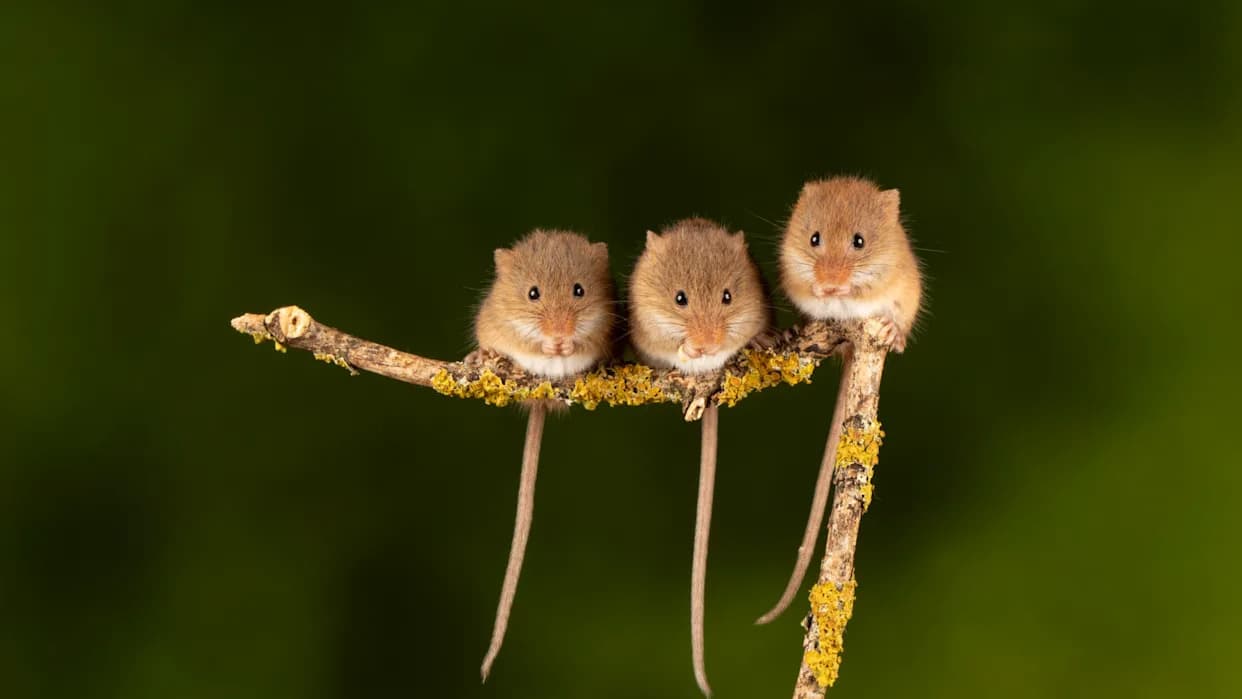
Three harvest mice playing around and entwining their tails together to stop them from falling.
Female western house mice (Mus musculus domesticus) commonly mate with multiple males, producing litters with mixed paternity. New research from the Max Planck Institute for Evolutionary Biology shows this behavior — called polyandry — can offer a reproductive advantage when maternal resources are limited.
Study Design and Methods
Two researchers placed hundreds of mice into several outdoor enclosures designed to mimic natural habitats and monitored them for four years. Some enclosures provided a high-quality diet while others provided a more typical, lower-nutrition diet. The team tracked mating patterns, paternity of pups, and litter sizes to test whether environmental quality changes the benefits of mating with multiple males.
Key Findings
About one-third of litters in both diet treatments were multiply sired. However, the reproductive benefit linked to polyandry — notably larger litter size — emerged only in the enclosures with lower-quality food. In high-quality environments, females produced relatively large litters regardless of whether they mated with one or several males.
“Our results suggested that polyandry provides greater lifetime fitness benefits when resources are of poorer quality,” the researchers write in BMC Ecology and Evolution. “In other words, polyandry potentially yields its greatest advantages when resources are a limiting factor, but contributes little when conditions are already favourable.”
Interpretation and Implications
The pattern suggests polyandry can act as a bet-hedging strategy: by mating with multiple males, females may increase the chance that at least some offspring survive under tougher conditions. That females still commonly engage in polyandry when food is abundant indicates additional benefits or constraints may also promote the behavior — for example, genetic compatibility, sperm competition, or social dynamics.
This study highlights how changing ecological pressures can shape mating systems and reproductive strategies. Future work could examine the genetic, social, and physiological mechanisms behind polyandry and whether similar patterns hold across other mammal species and natural environments.
Help us improve.