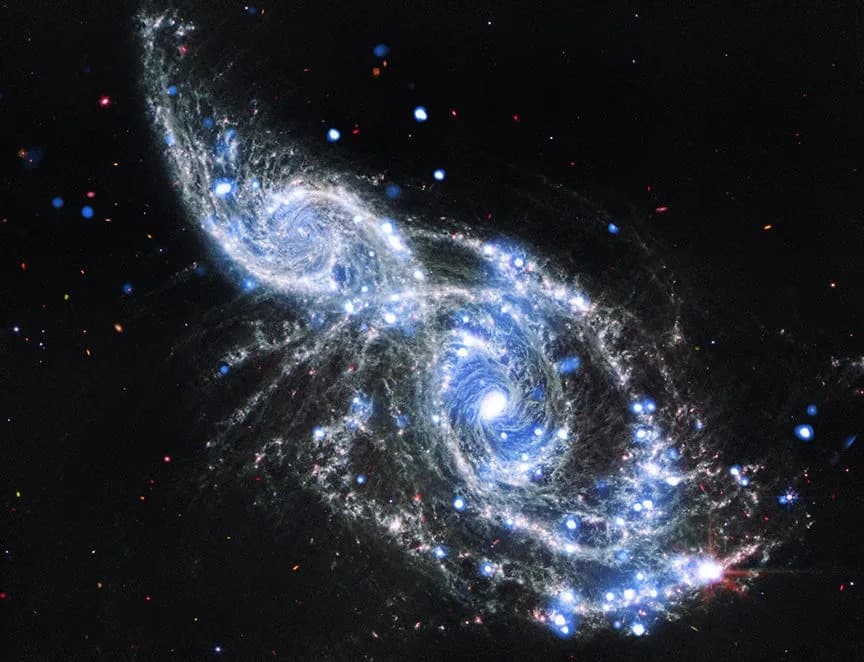
NASA released a composite image from the James Webb Space Telescope and the Chandra X‑Ray Observatory showing two spiral galaxies — IC 2163 and NGC 2207 — beginning to collide roughly 120 million light‑years away in Canis Major. Webb's infrared data highlights dust and active star‑forming regions, while Chandra's X‑rays reveal million‑degree gas and other energetic phenomena. The combined view captures a key intermediate stage after a close gravitational pass millions of years ago and before an eventual merger billions of years from now.
Webb and Chandra Capture a Stunning 'Galactic Hug' Between IC 2163 and NGC 2207
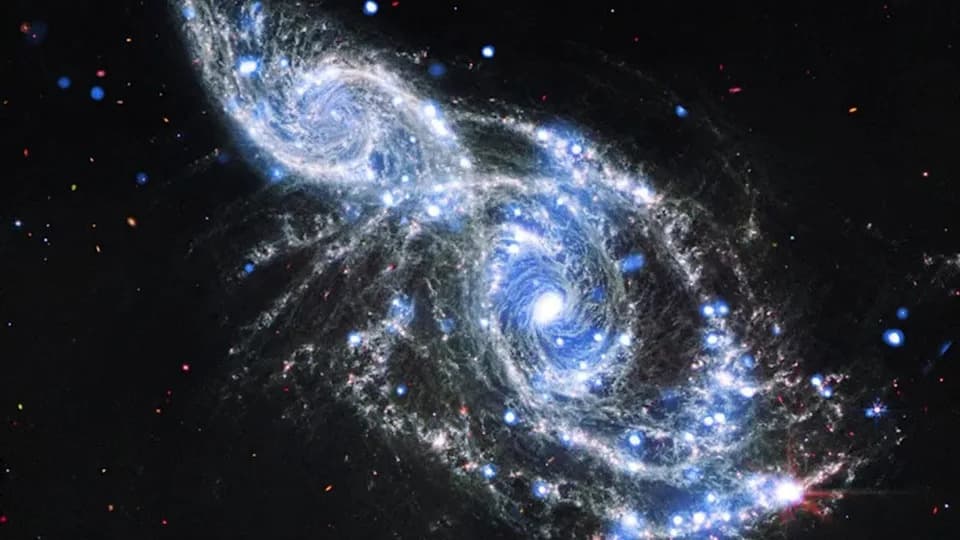
This composite image combines data from both the James Webb Space Telescope and Chandra X-ray Observatory. . | Credit: X-ray: NASA/CXC/SAO; Infrared: NASA/ESA/CSA/STScI/Webb; Image Processing: NASA/CXC/SAO/L. Frattare
Two of NASA's flagship space observatories — the James Webb Space Telescope and the Chandra X‑Ray Observatory — have produced a striking composite image of two spiral galaxies that are beginning to collide. The smaller galaxy, IC 2163, sits at the upper left of the frame, while NGC 2207 dominates the center and lower right. Their long, silvery‑blue spiral arms are dotted with bright knots and specks: telltale signs of gas, dust, and vigorous star formation triggered by the encounter.
What the Image Reveals
This composite merges Webb's infrared view with Chandra's X‑ray data to give a richer, more physical picture of the interaction. Webb's infrared sensitivity highlights cooler dust and warm gas as well as regions where new stars are forming; Chandra's X‑ray vision pinpoints million‑degree gas and other high‑energy phenomena shaped by extreme gravity, magnetic fields, and explosive events.
How the Telescopes Observe
James Webb: Optimized for infrared light, Webb operates in a sun‑orbit near the Sun–Earth L2 point — roughly 1 million miles (1.5 million kilometers) from Earth — an environment that helps keep the telescope cold and stable for sensitive infrared measurements.
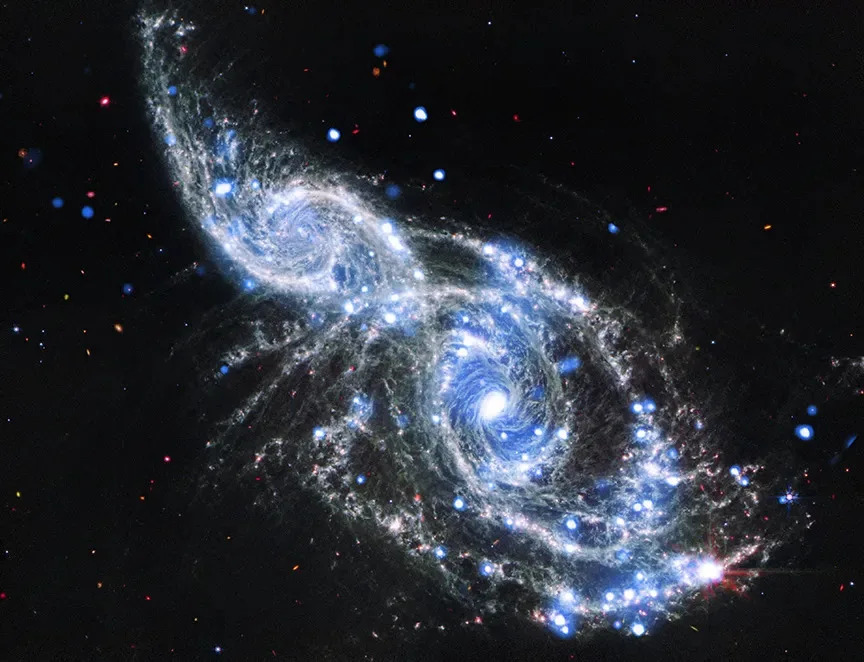
The two spiral galaxies will merge into one large galaxy billions of years from now. | Credit: X-ray: NASA/CXC/SAO; Infrared: NASA/ESA/CSA/STScI/Webb; Image Processing: NASA/CXC/SAO/L. Frattare
Chandra: Designed to detect X‑rays, Chandra flies in a highly elliptical orbit around Earth that allows long, uninterrupted observations above the planet's radiation belts, where Earth's atmosphere would otherwise block X‑rays.
Cosmic Context and Timescale
IC 2163 and NGC 2207 lie about 120 million light‑years away in the constellation Canis Major. Astronomers believe the two galaxies had a close gravitational pass millions of years ago that bent and stretched their spiral structures. Over billions of years the pair is expected to merge into a single galaxy; the new image captures a crucial intermediate stage between that past near‑miss and eventual coalescence.
Why Multiwavelength Matters
Combining infrared and X‑ray observations does more than make a pretty picture: it creates a multi‑layered map of where gas is cooling and forming stars, where material is heated to extreme temperatures, and how the collision redistributes the galaxies' raw material. Face‑on views like this let astronomers trace how spiral arms warp, where gas is compressed, and which regions are most likely to spawn new stars.
In short: Webb shows the dusty, star‑forming scaffolding; Chandra reveals the energetic, million‑degree processes — together they tell the fuller story of a galactic hug in progress.
To explore more, look for NASA's release of the composite image and related scientific commentary from teams working with Webb and Chandra.
Help us improve.