New whole-genome research shows heartworm (Dirofilaria immitis), the spaghetti-like parasite that threatens millions of dogs, has deeper evolutionary roots than previously recognized. Scientists sequenced more than 100 heartworm genomes and found regional genetic patterns shaped by ancient canid migrations, including wolves and possibly dingoes. Genetic similarities between Australian and Asian worms suggest a potential ancient introduction with dingoes, though the evidence is not yet definitive. The findings matter for understanding parasite spread and rising drug resistance.
Ancient Origins of the ‘Spaghetti’ Heartworm Found — Possible Link to Dingoes

A cross section of a dog's heart showing heartworm.
Every year millions of dogs worldwide face a potentially fatal parasite known as heartworm (Dirofilaria immitis). Often described by veterinarians as looking like a strand of spaghetti, adult worms live in the blood vessels of the heart and lungs and can grow up to 11.8 inches (30 centimeters). Left untreated, heartworm infection can cause serious illness and death.
New Genomic Study Sheds Light on Deep History
An international team of researchers sequenced whole genomes from more than 100 heartworm samples collected from pet dogs and wild canids around the world. By comparing those genomes, the scientists reconstructed population histories and identified distinct regional lineages shaped by ancient movements of their canine hosts.

Heartworms taken from a dog’s heart.Image: University of Sydney.
Ancient Canids Shaped Parasite Distribution
The analysis indicates that migrations of ancient canids, such as wolves and dingoes, strongly influenced the geographic distribution of heartworm populations over thousands of years. These host-driven movements left genetic signatures in parasite populations that persist today.
“For decades, we assumed heartworms were spread mainly through recent human activity,” said Dr. Rosemonde Power, a paleogeneticist at Stockholm University and co-author of the study. “What we’re seeing instead is evidence of deep co-evolution between heartworms and their canine hosts, even before humans were part of the picture.”
What About Australia?
One notable finding concerns heartworms from Australia. Genetic markers in those samples resemble parasites found in parts of Asia, raising the possibility that heartworm arrived in Australia with the continent’s first dingoes, which are believed to have migrated from Asia thousands of years ago. The authors emphasize, however, that this link is suggestive rather than conclusive: later introductions, including during European colonization, could also explain current patterns.
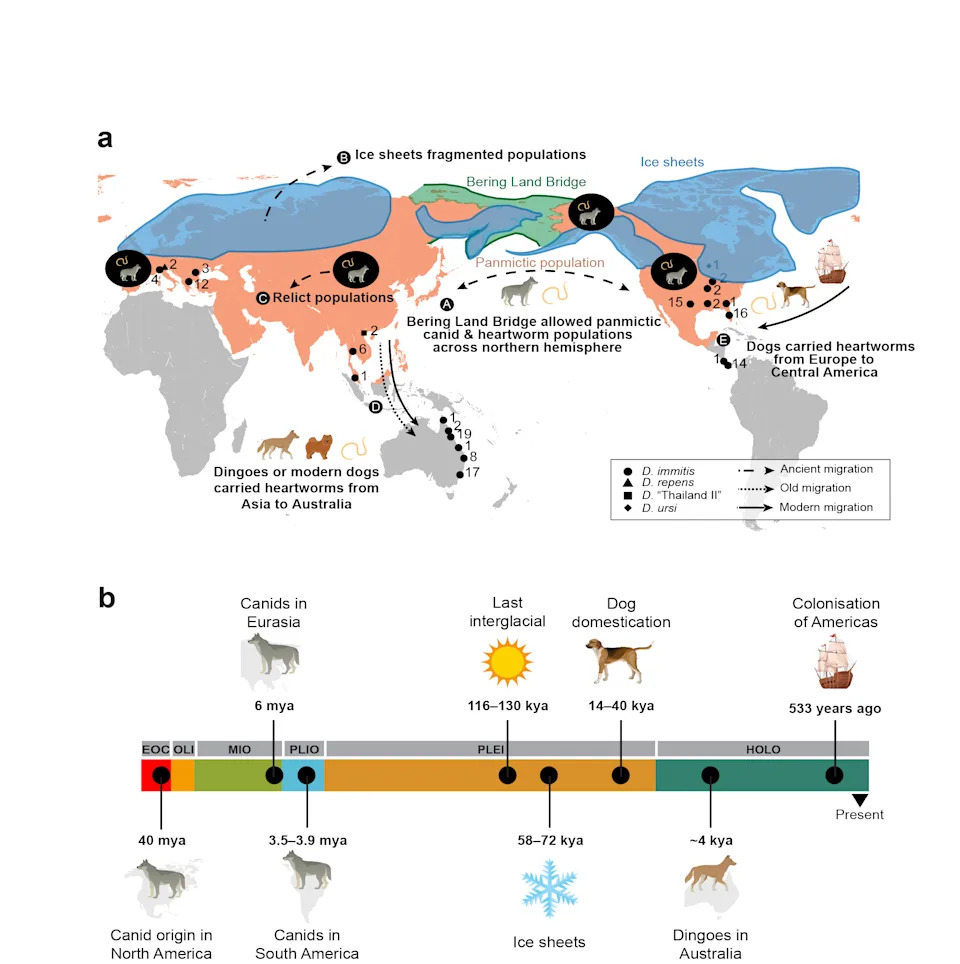
Graphic showing canid migrations and heartworm specimen sites.Image: University of Sydney.
“While our data suggest an ancient link between Australian and Asian heartworms, the sample size means we need to be careful about drawing firm conclusions,” said Jan Slapeta, a veterinarian at the University of Sydney and co-author. “What we can say with confidence is that heartworm evolution is far older and more complex than a simple story of parasites hitchhiking with modern dogs.”
Implications for Today
Understanding the deep evolutionary relationships among heartworm populations matters for modern animal health. Veterinarians are increasingly concerned about resistance to common heartworm treatments and preventives, and knowing how populations differ regionally can help guide diagnosis, treatment strategies, and surveillance efforts.
Next Steps
The researchers call for broader geographic sampling—especially from underrepresented regions—to clarify remaining questions about origins and dispersal, including the precise history of heartworm in Australia.
Bottom line: Whole-genome data reveal heartworm has a deeper, more complex history tied to ancient canid migrations, with practical implications for disease control and drug resistance today.
Help us improve.