The Nebra Sky Disc is a bronze plate inlaid with gold that was recovered from an illegally excavated hoard near Nebra and retrieved by police in 2002. Possibly up to 3,800 years old, the disc displays a crescent, a round celestial body and dozens of star points—several of which may form the Pleiades cluster. Analyses indicate it was decorated in multiple phases, may align with local landscape features like the Brocken for solstice observation, and continues to inform debates about early astronomy and ritual practice.
Nebra Sky Disc: A 3,800‑Year‑Old Bronze Map of the Heavens — Possibly Showing the Pleiades
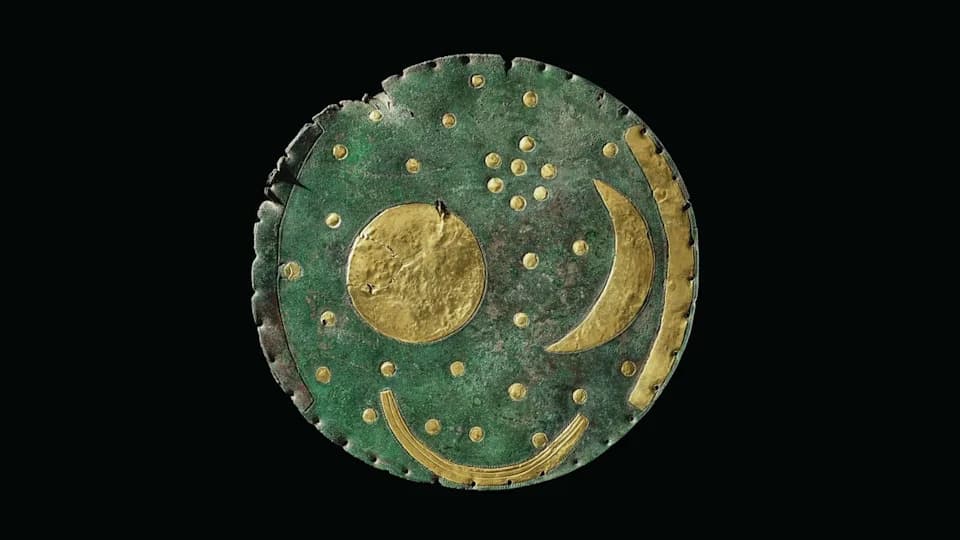
The Nebra Sky Disc was discovered during an illegal excavation in Germany. | Credit: © Juraj Lipták/LDA Saxony-Anhalt
The Nebra Sky Disc is one of Europe's most remarkable Bronze Age objects: a bronze plate inlaid with gold that many researchers interpret as a stylized map of the night sky. Discovered as part of an illegally excavated hoard in 1999 and recovered by police in 2002, the disc has sparked intense debate about early astronomy, ritual practice and prehistoric landscape knowledge.
Discovery and Context
The disc was found on Mittelberg Hill near Nebra in Saxony‑Anhalt, Germany, by metal detectorists who removed it from the site without archaeological supervision. Police recovered the object in 2002, along with other objects from a metal hoard that included swords, axes and bracelets. Because of the looting, some contextual information was lost, complicating efforts to understand who used the disc and why it was buried.
Material, Size and Decoration
According to the State Museum of Prehistory in Halle, the plate was hammered from about 4 kilograms (8.8 pounds) of bronze into a circular disc roughly 32 centimeters (12.6 inches) across. Craftspeople inlaid approximately 50 grams (1.8 ounces) of gold to depict a crescent, a round celestial body (interpreted as a full moon or sun), and an array of small golden dots commonly read as stars.
Production Phases and Alterations
Microscopic and compositional analyses indicate the disc was produced in at least five distinct phases. The initial design included the round body, the crescent and 32 star points. Later additions included large curved arcs at either side and a third arc along the lower edge (often interpreted as a boat). The rim was then perforated—possibly to mount the disc on a pole—and, before burial, the left arc was intentionally removed. The time elapsed between these stages remains uncertain.
Dating, Provenance Debates and Scientific Tests
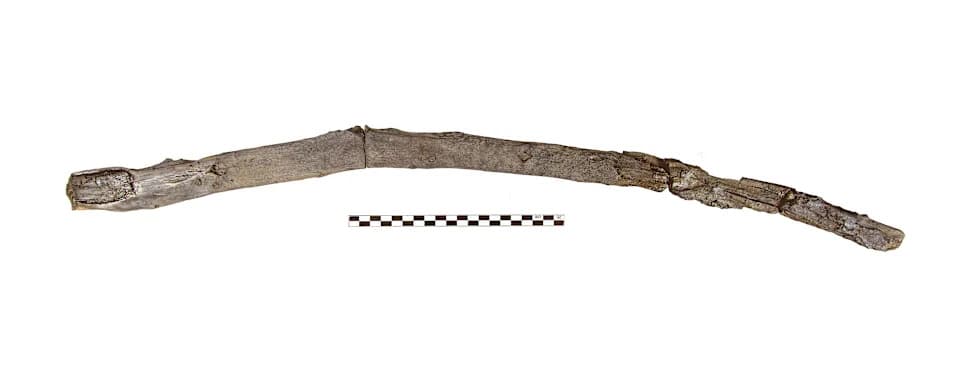
Stylistic links with contemporary axe types and radiocarbon dating of wood from sword hilts found with the hoard suggest the burial occurred around 1600 B.C., though the disc may have been manufactured as early as 1800 B.C. Some researchers questioned the object's provenance and age based on soil and chemical studies, proposing a later date and different origin. Subsequent analyses countered those claims, supporting the disc’s authenticity and its association with the Nebra findspot while indicating a multi‑stage manufacture.
Interpretation: Sky Map, Calendar or Ritual Object?
Many scholars read the disc as a representation of the night sky. Several of the small gold dots align to form a recognizable pattern for the Pleiades (the "Seven Sisters"). The broad golden arcs flanking the sky motif may mark horizon lines connected to the summer and winter solstices, and the lower arc (the "boat") has been interpreted as a mythic vessel that carries the sun across the sky in many ancient cosmologies.
When oriented to the plateau on Mittelberg Hill, the disc’s western horizon arc points toward the Brocken, a prominent peak behind which the sun appears to set at the summer solstice—an alignment that supports a practical or symbolic connection to solar observations and seasonal calendrics.
Damage, Display and Continuing Research
Because looters damaged the object before its recovery—scratching the bronze, damaging the gold rondel interpreted as the sun or full moon, and cleaning it improperly—some evidence was lost or altered. The disc is now conserved and on public display at the State Museum of Prehistory in Halle, where it continues to be studied and to prompt debate about Bronze Age astronomy, ritual practice and social display.
Summary: The Nebra Sky Disc remains a unique window into prehistoric sky‑knowledge. Though questions about precise dating, ownership and original use persist, the disc is widely regarded as among the earliest material records suggesting systematic observation and symbolic use of celestial phenomena in Bronze Age Europe.
Help us improve.