The James Webb Space Telescope enabled astronomers to produce a three-dimensional atmospheric map of WASP-18b using a technique called spectroscopic eclipse mapping. A team of 36 researchers published the results in Nature Astronomy, applying two complementary methods—Eigenspectra (primary) and ThERESA (confirmation)—to JWST eclipse spectra. The 3D map shows a scorching dayside (~5,000°F / 2,760°C) and a cooler limb region, and the approach opens a path to more detailed atmospheric studies of other bright exoplanets.
Astronomers Use JWST to Create the First 3D Map of Exoplanet WASP-18b
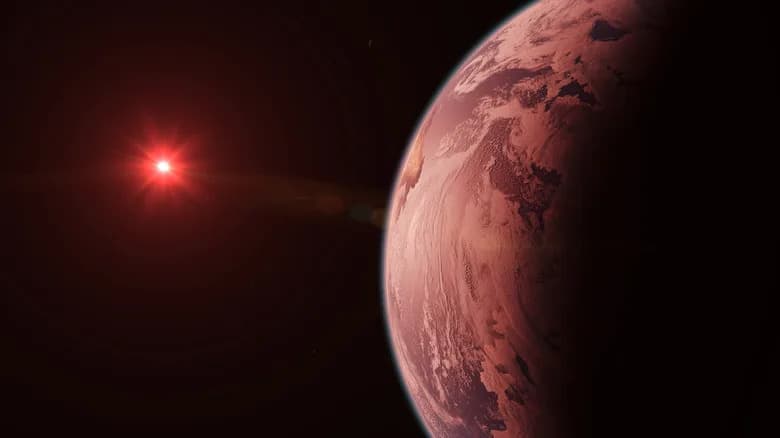
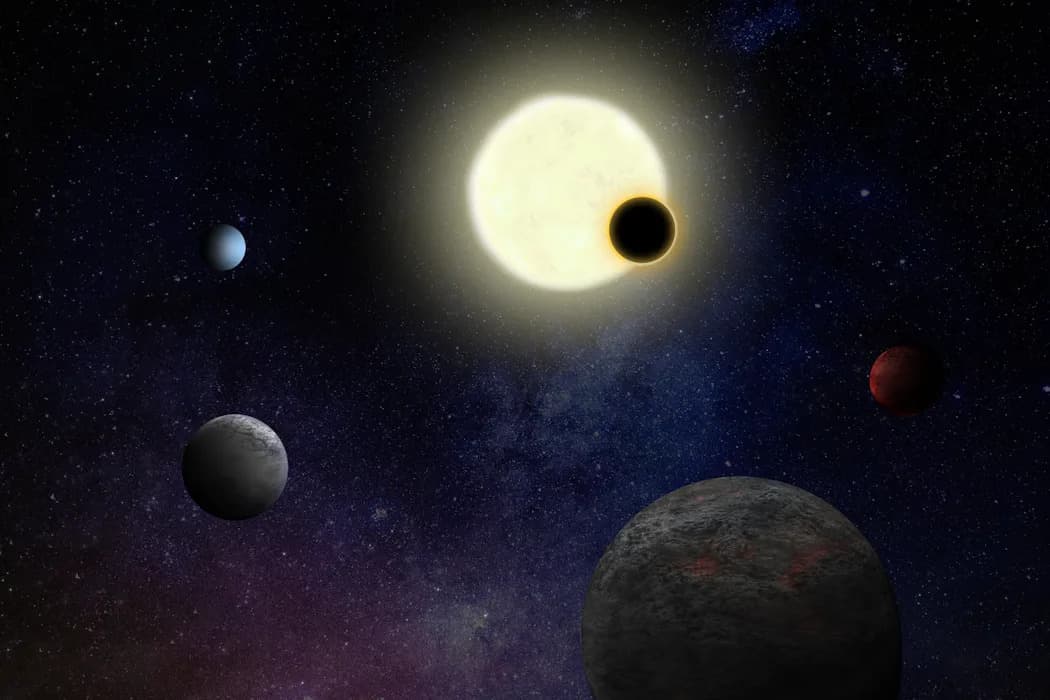
concept image of an exoplanet orbiting a red star - Darryl Fonseka/Getty Images
The James Webb Space Telescope (JWST) has enabled astronomers to move beyond flat pictures of distant worlds: a team of researchers has produced a three-dimensional atmospheric map of the exoplanet WASP-18b, revealing temperature and chemical structure across its observable atmosphere.
WASP-18b is a gas giant about 400 light-years from Earth with an orbital period of roughly 23 hours. Its dayside reaches extreme temperatures of around 5,000°F (≈2,760°C), producing strong infrared emission that made the planet's atmosphere accessible to JWST's sensitive instruments.
How the 3D Map Was Made
The international team of 36 researchers—representing institutions including Cornell University, Arizona State University, the Austrian Academy of Sciences and the University of Montreal—published their results in Nature Astronomy (late 2025) in a paper titled "Horizontal and vertical exoplanet thermal structure from a JWST spectroscopic eclipse map."
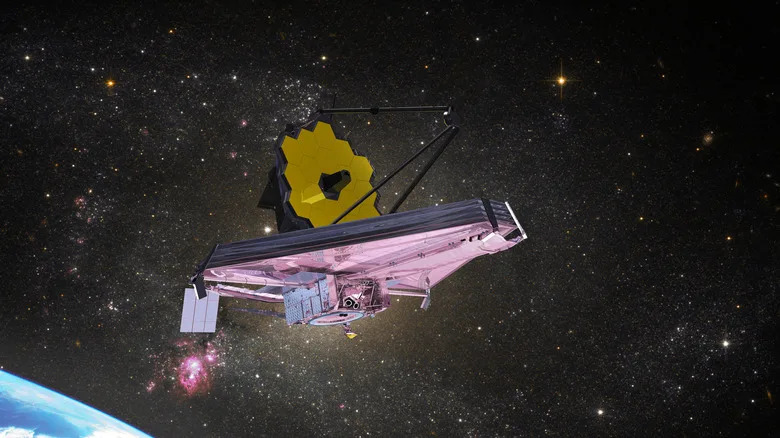
Graphic of the James Webb Space Telescope in space - 24k-production/Getty Images
The method, known as spectroscopic eclipse mapping or 3D eclipse mapping, uses JWST spectra taken during a secondary eclipse—when the planet slips behind its host star—to measure how the planet's infrared light disappears wavelength by wavelength. From those changes the team reconstructed spatially and vertically resolved atmospheric information.
Two Complementary Analysis Approaches
The researchers combined two analysis techniques:
- Eigenspectra: Treats each spectral slice independently. This approach provided flexible fits and captured subtle features in the JWST signal, so the team emphasized it as their primary retrieval tool.
- ThERESA: A fully three-dimensional physical model that fits all wavelengths simultaneously. ThERESA is more constrained and physically realistic, but harder to tune; the team used it mainly as a consistency check.
Using Eigenspectra to group regions with similar spectral signatures, the team then applied standard atmospheric retrieval tools to infer how temperature varies with altitude and which molecular species are present in different parts of the atmosphere.
an image of outer space with stars, planets, and galaxies - Bymuratdeniz/Getty Images
What the Map Reveals
The resulting layered, region-by-region profile amounts to a 3D view of WASP-18b's observable atmosphere. The main features are a very hot dayside facing the star and a comparatively cooler ring at the planet's limb. These contrasts reflect uneven heating and atmospheric circulation on this ultra-hot gas giant.
Why This Matters
Spectroscopic eclipse mapping with JWST opens a new window on exoplanet climates, enabling scientists to measure horizontal and vertical thermal structure and chemical variations rather than averaging properties across an entire planet. This level of detail helps test atmospheric circulation models and improves our understanding of extreme planetary environments.
Looking Ahead
The team notes clear paths to improvement: additional JWST observations of WASP-18b will sharpen and extend the 3D reconstruction, and the technique can be applied to other bright, transiting, infrared-bright exoplanets. While roughly 6,000 exoplanets are known today, practical application of spectroscopic eclipse mapping will focus first on the best-suited targets—hot, large, and close-orbiting planets that produce strong infrared signals.
Bottom line: This work demonstrates that JWST plus spectroscopic eclipse mapping can deliver true three-dimensional atmospheric information for distant worlds, marking a major step forward in comparative exoplanetology.
Help us improve.