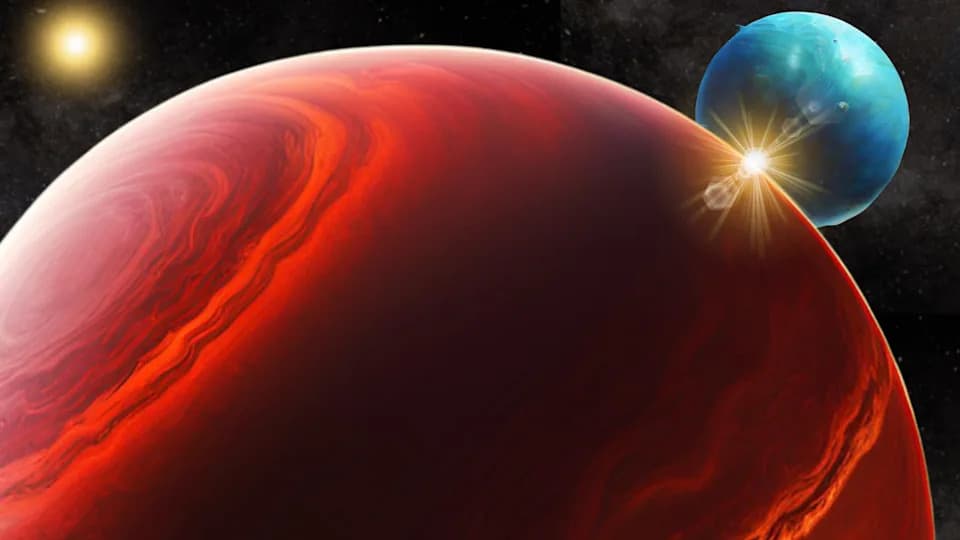
Using the James Webb Space Telescope, astronomers detected PSR J2322-2650b, a Jupiter‑mass companion stretched into a 'lemon' shape by its nearby pulsar and completing an orbit in 7.8 hours at roughly one million miles. Webb’s infrared data — which see the planet but not the pulsar’s high‑energy emission — reveal an atmosphere dominated by helium and carbon and temperatures near 3,700°F. Researchers propose carbon‑soot clouds and possible diamond‑like condensates and debate whether the object is a stripped stellar remnant or an entirely new class of astronomical body.
James Webb Spots 'Lemon‑Shaped' Exoplanet Stretched by a Pulsar

NASA, ESA, CSA, Ralf Crawford (STScI)
A team using the James Webb Space Telescope has identified an extraordinary exoplanet so close to its host that the star's gravity has stretched it into an elongated, lemon‑like shape.
A Scorched, Stretched World
The object, designated PSR J2322-2650b, has a mass roughly comparable to Jupiter and completes an orbit in just 7.8 Earth hours at a distance of about one million miles — roughly 1% of the Earth‑Sun separation. Its host is a rapidly rotating neutron star known as a pulsar. The pulsar’s intense gravity produces extreme tidal forces that deform the companion into a markedly oblong shape.
Why Webb Can See the Planet
Pulsars emit most of their energy at radio and high‑energy wavelengths (X‑rays and gamma rays), which are largely outside the infrared bands Webb observes. That relative faintness of the star in infrared allowed Webb to detect thermal and reflected light from the companion with unusually clean spectra, giving astronomers a rare, detailed view of the object’s atmosphere and surface conditions.
Unusual Chemistry and Weather
Webb’s observations suggest an atmosphere dominated by helium and carbon, with surface or atmospheric temperatures approaching about 3,700°F (roughly 2,000°C). Such a composition is unprecedented for a planet: molecular carbon normally bonds with oxygen, nitrogen or other elements common on planets and gas giants, so their apparent absence here is puzzling.
The team proposes exotic weather: carbonaceous soot suspended in the atmosphere and, under extreme pressure and temperature conditions deeper within the object, carbon compounds that could form diamond‑like condensates or shards.
Origins: Stripped Remnant or New Class?
Very few pulsars are known to host companions, and none previously reported combine this extreme shape and chemistry. One hypothesis is that PSR J2322-2650b is the eroded remnant of a star or planetary body that has been whittled away over eons by the pulsar — a black‑widow–type process observed in binary systems with pulsars and low‑mass stars. Another possibility is that astronomers are seeing an object formed through an unknown pathway, perhaps representing a new class of astronomical object.
"Did this form like a normal planet? No... Did it form by stripping a star? Probably not... It’s very hard to imagine how you get this extremely carbon‑enriched composition," said lead author Michael Zhang (University of Chicago), summarizing the team’s puzzle.
What Comes Next
Further observations across more wavelengths and more detailed modeling of tidal stripping, chemistry, and interior structure will be needed to understand whether PSR J2322-2650b is a dying remnant, an exotic planet, or an entirely new kind of object. The discovery, reported in The Astrophysical Journal Letters, opens new questions about what compact‑object systems can produce.
Help us improve.